

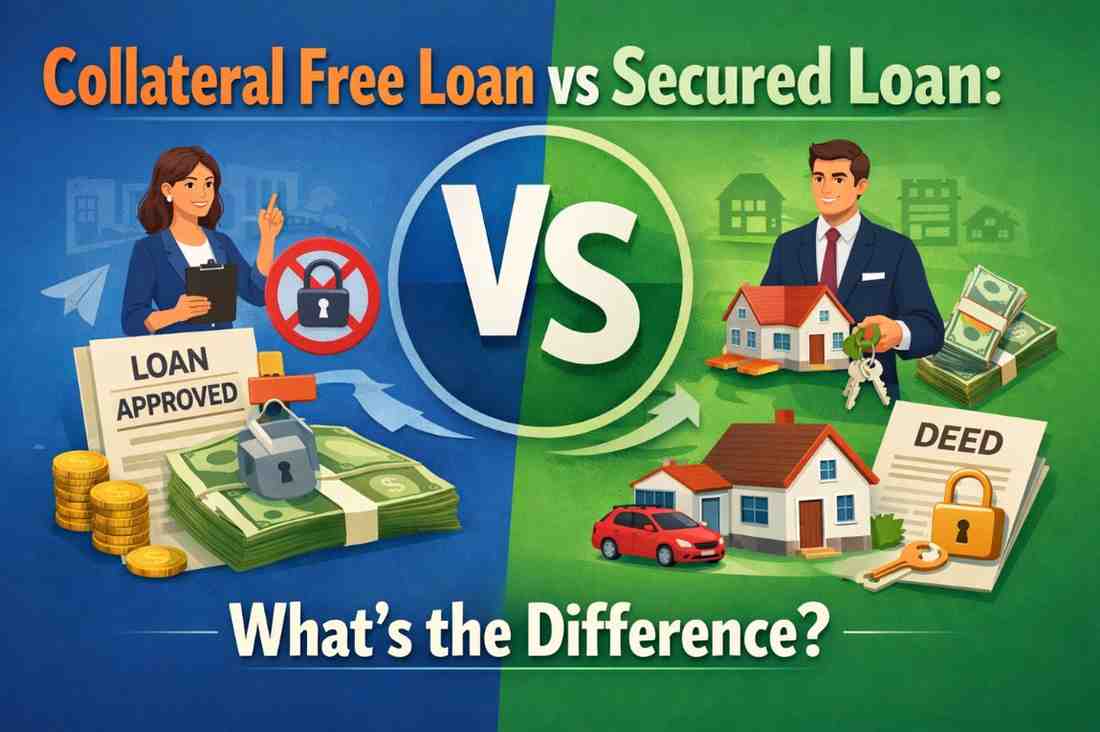
Access to finance is a major concern for businesses of all sizes. Whether it is for managing day-to-day expenses, purchasing raw materials, paying salaries, or expanding operations, timely funding can decide how smoothly a business runs.
When looking for business finance, most owners come across two common options: collateral free loans and secured loans. While both serve the same purpose—providing funds—the way they work is very different. Choosing the wrong type of loan can put unnecessary pressure on cash flow or even risk valuable assets.
This blog explains the difference between a collateral free loan and a secured loan, their benefits, and how to decide which option is better for your business.
A collateral free loan is a loan that does not require the borrower to pledge any asset or property as security. Instead of relying on collateral, lenders assess the business’s financial strength and repayment capacity.
These loans are commonly used by MSMEs, startups, traders, service providers, and small manufacturers, especially those who do not own high-value assets or do not want to risk them.
Lenders usually evaluate:
A secured loan is a loan where the borrower provides collateral to the lender. The asset acts as security, and the lender has the right to recover dues by selling the asset if the borrower defaults.
Secured loans are often chosen by established businesses that own property or equipment and are looking for larger funding or long-term finance.
Understanding the differences between these two loan types helps businesses choose wisely.
Collateral free loans have become increasingly popular, especially among small and medium businesses.
Business owners do not need to mortgage personal or business assets, reducing financial stress.
Businesses without property or equipment can still access funding.
Quick approvals help businesses manage urgent cash flow gaps.
Less paperwork compared to secured loans.
Funds can be used for salaries, vendor payments, rent, inventory, and other operational expenses.
Secured loans remain a strong option for businesses with asset backing.
Reduced lender risk results in lower interest rates.
Loan amount depends on the value of the collateral.
Longer tenure reduces monthly repayment burden.
Ideal for purchasing machinery, property, or expanding infrastructure.
The right loan depends on your business needs, financial position, and future plans.
MSMEs often face challenges such as limited assets, delayed payments from buyers, and fluctuating cash flows. For such businesses, collateral free loans provide a flexible and accessible funding option without risking assets.
Secured loans may suit well-established MSMEs that have stable revenue and own assets, especially when planning long-term growth or capital investment.
Before applying for a loan, businesses should carefully assess:
Both collateral free loans and secured loans play an important role in business financing. A collateral free loan offers speed, flexibility, and safety from asset risk, making it ideal for MSMEs and working capital needs. Secured loans offer affordability and higher funding capacity, making them suitable for long-term investments.
Choosing the right loan depends on your business size, funding purpose, and financial stability. Making an informed decision can help your business grow without unnecessary risk.
Yes, collateral free loans are ideal for small businesses and MSMEs that do not own assets or need quick funding.
Are interest rates higher for collateral free loans?
Generally, yes. Since no collateral is provided, lenders charge slightly higher interest rates.
Can MSMEs apply for secured loans?
Yes, MSMEs that own assets such as property or machinery can apply for secured loans.
Which loan is easier to get approved?
Collateral free loans usually have faster and simpler approval processes.
Submit guest articles that reach decision-makers, influencers, and professionals. Yarabook offers a trusted platform for quality content, strong backlinks, and SEO-driven visibility. Pay. Publish. Promote.