

Running a small or mid-sized business in today’s fast-moving commercial environment demands more than spreadsheets and manual stock counts. Whether you operate a warehouse, manage a mobile sales team, or distribute products across multiple locations, the pressure to stay accurate, agile, and efficient has never been greater. Inventory management software has stepped in to meet that pressure — and the results are reshaping how businesses of every size handle their day-to-day operations.
This article explores how modern inventory platforms are changing the game for small businesses, what features actually matter, and why integrating your stock management with your accounting system is no longer a luxury but a necessity.
Before diving into solutions, it helps to understand the scale of the problem. Inventory errors are not just inconvenient — they are expensive. Overstocking ties up working capital in products that sit on shelves. Understocking leads to missed sales, frustrated customers, and emergency reorders at premium prices. Shipping the wrong items damages brand reputation and triggers costly returns.
For businesses managing inventory manually — through paper logs, basic spreadsheets, or disconnected systems — these problems are almost inevitable. Human error creeps into every count. Stock levels recorded in the morning may be inaccurate by afternoon. And when your inventory data does not sync automatically with your accounting software, reconciling the two becomes a time-consuming and error-prone exercise that pulls staff away from more valuable work.
The good news is that modern inventory software directly addresses each of these pain points, offering automation, real-time visibility, and mobile accessibility that manual systems simply cannot match.
Today’s best inventory platforms go far beyond simple stock tracking. They function as end-to-end operational tools that connect purchasing, receiving, counting, order fulfillment, shipping, and sales into a single unified workflow.
Smart inventory software allows businesses to set minimum stock thresholds and automatically generate purchase orders when levels fall below those targets. Rather than relying on a manager to notice a shortage and manually raise an order, the system flags the issue and streamlines the replenishment process. Purchase orders can be created, sent, and received directly from a mobile device — critical for teams that are frequently out of the office or on the warehouse floor.
One of the most time-intensive tasks in any inventory-heavy business is the stock count. Traditional physical inventory requires shutting down operations, mobilizing staff, and spending hours — sometimes days — manually counting and recording every item. Modern software, particularly when paired with barcode scanning technology, compresses this process dramatically. Staff can conduct cycle counts on a rolling basis using handheld mobile devices, reducing the disruption and improving ongoing accuracy rather than relying on infrequent full counts.
Barcode scanning eliminates the transcription errors that plague manual counting. Each scan is precise, timestamped, and immediately reflected in the system — giving managers a real-time picture of stock levels without the guesswork.
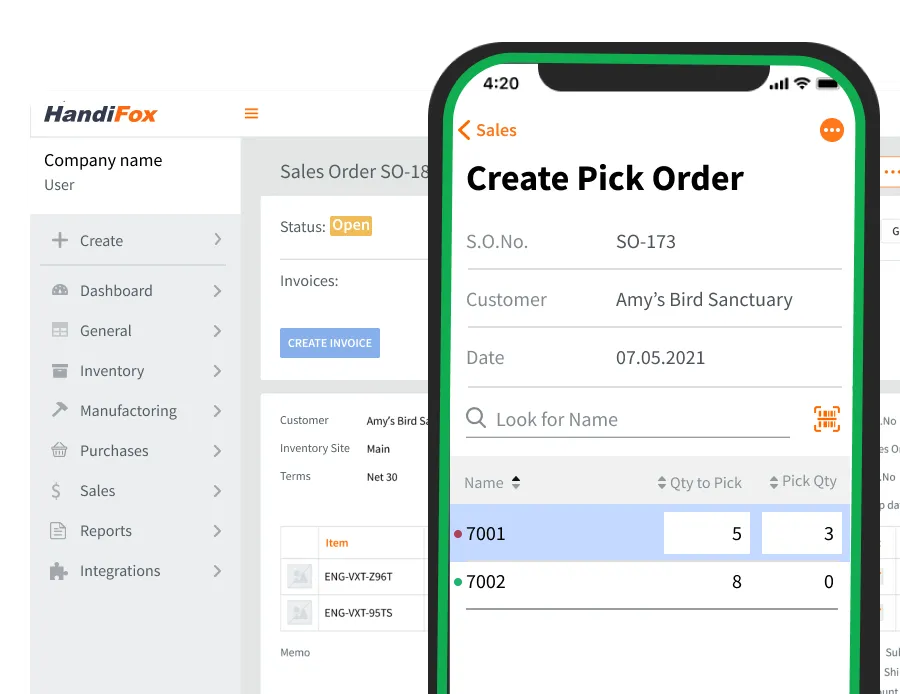
For businesses processing outbound orders, the pick-pack-ship workflow is where errors most often occur. Items get picked incorrectly, quantities get miscounted, and the wrong products end up in boxes headed to customers. Modern inventory platforms address this with built-in barcode verification at each stage of fulfillment. A pick list is generated automatically based on the order, staff scan items as they pick them, and the system flags any discrepancy before the order is sealed and shipped. The result is fewer returns, fewer customer complaints, and a more reliable fulfillment operation overall.
For businesses with field sales teams — route sales representatives, mobile technicians, or on-site service providers — the ability to process sales, check inventory availability, generate invoices, and record payments from a mobile device is transformative. It eliminates the lag between field activity and back-office records, reduces paperwork, and gives sales staff the tools they need to close deals on the spot without returning to a central office.
For the millions of small businesses that rely on QuickBooks for accounting, one of the most powerful features a modern inventory platform can offer is seamless, two-way synchronization with that system. When inventory transactions — purchases, sales, adjustments — automatically update your accounting records in real time, the hours previously spent on manual data entry and reconciliation are simply eliminated.
This kind of integration works for both QuickBooks Desktop and QuickBooks Online users, meaning businesses do not need to abandon their existing accounting setup to benefit from more sophisticated inventory management. The inventory software handles the operational side while QuickBooks handles the financial side — and the two systems stay continuously aligned.
As businesses grow, inventory complexity grows with them. A company might start with a single warehouse and expand to multiple storage facilities, retail locations, or distribution hubs. Managing stock across all of these simultaneously — knowing what is where, transferring items between locations, and ensuring each site has what it needs — requires a level of coordination that manual systems cannot sustain.
This is where inventory management software multiple locations capability becomes not just useful but essential. Multi-location tracking gives managers a consolidated view of total inventory while also providing granular visibility into stock levels at each individual site. Transfers between locations can be initiated and tracked digitally. Replenishment decisions can be made based on accurate, location-specific data rather than estimates. And discrepancies at one site do not distort the overall picture.
For businesses in industries like automotive parts, medical supplies, food and beverage distribution, or construction materials — where products move frequently between sites, vehicles, and customer locations — this kind of multi-location visibility is a genuine operational differentiator.
A common misconception about inventory software is that it is designed primarily for large warehouses or manufacturing environments. In reality, modern platforms are built to adapt to a wide range of industries and business models.
Distributors managing high SKU counts and high order volumes benefit enormously from automated purchase orders, real-time stock visibility, and integrated invoicing. The ability to process customer orders in the field and immediately trigger warehouse picking and packing reduces order-to-delivery time and minimizes errors.
Teams that carry inventory in vehicles — HVAC technicians, plumbing supply representatives, medical equipment service providers — need mobile-first tools that work even in environments with limited connectivity. The best platforms offer offline functionality that syncs when a connection is restored, ensuring field staff always have accurate data regardless of where they are working.
Expiration date tracking and lot number management are critical in food distribution. Modern inventory software that supports these features helps businesses stay compliant, reduce waste, and respond quickly in the event of a recall.
Clothing and accessories businesses deal with complex product variations — size, color, style — that require careful SKU management. Inventory platforms that handle these variations cleanly, and that sync with point-of-sale and e-commerce systems, give apparel businesses the control they need to operate profitably.
The most forward-looking inventory platforms are now incorporating artificial intelligence to further reduce the manual burden on users. AI-powered onboarding assistants guide new users through setup without the need for lengthy manuals. Real-time task guidance helps staff complete complex workflows correctly the first time. Predictive analytics flag potential stockouts before they occur and suggest reorder quantities based on historical sales data.
This is not AI for its own sake — it is practical, workflow-embedded intelligence that reduces errors, accelerates execution, and lowers the learning curve for new staff. For small businesses with limited training resources and tight margins, this kind of built-in guidance has real operational value.
With many options available, selecting the right inventory management tool requires clarity about your specific needs. Key questions to ask include: Does the platform integrate with your existing accounting software? Does it support mobile operation for your field team? Can it handle multiple locations if your business grows? Is it accessible on both Android and iOS?
For businesses that want a comprehensive answer to all of these questions in a single platform, exploring a dedicated solution through the HandiFox site is a practical starting point — the platform covers everything from barcode scanning and purchase orders to mobile sales and QuickBooks integration in one cohesive system.
Inventory management has evolved from a back-office administrative task into a strategic operational function. Businesses that invest in the right software gain not just efficiency but also the visibility and control needed to make better purchasing decisions, serve customers more reliably, and scale without proportionally increasing overhead.
The technology is accessible, the integration options are broad, and the return on investment — measured in time saved, errors avoided, and sales captured — is well within reach for businesses of every size.
Submit guest articles that reach decision-makers, influencers, and professionals. Yarabook offers a trusted platform for quality content, strong backlinks, and SEO-driven visibility. Pay. Publish. Promote.