

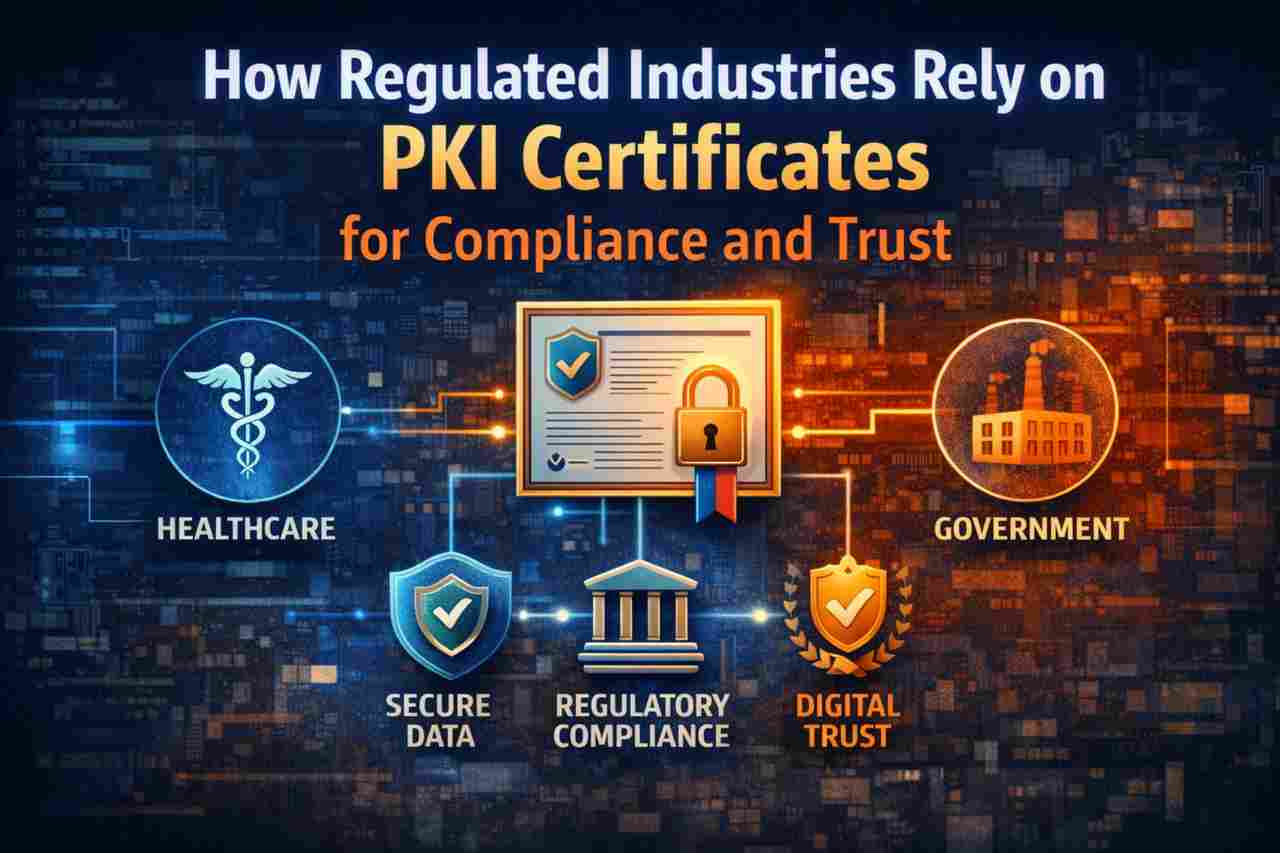
Trust is the currency of regulated industries.
Whether it’s financial services, healthcare, government, telecom, or critical infrastructure, compliance frameworks demand verifiable identity, data integrity, confidentiality, and non-repudiation. In this environment, traditional security controls are no longer sufficient.
This is where the PKI certificate becomes foundational.
More than just a technical security tool, PKI certificates have evolved into compliance enablers, legal trust anchors, and digital identity credentials. Today, enterprises across regulated sectors depend on PKI services to maintain regulatory alignment, operational resilience, and digital trust at scale.
Why Regulated Industries Cannot Afford Weak Digital Trust
Regulated industries operate under intense scrutiny.
Financial institutions must comply with PCI DSS, SOX, ISO 27001, and regional banking mandates.
Healthcare organizations must meet HIPAA, HITECH, and patient data protection laws.
Government and defense organizations follow national cybersecurity frameworks and classified data protection protocols.
Telecom and utilities face critical infrastructure regulations and data sovereignty laws.
At the heart of every regulation lies the same core requirement:
Prove who accessed what, when, and ensure that no data or identity was altered.
This is precisely the role a PKI certificate plays.
What Makes PKI Certificates Essential for Compliance
A PKI certificate provides cryptographic proof of identity and trust. It enables:
Unlike passwords or OTP-based systems, PKI certificates rely on asymmetric cryptography, ensuring that identity credentials cannot be intercepted, replayed, or forged.
This makes PKI services indispensable for organizations operating under strict regulatory mandates.
Compliance Requires Cryptographic Proof, Not Just Access Logs
Most regulations no longer accept simple audit logs as sufficient evidence of security.
They require:
This is where a PKI certificate becomes mandatory, not optional.
For example:
Without enterprise-grade PKI services, meeting modern compliance standards becomes nearly impossible.
Why Cloud and Remote Work Made PKI Mandatory
The rise of cloud computing, remote work, and API-driven operations has shattered traditional network boundaries.
Security teams can no longer rely on perimeter defenses.
Instead, trust must be built directly into identity and communication layers.
This is why PKI certificates now serve as:
Modern PKI services ensure that every identity, human or machine, is cryptographically verified, supporting Zero Trust security and regulatory compliance simultaneously.
How PKI Certificates Support Regulatory Controls
PKI certificates replace weak password-based authentication with cryptographic proof of identity.
Certificates enable TLS encryption, protecting sensitive data in transit and at rest.
Digital signatures ensure transactions cannot be denied or altered, supporting legal compliance.
Every cryptographic operation generates verifiable audit logs required for regulatory reporting.
Certificates authenticate servers, endpoints, IoT devices, APIs, and workloads.
These capabilities make PKI services the backbone of regulatory trust frameworks.
The Compliance Cost of Poor PKI Management
While PKI certificates are essential, mismanaged PKI environments introduce serious risks, including:
Without automated PKI services, organizations often face:
This is why regulated enterprises are rapidly modernizing their PKI infrastructure.
Why PKI Is Becoming a Governance Platform, Not Just Infrastructure
Historically, PKI was treated as backend security plumbing.
In regulated industries, that mindset has changed.
Today, a PKI certificate acts as a governance control point for:
Modern PKI services integrate directly with identity governance, access management, DevOps pipelines, and cloud platforms, turning cryptography into a central compliance enforcement layer.
How eMudhra Delivers Compliance-Ready PKI Services
eMudhra provides enterprise-grade PKI services designed specifically for regulated industries operating at scale.
Built on globally trusted cryptographic infrastructure, eMudhra enables organizations to deploy, manage, and govern PKI certificate ecosystems across complex digital environments.
Through its comprehensive PKI services platform, eMudhra enables regulated enterprises to transform cryptographic trust into a strategic compliance advantage.
Why PKI Certificates Are Now a Board-Level Concern
Regulators are intensifying enforcement. Attackers are targeting identity. Cloud adoption is accelerating.
This convergence has elevated PKI certificate governance from an IT responsibility to a board-level priority.
Organizations that fail to modernize their PKI infrastructure face:
Those that invest in advanced PKI services gain:
Trust, Compliance, and PKI: The New Digital Triangle
In regulated industries, trust is no longer assumed , it must be cryptographically proven.
A modern PKI certificate infrastructure, powered by scalable PKI services, is now essential for:
In 2026 and beyond, PKI is no longer optional security, it is a foundational governance infrastructure.
Submit guest articles that reach decision-makers, influencers, and professionals. Yarabook offers a trusted platform for quality content, strong backlinks, and SEO-driven visibility. Pay. Publish. Promote.