

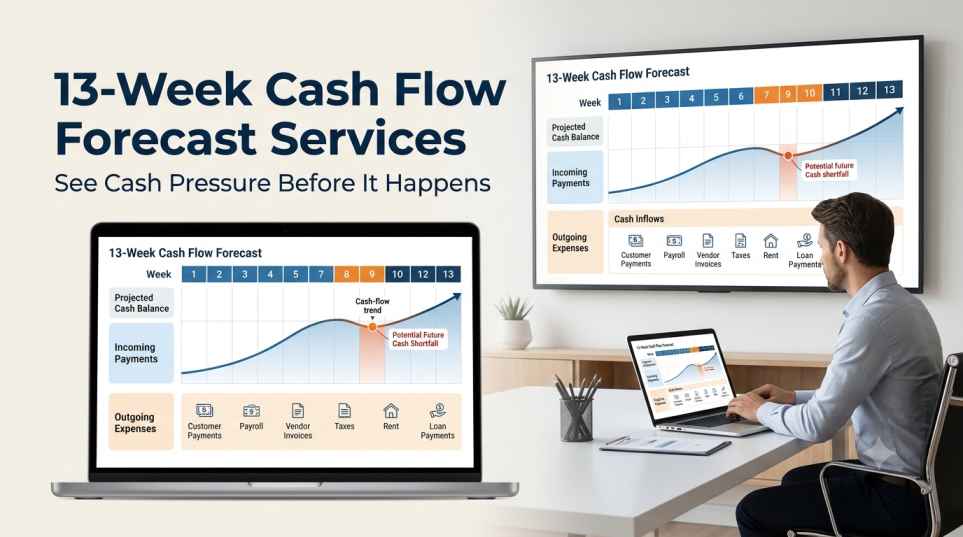
A 13-week cash flow forecast is a rolling weekly projection of expected cash inflows and outflows over roughly three months, used to identify potential cash shortfalls before they happen.
Quick answer: 13-Week Cash Flow Forecast Services help businesses project weekly cash inflows and outflows over a rolling 13-week period. The forecast can reveal potential cash shortages, upcoming payment pressure, and collection gaps early enough for management to evaluate possible responses.
For tight-margin businesses, that short window matters. A small delay in customer payments, an unusually large expense, or a seasonal slowdown can create real pressure even when the business is profitable on paper.
A company may invoice $100,000 in a month but collect only $60,000 before payroll, rent, loan payments, and supplier bills come due. The income statement looks healthy; the bank account tells a different story.
That’s the core reason cash flow forecasting for small business matters. Profit measures whether a business is fundamentally making money over time; cash flow measures whether the money to cover today’s obligations is actually in the bank right now. A business can be true on the first and false on the second at the same time.
According to the Federal Reserve Banks’ 2024 Small Business Credit Survey, 51% of small employer firms reported uneven cash flow as a financial challenge, and 56% reported difficulty paying operating expenses — both figures up from the prior year. Tight-margin companies feel this most acutely, because there’s little cushion to absorb timing surprises from slow-paying customers, large vendor invoices, tax deadlines, or seasonal swings.
For businesses that regularly deal with narrow cash cushions, 13-Week Cash Flow Forecast Services can turn weekly cash monitoring into a repeatable management process rather than a once-a-year exercise.
It’s a short-term projection estimating cash receipts and payments for each week over about three months, generally starting from the current cash balance:
Beginning cash + expected inflows − expected outflows = projected ending cash
It’s updated as actual results come in, making it a rolling tool rather than a one-time spreadsheet.
Example: A business starts the week with $75,000, expects $50,000 in combined receipts, and $40,000 in payroll, vendor payments, and taxes. Projected ending cash: $75,000 + $50,000 − $40,000 = $85,000. The next week’s projection starts from that new balance.
Another example: A company starts the 13-week period with $90,000. Its forecast shows collections dipping while payroll and taxes stay steady, projecting cash down to $28,000 by week seven. That doesn’t mean the business is losing money — it means management has identified a constrained stretch and can investigate before reaching it.
A cash flow statement reports what already happened to cash. A forecast estimates what’s expected to happen next.
Most businesses use both — the statement to understand the past, the forecast to plan ahead.
It offers enough visibility for near-term operating and financing decisions while keeping assumptions close to the present. The right window can vary by business — some shorten it when cash is especially tight, others extend it during financing cycles.
An annual budget shows expected revenue and expenses over 12 months but not necessarily when cash arrives. A 13-week model helps answer: When could cash bottom out? Which payments are due when? Is there enough for a planned purchase? When might financing be needed?
It surfaces shortfalls earlier. If cash is projected to dip below a comfortable level in week eight, management has time to accelerate collections, delay a purchase, or line up financing — instead of discovering the problem in the bank balance.
It separates timing issues from profit issues. A temporary shortage doesn’t mean the business is unprofitable; it might be collection timing, a one-time payment, or debt obligations. Knowing which one shapes the right response.
It makes receivables more visible. If customers pay 30–90 days after invoicing, a weekly view highlights the gap between billing and actual cash, drawing attention to overdue accounts.
It supports better-timed spending. A $25,000 equipment purchase might make sense long-term but create pressure if it lands right before payroll and vendor payments are due.
| Annual Budget | 13-Week Forecast |
|---|---|
| ~12 months | ~13 weeks |
| Planned revenue/expenses | Expected cash movement |
| Annual planning | Short-term decisions |
| Reviewed monthly/quarterly | Updated weekly |
| Broader assumptions | Near-term payment/collection detail |
The two work best together: the budget sets expected performance, the forecast confirms cash is there to support it.
Inflows: customer collections, deposits, loan proceeds, investment contributions, asset sales.
Outflows: payroll, rent, vendor payments, taxes, insurance, loan payments, equipment, subscriptions, professional fees.
Detail level should match the business — group small recurring items, track major movements separately. The goal is a forecast management will actually use, not the most complex spreadsheet possible.
A forecast is only as good as the inputs. Example: expected collections of $80,000 but actual collections of $68,000 — that $12,000 gap shouldn’t silently roll into next week. Investigate whether customers are paying slower, invoices were delayed, or the original estimate was too optimistic. Comparing forecast to actual over time sharpens future accuracy.
SMB budgeting and variance reporting adds context — if expenses run 8% over budget, the forecast shows when that hits the bank balance. Two questions, together: Are we operating to plan? and Will we have enough cash to meet obligations?
KPI dashboard reporting for small business — gross margin, AR/AP days, revenue growth, labor cost, inventory turnover — rounds out the picture, tailored to how the business actually makes money (revenue per mile for trucking, occupancy and management fees for property management, and so on).
Construction — timing gaps between project costs, progress billing, and retainage make Fractional CFO for construction companies support useful for job-level cash tracking and work-in-progress oversight.
Property management — owner distributions, vendor payments, and fees across multiple properties call for Fractional CFO for property management companies support that looks at cash needs portfolio-wide.
Auto dealerships — inventory, floor-plan financing, and payroll benefit from department-level P&L visibility alongside cash monitoring.
Logistics/trucking — fuel, driver payroll, and equipment financing often pair well with cost-per-mile profitability tracking alongside short-term cash forecasting.
Consider outside help when records aren’t reconciled, AR data is unreliable, the business has multiple entities, cash swings significantly week to week, lender reporting is needed, or forecasts keep missing actuals. Fractional CFO services for small business can provide this oversight without hiring a full-time CFO — building the process, reviewing assumptions, and helping interpret what the numbers mean.
Cube Accounting Solutions provides accounting, tax, and Fractional CFO services for businesses across the U.S., including cash flow forecasting, budgeting and variance analysis, KPI reporting, and profitability analysis — through outsourced or part-time CFO arrangements sized to the business.
What is a 13-week cash flow forecast? A rolling weekly projection of expected cash inflows and outflows over roughly three months, used to spot shortfalls before they happen.
How is it different from an annual budget? A budget sets broader annual targets; a 13-week forecast tracks cash timing week by week and updates far more often.
How often should it be updated? Weekly, incorporating actual results as they occur.
Who benefits most? Businesses with tight margins, seasonal swings, long payment cycles, or upcoming financing needs — construction, property management, dealerships, and logistics companies among them.
Can a fractional CFO help with this? Yes — building the process, reviewing assumptions, comparing projected to actual results, and connecting cash planning to budgeting and reporting.
Can a fractional CFO help me get a business loan? They may help prepare projections and supporting financial information lenders often request; approval itself depends on the lender’s requirements and the business’s financial condition.
A business doesn’t need to be losing money to feel cash pressure — delayed collections, unexpected expenses, and seasonal swings can strain even a profitable company. 13-Week Cash Flow Forecast Services give owners a structured way to see that pressure coming, built on regular updates, realistic assumptions, and a connection to the rest of the company’s financial picture.
Submit guest articles that reach decision-makers, influencers, and professionals. Yarabook offers a trusted platform for quality content, strong backlinks, and SEO-driven visibility. Pay. Publish. Promote.