

Accounting firms manage a large volume of client information, deadlines, tasks, documents and communications. As a practice grows, relying on spreadsheets, emails and disconnected systems can make it harder to maintain an organised workflow.
Cloud based practice management software for accountants can bring many of these activities together in one digital environment. By centralising practice information and providing access through the internet, cloud-based systems can help accounting teams manage work more consistently.
Cloud based practice management software is a digital system that allows accounting firms to manage clients, tasks, workflows, deadlines and other practice activities online.
Unlike software that is installed and maintained on individual office computers, cloud-based platforms are generally hosted remotely. Users can access the system through an internet connection, subject to the platform’s access controls and availability.
The exact features vary between providers, but accounting practice management systems may include:
Client management
Task and workflow management
Deadline tracking
Document management
Internal communication
Time tracking
Reporting and analytics
Automated reminders
Client portals
Accounting practices increasingly rely on digital processes to manage client work. A cloud-based system can provide a central location for information that might otherwise be spread across emails, spreadsheets and separate applications.
This can make it easier for team members to understand what work needs to be completed, who is responsible for it and when it is due.
Cloud access can also be useful for firms with employees working across different locations. Instead of relying on a single office network, authorised users can access relevant practice information remotely.
Accounting firms often work with clients who have different deadlines, services and communication requirements. Keeping client information organised is therefore essential.
A practice management platform can provide a central client record containing relevant information, tasks and workflow details.
Centralisation can reduce the need to search through multiple systems when checking the status of client work.
Accounting work involves recurring activities such as tax returns, VAT submissions, payroll processing and accounts preparation. These tasks often have specific deadlines and may require several stages of review.
A workflow system can help firms establish consistent processes for recurring work.
For example, a workflow might include:
Assigning the task to a team member.
Collecting the required information.
Completing the relevant accounting work.
Reviewing the work.
Completing the final submission.
Recording the completed task.
Having a defined workflow can make responsibilities clearer and reduce the likelihood of routine tasks being overlooked.
Missed deadlines can create unnecessary pressure for accounting teams. Firms may have to manage multiple statutory and client-specific deadlines at the same time.
Cloud-based practice management platforms can provide deadline tracking and automated reminders. These features can help teams identify upcoming work and prioritise tasks.
However, software should support a firm’s processes rather than replace professional judgement. Teams still need to check deadlines and ensure that the underlying client information is complete and accurate.
Cloud technology can be particularly useful for accounting practices with remote or hybrid employees.
Authorised team members can access relevant work information without needing to be physically present in the office. This can make it easier for managers to allocate tasks, monitor progress and communicate with team members.
Access permissions are important in this environment. Firms should ensure that employees can only access the information appropriate to their responsibilities.
Spreadsheets can be useful for many accounting tasks, but they may become difficult to maintain when a firm has a large number of clients and recurring workflows.
A dedicated practice management platform can provide structured records for tasks, deadlines and client information.
This can reduce manual updating and provide greater visibility over work in progress.
Automation is another important feature of modern practice management systems. Repetitive activities such as reminders, recurring tasks and workflow notifications can potentially be automated.
The benefit is not simply reducing the number of manual actions. Automation can also help establish consistency across the practice.
For example, a recurring workflow can be created for a particular type of client service so that the relevant tasks are generated according to the firm’s process.
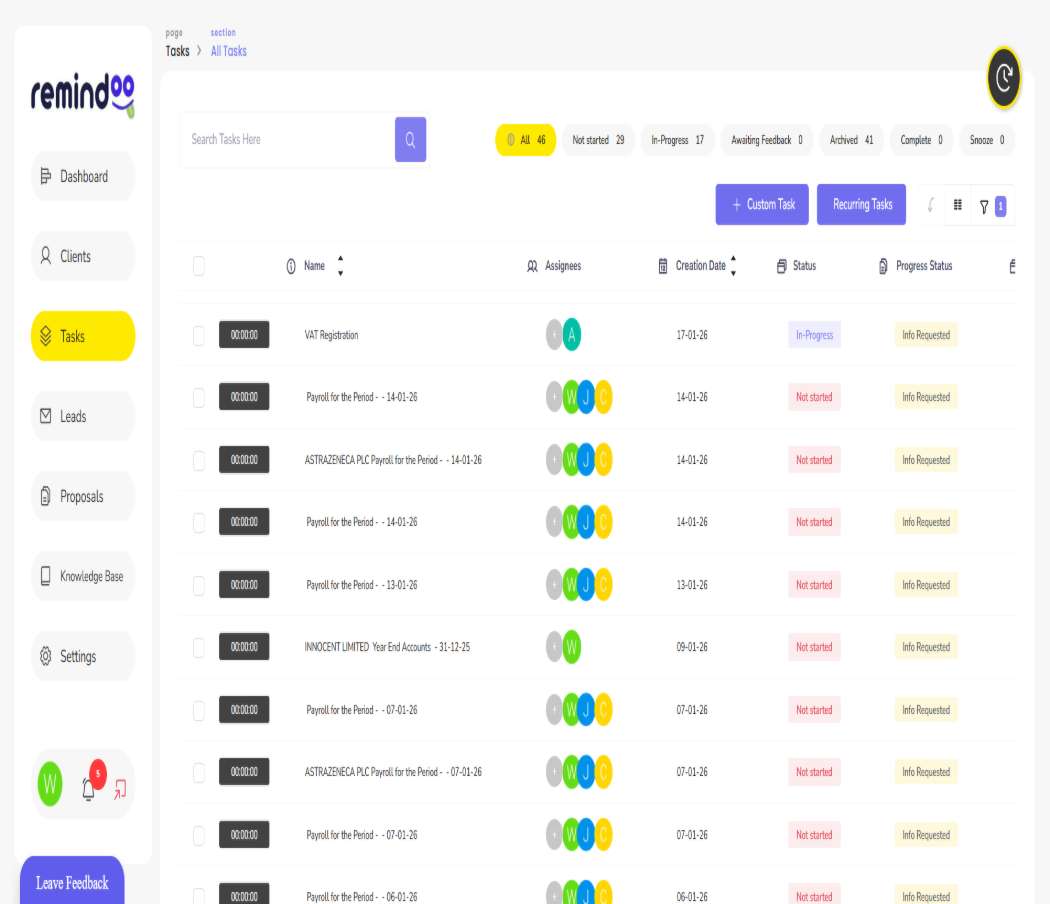
Remindoo is an example of a cloud-based practice management platform designed for accountants and bookkeepers. It brings together features such as client management, task and workflow management, reminders, analytics and client-related processes.
For accounting firms, the purpose of using a platform such as Remindoo is to create greater visibility across ongoing client work rather than managing every activity through separate spreadsheets and email conversations.
Its workflow features can help accounting teams organise recurring work, assign responsibilities and monitor progress from a central system.
As with any practice management software, firms should evaluate the features against their own workflows before deciding whether a particular platform is appropriate.
Not every accounting practice has the same requirements. Before choosing a system, firms should consider the following areas.
The platform should make it easy to organise client information and identify relevant work.
Firms should be able to create workflows that reflect their actual processes rather than being forced into a rigid structure.
Managers should be able to assign responsibilities and see which tasks are outstanding.
The system should provide clear visibility of upcoming deadlines and, where appropriate, reminders.
Client financial information is sensitive. Firms should understand how the provider handles authentication, permissions, data protection and security.
Useful reporting can help managers understand workloads, outstanding tasks and overall practice performance.
If a firm already uses accounting, payroll, document management or communication software, compatibility between systems should be considered.
Cloud technology can benefit many accounting firms, but the right solution depends on the firm’s size, workflow and existing systems.
A small practice may prioritise simplicity and client management, while a larger firm may need advanced workflow controls, reporting, user permissions and integrations.
Firms should identify their main operational challenges before choosing software. This helps ensure that technology addresses genuine problems rather than adding another system for employees to maintain.
Cloud based practice management software for accountants can help firms organise client information, manage recurring workflows, track deadlines and improve visibility across ongoing work.
The value of cloud-based practice management comes from combining technology with well-designed processes. Firms should therefore consider their workflows, security requirements, integrations and team structure before selecting a platform.
Solutions such as Remindoo demonstrate how modern practice management platforms can bring client management, task tracking, workflows and reminders into a central environment. When implemented appropriately, cloud-based software can help accounting practices create more organised and consistent ways of managing client work.
Submit guest articles that reach decision-makers, influencers, and professionals. Yarabook offers a trusted platform for quality content, strong backlinks, and SEO-driven visibility. Pay. Publish. Promote.