

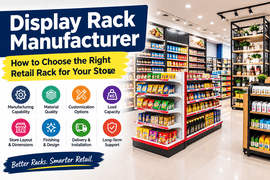
Choosing the right retail rack is an important decision for any store because the rack has to do more than simply hold products. It affects product visibility, aisle movement, storage capacity, accessibility, and the overall use of available floor space. For this reason, businesses should evaluate a Display Rack Manufacturer based on manufacturing capability, material quality, customization, finishing, design options, delivery capability, and project support rather than comparing prices alone.
A display rack manufacturer designs and produces racks according to the requirements of different retail environments. Unlike a general reseller, a manufacturer can provide greater control over rack dimensions, shelf configurations, materials, finishes, load requirements, and production quantities.
Retail stores have different layouts and product categories, so one standard rack configuration may not work for every business. A supermarket may require multiple shelving levels and strong product visibility, while a pharmacy, garment store, or kirana store may require a different combination of shelving, height, depth, and accessibility.
Working directly with a manufacturer can therefore make it easier to discuss technical requirements and select a rack configuration suitable for the actual store environment.
Before placing an order, check whether the manufacturer can produce the required rack types and quantities. This becomes particularly important for large retail projects and bulk orders where consistency between individual racks matters.
A capable manufacturer should be able to discuss dimensions, shelf arrangements, load requirements, quantity, finishing, and other project-specific requirements before production.
The material used in a display rack directly affects its strength, durability, and long-term performance. Businesses should understand what material is being used and how the rack is constructed.
Important points include the thickness and quality of the metal, shelf construction, frame strength, joints, support structure, and overall stability. For stores carrying heavier products, load capacity should be considered before selecting the rack.
Retail spaces are rarely identical. Columns, walls, entrances, counters, corners, and aisle widths can affect how racks should be installed. Custom dimensions can help businesses use available space more effectively instead of forcing a standard rack into an unsuitable layout.
The rack should match the products being displayed and the way customers interact with them. Product weight, size, packaging, visibility, replenishment frequency, and customer accessibility should all be considered during selection.
Different retail environments require different rack configurations.
Center display racks are positioned in the middle of a store and can provide shelving from multiple sides. They are commonly useful for creating organized product aisles while making products accessible to customers from different directions.
Wall-mounted or wall-positioned racks make use of vertical wall space without occupying the same floor area as a central display. They can be useful for stores that need additional display capacity around the perimeter.
End-cap racks are placed at the ends of aisles and can provide an additional product display area. Their position can make selected products easier for customers to notice while moving through the store.
Grocery and supermarket environments generally require organized shelving, practical aisle spacing, and sufficient capacity for frequently purchased products. Rack configuration should be planned according to product categories and store layout.
Pharmacies and specialized retail stores may require different shelf dimensions and product arrangements. The rack design should support easy product identification and convenient access while maintaining an organized appearance.
Custom racks can be useful when standard dimensions do not match the available store space. A manufacturer can consider measurements, layout requirements, shelf configuration, product categories, and the intended placement of the racks.
For businesses looking for custom display racks in Delhi, customization can help address specific space and merchandising requirements instead of relying entirely on standard sizes.
Customization is particularly relevant when a project involves unusual wall dimensions, restricted aisle areas, different shelf levels, or a combination of rack types throughout the same store.
The lowest quotation is not automatically the best option. When comparing manufacturers, businesses should review what is included in each quotation.
Important comparison points include rack dimensions, material specifications, shelf configuration, quantity, finishing, load requirements, transportation, installation, and expected delivery schedule.
A quotation should be clear enough to allow a practical comparison between different suppliers. If important specifications are missing, a lower price may not represent a lower overall project cost.
Businesses should also confirm whether the manufacturer can handle the required quantity within the expected timeframe and whether the same specifications will be maintained across the complete order.
Finishing is another important part of rack quality. A suitable finish can improve the appearance of the racks and provide an additional layer of protection for the metal surface.
Powder coating is commonly considered for retail racks because it can provide a consistent surface finish when properly applied. However, businesses should not evaluate a rack only by its appearance. Construction quality, stability, shelf strength, dimensions, and finishing should be considered together.
A good-looking rack that does not meet the store’s load or layout requirements may still be unsuitable for the project.
Bulk orders require more planning than purchasing a small number of racks. Before production begins, businesses should finalize the rack types, dimensions, quantities, shelf configuration, finish, and placement requirements.
It is also useful to prepare a store layout or measurement plan where possible. This reduces the risk of ordering racks that are unsuitable for particular areas of the store.
For multi-location retail businesses, maintaining consistent specifications can also help create a more uniform store environment.
Direct communication with a manufacturer can simplify the process of explaining technical requirements. Instead of selecting from a limited list of standard products, businesses can discuss dimensions, quantity, load requirements, layout considerations, and customization needs.
This communication is especially valuable for projects where several rack types are required or where the available space has specific limitations.
Bharat Display Solutions is a display rack manufacturer based in Delhi, serving businesses across Delhi NCR and Pan-India. The company provides display rack solutions for supermarkets, grocery stores, pharmacies, kirana stores, garment shops, departmental stores, and other retail environments.
Its product range includes different rack configurations such as supermarket display racks, center display racks, wall display racks, and end-cap racks. The company also supports custom sizes, bulk requirements, and direct manufacturer supply.
For businesses planning a new retail setup or upgrading an existing store, discussing the required rack dimensions, product categories, store layout, and quantity with the manufacturer can help identify a more suitable solution.
Before finalizing a display rack manufacturer, businesses can ask:
What material is used to manufacture the racks?
What load capacity does each shelf support?
Can the rack dimensions be customized?
Which rack types are suitable for the store layout?
What finishing options are available?
Can the manufacturer handle bulk orders?
What is the expected production and delivery timeline?
Are transportation and installation included?
Can the manufacturer provide racks for different store areas?
Are the specifications clearly mentioned in the quotation?
These questions help businesses compare manufacturers based on actual project requirements rather than price alone.
A display rack manufacturer designs and produces retail display racks according to specified dimensions, materials, configurations, quantities, and finishing requirements.
Consider the store layout, product type, product weight, available floor and wall space, shelf configuration, customer accessibility, and required rack quantity before making a decision.
Custom racks can be more suitable when standard dimensions do not fit the store layout. However, the choice depends on the specific space, products, and project requirements.
Display racks are used in supermarkets, grocery stores, pharmacies, kirana stores, garment shops, departmental stores, and many other retail environments.
Comparing manufacturers helps businesses evaluate material quality, construction, customization, finishing, pricing, delivery capability, and overall suitability before committing to an order.
A display rack is not simply a storage unit; it is part of a store’s operational and merchandising infrastructure. The right rack can help organize products, use available space efficiently, improve accessibility, and create a more practical retail environment.
When selecting a Display Rack Manufacturer, businesses should evaluate manufacturing capability, material quality, customization options, rack design, finishing, quotation transparency, delivery capability, and project support. A manufacturer that understands the actual requirements of the store can provide a more suitable solution than a supplier selected only because of the lowest initial price.
Submit guest articles that reach decision-makers, influencers, and professionals. Yarabook offers a trusted platform for quality content, strong backlinks, and SEO-driven visibility. Pay. Publish. Promote.