

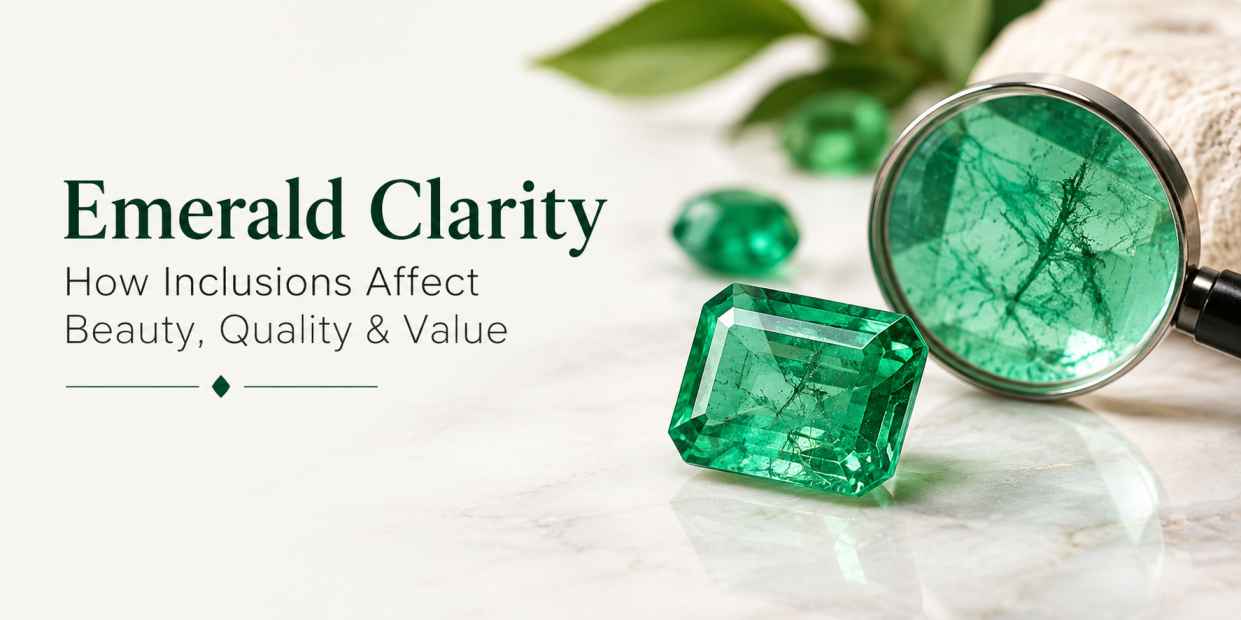
When shopping for an emerald stone, clarity can be confusing. Unlike diamonds, emeralds are rarely completely free from internal features. Tiny fractures, mineral crystals, fluid-filled cavities, and other natural characteristics are common. These inclusions are often called the “jardin,” a French word meaning garden, because they can create a mossy appearance inside the gem.
It also helps explain why the emerald gemstone price varies between stones.
Emerald clarity is assessed differently from diamond clarity. Buyers generally look for a balance between transparency, color, and natural characteristics.
Common inclusions include tiny crystals, liquid pockets, fissures, growth patterns, and healed fractures. Some appear as dots or needles, while others look like wispy threads or garden-like formations.
Inclusions are not automatically defects. Their effect depends on how noticeable they are, whether they interrupt transparency, and whether they threaten durability.
Not necessarily. In some emeralds, inclusions contribute to character and visual identity. A well-distributed jardin can add character. However, large, dark, or distracting inclusions may reduce visual appeal.
Almost every natural emerald has inclusions. The better question is how they affect appearance when viewed in person.
An emerald with moderate inclusions may appear more beautiful than a slightly cleaner stone with weak color. This is why clarity should always be considered alongside hue, tone, saturation, cut, and transparency.
Clarity becomes particularly important when inclusions interfere with light passing through the stone. Higher transparency can make an emerald appear more lively, while heavy internal features can create a cloudy or dull appearance.
Quality is multidimensional. A transparent emerald with pale color may not be as appealing as a richly saturated stone with moderate inclusions.
Strong green color is important. An emerald with vivid, evenly distributed color and moderate inclusions can be highly desirable.
Compare stones under consistent lighting and inspect them from different angles. An inclusion may look obvious from one direction but less noticeable when mounted.
Clarity can have a direct effect on value, but it is only one part of the pricing equation. The emerald gemstone price also depends on color, carat weight, origin, treatment, cut, transparency, certification, and rarity.
Exceptionally clean natural emeralds can be scarce and expensive. Yet an emerald with visible jardin can still be valuable when its color and appearance are outstanding.
Treatment also matters. Many emeralds are fracture-filled to improve apparent clarity, and this can influence value. Reputable sellers should disclose treatment.
Not every inclusion creates a problem. Surface-reaching fractures, however, can affect durability, particularly if they are extensive or located in vulnerable areas. Emeralds are relatively brittle compared with some other gemstones, so they should be handled carefully.
Ask whether the stone has been treated and whether a laboratory report is available.
Start by examining the stone in natural or neutral lighting. Look at it face-up, then tilt it gently to observe the interior from different directions.
Next, check whether inclusions are visible without magnification. If they are, determine whether they add character or noticeably interfere with transparency. A loupe can reveal additional details.
Ask for information about treatment, origin, certification, dimensions, and weight. If you are considering gem online shopping, request clear photographs, videos, and laboratory documentation before purchasing.
A trustworthy seller should explain whether an emerald is natural, treated, and laboratory certified. Ask about treatment and whether the report identifies it as natural emerald.
Compare stones by appearance, not price alone. Two emeralds with the same carat weight can have very different values.
No. “Cleaner” does not automatically mean “higher quality.” Emerald evaluation involves a combination of factors, and color and transparency can be more visually important than microscopic clarity differences.
A slightly included emerald with beautiful color and good transparency may be more attractive than a cleaner stone with weak saturation. Your choice depends on budget and purpose.
For jewelry, prioritize an emerald that looks attractive at normal viewing distance and has no obvious durability concerns. For significant purchases, documentation, treatment disclosure, provenance, and certification matter.
Natural emeralds are not typically expected to look perfectly clean. Their internal gardens are part of what makes them distinctive.
Compare several stones when possible. Consider color first, then transparency, clarity, cut, treatment, certification, and price. This can help you recognize value rather than paying extra for cleanliness.
Yes. Inclusions are extremely common in natural emeralds. They can include crystals, fractures, liquid pockets, and growth features. Their presence does not automatically indicate poor quality.
They can, especially when they are large, highly visible, reduce transparency, or create durability concerns. However, color, origin, treatment, certification, and carat weight also influence pricing.
Jardin refers to the garden-like network of inclusions commonly found inside emeralds. It can look like leaves, branches, clouds, or moss and is a characteristic feature of many natural emeralds.
Exceptionally clean emeralds exist, but they are very rare. A natural emerald that is highly transparent and has excellent color with minimal visible inclusions can command a significant premium.
Not necessarily. Ask for photographs, videos, treatment details, certification, and return policies. During gem online shopping, evaluate the stone’s overall appearance and disclosed characteristics rather than expecting perfect clarity.
Submit guest articles that reach decision-makers, influencers, and professionals. Yarabook offers a trusted platform for quality content, strong backlinks, and SEO-driven visibility. Pay. Publish. Promote.