

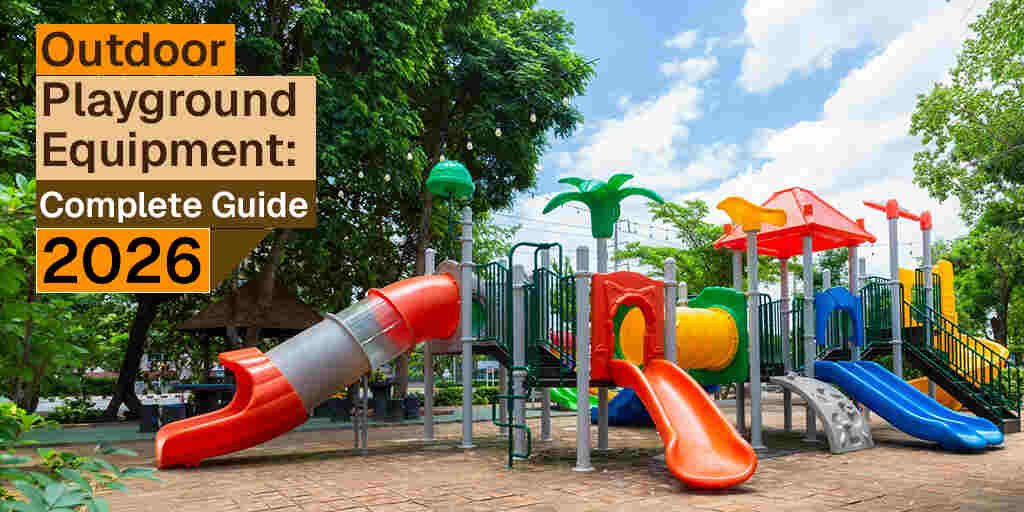
Outdoor play gives children far more than just a place to have fun. Research indicates that children who spend at least two hours outside participate in 27% more moderate-to-vigorous physical activity compared to those who spend less time outdoors. Beyond promoting physical health and active lifestyles, outdoor play supports cognitive development, social skills, concentration, and emotional well-being. Consequently, thoughtful playground planning is essential for schools, residential HOAs, municipal parks, and commercial developments.
Every site presents a distinct design and architectural challenge. A project location might range from a tight 400-square-foot courtyard behind a daycare center to an expansive 3,000-square-foot destination park. The key to successful planning lies in selecting and combining play structures so the spaces feel open, safe, and engaging for children. Partnering with a reliable outdoor playground equipment supplier helps ensure proper safety clearances and maximum play value across any footprint.
Here is a practical guide to planning outdoor play equipment for small, medium, and large playground spaces.
1. The Small Playground: Under 500 Sq. Ft.
Designing for tight spaces, such as HOA courtyards or urban pocket parks, requires maximizing every square foot. The most common error in small footprints is crowding too many freestanding elements, which restricts clearance and creates a cramped environment.
Build Vertically
Rather than spreading individual units across the ground, choose integrated systems. A compact unit of multi activity outdoor play equipment combines slides, steps, climbing walls, and activity panels within a single footprint. This maximizes play variety without exhausting ground-level clearance zones.
Match Equipment to Age Groups
Toddlers (6–23 months): Prioritize low platforms, gentle ramps, crawl tunnels, and tactile ground-level panels.
Preschoolers (2–5 years): Select equipment scaled to early physical development, ensuring elevated platforms feature required guardrails and fall protection.
Reconsider Traditional Swings
A standard swing set requires extensive safety clearance zones extending forward and backward. In a playground under 500 sq. ft., swing safety margins can easily consume over half of the usable space. If space is tight, reallocate that footprint to vertical multi-use units.
Choose Practical Surfacing
Poured-in-place rubber or synthetic turf works exceptionally well in tight sites, offering impact attenuation, seamless accessibility, and clean visual boundaries.
2. The Medium Playground: 1,000–2,000 Sq. Ft.
Medium sites—such as those at elementary schools, places of worship, or neighborhood parks—allow planners to pair a central multi-play structure with dynamic standalone features.
Establish a Natural Play Loop
Organize equipment to encourage continuous flow. Children should be able to climb, slide, and loop back to the main structure without intersecting other activity zones or high-traffic pathways.
Integrate Climbers with Slides
Elevate play value by pairing slides directly with dynamic Climbers, such as rope nets, arch climbers, climbing walls, and balance beams. This combination challenges coordination and strength within a consolidated zone.
Separate High-Motion Equipment
Place moving components like swings along outer borders or corners. Keeping swing paths isolated prevents collisions with main running routes.
Enforce Safety Clearance Zones
Every piece of equipment requires dedicated use zones according to safety standards. Maintain required clearances around climbing elements, keep slide exit zones unobstructed, and avoid overlapping fall zones where prohibited.
Maintain Loose-Fill Surfacing
When using Engineered Wood Fiber (EWF) or rubber mulch, budget for ongoing maintenance. Install heavy-duty wear mats under high-impact zones, such as slide exits and swing bays, to preserve depth and safety compliance.
3. The Large Destination Playground: 3,000+ Sq. Ft.
While large parks offer immense flexibility, wide-open sites can quickly become chaotic without structured zoning. Dividing a large playground into age-specific activity zones keeps play safe and manageable.
Dedicated Age Zones
Toddler Zone (6–23 Months): Focus on simple ground-level activity panels, low ramps, crawl tunnels, and full-bucket toddler swings.
Preschool Zone (2–5 Years): Include low climbing structures, shorter slides, spring rockers, and accessible entry points.
School-Age Zone (5–12 Years): Incorporate advanced Climbers, dome/net structures, monkey bars, tall slides, overhead spinners, and tire swings to challenge older children.
Preserve Unobstructed Sightlines
Position perimeter seating and benches so caregivers retain clear visual lines across all zones. Avoid tall visual barriers that block supervision between age areas.
Expand into Adult Fitness
Destination parks frequently cater to multi-generational visitors. Integrating workout zones adjacent to play areas encourages parents and adults to remain active while supervising children. If you are looking to build an outdoor gym area, here’s a comprehensive guide to choosing the best gym equipment for parks. Selecting the best fitness equipment in parks helps transform traditional playgrounds into comprehensive community wellness hubs.
Conclusion
Successful playground planning balances spatial footprint, target age demographics, fall zone safety, and play diversity. Whether designing a compact pocket park or an expansive destination site, choosing Premium children’s play equipment engineered for safety and durability ensures a vibrant, active environment children will enjoy for years.
Submit guest articles that reach decision-makers, influencers, and professionals. Yarabook offers a trusted platform for quality content, strong backlinks, and SEO-driven visibility. Pay. Publish. Promote.