

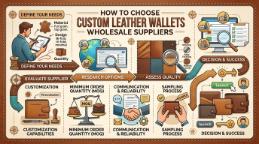
Finding the right wholesale supplier is one of the most important decisions for brands, retailers, corporate gifting companies, and promotional businesses looking to sell custom leather wallets. A supplier does more than provide products. Their materials, craftsmanship, production capacity, communication, and quality-control standards can directly affect your brand reputation and profit margins.
Custom leather wallets require particular attention because customers interact with them every day. Stitching, leather quality, edge finishing, pocket construction, logo placement, and durability all contribute to how buyers perceive the product. Choosing a supplier based only on the lowest quotation can therefore create quality problems that cost more to fix later.
A reliable supplier should be able to consistently reproduce an approved design while meeting agreed quality and delivery requirements. This becomes especially important when a business moves from a small test order to recurring wholesale purchases.
Customization adds further considerations. Your supplier may need to accommodate branded embossing, specific leather colors, custom dimensions, special stitching, packaging, or unique interior layouts. Every specification needs to be understood and reproduced accurately during manufacturing.
Before choosing a supplier, evaluate several areas rather than focusing exclusively on price.
| Evaluation Area | What to Check | Why It Matters |
|---|---|---|
| Leather Quality | Material, thickness, texture, and finish | Influences durability and perceived value. |
| Craftsmanship | Stitching, edges, seams, and construction | Determines how well the wallet withstands regular use. |
| Customization | Logo, color, dimensions, and packaging options | Ensures the product fits your brand identity. |
| Production Capacity | MOQ, order volume, and reorder capability | Supports both initial launches and future growth. |
| Quality Control | Samples, inspections, and defect procedures | Reduces the risk of inconsistent wholesale inventory. |
The leather is one of the first characteristics buyers should investigate. Different leather types can vary significantly in appearance, texture, thickness, durability, and price. Your material choice should correspond with the position of your product in the market.
Request physical samples whenever possible. Examine the surface, flexibility, edges, folds, and overall finish. A wallet intended for everyday use should feel durable while remaining practical and comfortable to carry.
Also ask the supplier for clear material specifications. Understanding exactly what is being supplied makes it easier to maintain consistency across repeat orders and prevents disagreements about quality later.
Excellent leather cannot compensate for poor construction. Stitching should be consistent, secure, and appropriate for areas that experience repeated bending and pulling. Check card slots, cash compartments, folded corners, seams, and other high-stress points.
Edge finishing is equally important. Clean, properly finished edges give a wallet a refined appearance and can help reduce premature wear. When comparing suppliers, examine multiple samples side by side so differences in symmetry, stitching, thickness, and finishing become easier to identify.
The ability to customize a wallet is often the main reason a brand chooses a manufacturer rather than purchasing generic inventory. A capable supplier should be able to translate your branding and product specifications into a consistent manufacturing process.
Ask whether customization changes the minimum order quantity, sampling costs, production schedule, or unit price. Confirming these details early prevents unexpected costs during production.
Price matters, but the cheapest quotation is not always the best value. Compare the complete cost of your order, including sampling, customization, packaging, shipping, and potential costs associated with defective products.
Minimum order quantities are also important. A growing brand may want to test demand with a smaller initial purchase, while an established retailer may need much larger production runs. Ideally, your supplier should accommodate your current requirements and have sufficient capacity to support future growth.
Before placing an order, ask:
A physical sample provides information that photographs cannot. It allows you to inspect the actual leather, stitching, dimensions, logo application, pocket functionality, and finishing before committing significant funds.
Use a structured approval process:
Communication is an essential part of custom manufacturing. A supplier needs to understand detailed instructions and communicate clearly about materials, production schedules, customization limitations, and delivery expectations.
Look for a manufacturer that answers questions directly, confirms important specifications, and provides realistic timelines. Good communication becomes even more valuable when you place repeat orders or introduce new wallet designs.
For businesses exploring established sources for custom leather wallets wholesale, reviewing available product options can also help when assessing styles, customization requirements, and potential wholesale collections.
A supplier should ideally be capable of supporting your business beyond its first purchase. If a particular wallet becomes a successful product, you need confidence that the manufacturer can reproduce it consistently and increase production when necessary.
Ask about production capacity, reorder timelines, material availability, and processes for maintaining consistency between batches. A scalable relationship can reduce the need to repeatedly search for new suppliers as your business expands.
Several avoidable mistakes can create problems during wholesale purchasing:
Taking time to evaluate these factors can significantly reduce purchasing risks and create a stronger foundation for future orders.
Focus on leather quality, craftsmanship, customization capabilities, minimum order quantities, production capacity, quality control, communication, pricing, and delivery reliability.
A sample lets you verify the actual material, construction, dimensions, branding, and functionality before investing in a larger wholesale order.
Not necessarily. Total value depends on product quality, defect rates, customization, packaging, delivery, and supplier reliability as well as the unit price.
Before choosing a supplier, ask about production capacity, reorder lead times, material availability, and their ability to maintain consistent specifications across multiple batches.
Choosing a custom leather wallet supplier should be approached as a long-term business decision. Quality materials, skilled craftsmanship, customization options, reasonable pricing, reliable production, and responsive communication all contribute to a successful wholesale relationship.
Rather than rushing toward the lowest quotation, define your requirements, compare suppliers using consistent criteria, inspect samples, and establish clear production expectations. For businesses seeking a broader leather goods manufacturing partner, exploring Rays Creations can be a useful next step in evaluating available solutions.
With the right supplier, custom leather wallets can become more than another accessory in your catalog. They can provide a durable, practical product that strengthens your brand identity while creating opportunities for repeat wholesale sales and long-term customer loyalty.
Submit guest articles that reach decision-makers, influencers, and professionals. Yarabook offers a trusted platform for quality content, strong backlinks, and SEO-driven visibility. Pay. Publish. Promote.