

You delivered the goods. You raised the invoice. And now you wait — 60, 90, sometimes 120 days — while your rent, salaries, and vendor payments don’t care about your buyer’s payment cycle. Sound familiar? That’s the daily reality for millions of Indian MSMEs.
Invoice trading is the financial tool that turns that waiting game into instant cash. Instead of staring at a pending invoice, you sell it to an investor at a small discount and walk away with funds in your account — sometimes within 24 hours.
India’s invoice trading ecosystem in 2026 is one of the most sophisticated in Asia, backed by RBI regulations, government mandates, and a growing network of fintech platforms. This article breaks down everything you need to know — simply, clearly, and without the financial jargon.
Invoice trading means selling your unpaid business invoices to a third-party investor or financier in exchange for immediate cash. The investor pays you a large portion of the invoice value upfront — typically 80–95% — and collects the full payment directly from your buyer when the invoice is due.
Think of it like this: you have a ₹10 lakh invoice due in 90 days. Instead of waiting, you sell it to an investor today for ₹9.5 lakh. You get cash now; the investor earns ₹50,000 as a return when your buyer pays up. Everyone wins.
Key fact: Invoice trading is not a loan. There is no EMI, no debt on your balance sheet, and no collateral needed. You are simply converting a future receivable into present cash.
These three terms often get used interchangeably, but they are meaningfully different — and the difference matters when you are choosing a financing solution.
In invoice trading, invoices are listed on a marketplace where multiple investors bid to fund them. It is competitive, transparent, and typically results in better rates for the seller. The risk of buyer default may or may not transfer to the investor depending on the platform structure.
Invoice discounting is more like a secured overdraft — you borrow money against your invoices but retain the responsibility of collecting payment. Your buyer may not even know you have used the invoice as collateral. This is common with banks and NBFCs.
Invoice factoring, on the other hand, involves selling both the invoice and the right to collect payment from the buyer. The factor (usually a financial company) takes over the collections process entirely. It is more hands-off for the seller but can sometimes affect buyer relationships.
Bottom line: Invoice trading is the most market-driven and transparent version of receivables financing, especially on regulated platforms like TReDS.
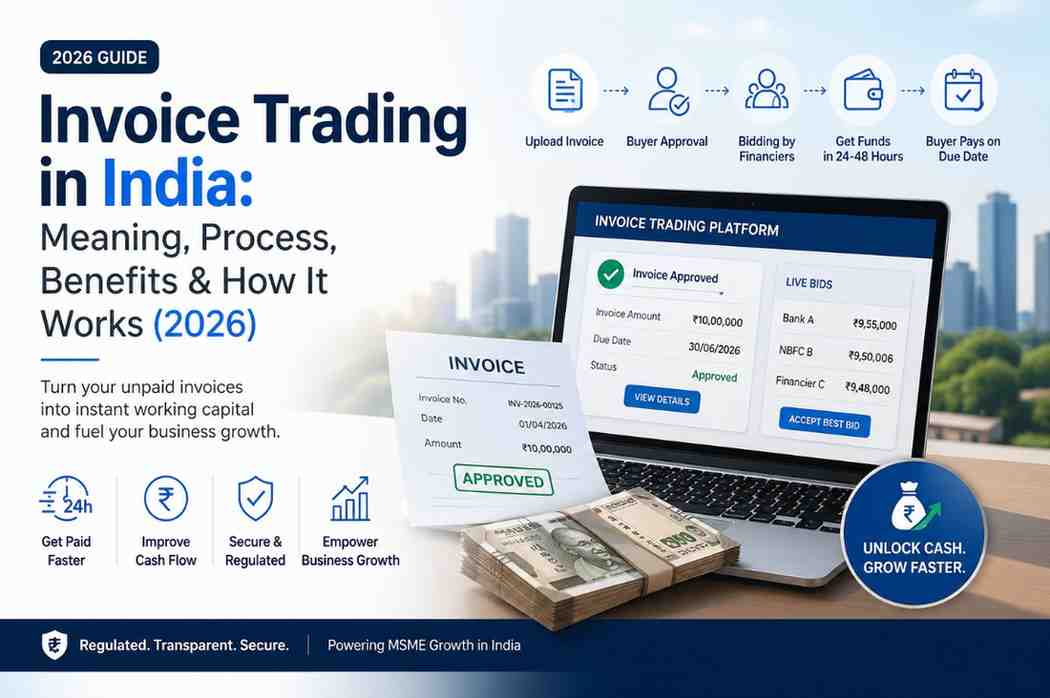
The process is cleaner than most people expect — especially on India’s regulated TReDS (Trade Receivables Discounting System) platforms. Here is how a typical invoice trading transaction unfolds:
The supplier (usually an MSME) delivers goods or services to a large corporate buyer and generates a GST-compliant invoice. This invoice is then uploaded to a digital platform — either a TReDS exchange or a fintech marketplace.
The corporate buyer logs into the platform and approves the invoice, confirming that the goods or services were received and the amount is payable on the due date. This is a critical step — financiers only bid on buyer-approved invoices, which significantly reduces risk.
Once approved, the invoice goes live on the marketplace. Banks, NBFCs, and other registered financiers place bids, offering to fund the invoice at various discount rates. Because multiple financiers compete, the seller usually gets the best possible rate — market forces work in their favor here.
The MSME reviews the bids and accepts the most favorable one. No lengthy paperwork. No branch visits. The entire process is digital and auditable.
After acceptance, the funds are transferred directly to the supplier’s bank account. Platforms like M1xchange and RXIL are known to disburse funds within one to two working days — a sharp contrast to the 60–90 day wait that was previously the norm.
On the invoice due date, the corporate buyer pays the full invoice amount directly to the financier. The transaction closes cleanly. The MSME has already moved on — with working capital in hand.
Invoice trading is primarily designed for B2B businesses — companies that sell goods or services to other businesses and raise formal invoices. Here is who benefits most:
The benefits go beyond just getting paid faster. Here is what invoice trading actually does for your business:
The most obvious benefit — and the most impactful one. Instead of waiting 60 to 90 days for payment, you get 80–95% of the invoice value credited within 24–48 hours. For a business running on thin margins or managing seasonal demand, this is transformational.
Unlike a bank loan, invoice trading does not require you to pledge property, machinery, or any fixed asset. Unlike venture funding, you do not give away equity. The invoice itself is the asset — and you created it by doing honest business.
Because multiple financiers bid for your invoice on TReDS platforms, the discount rate is determined by competition — not by a single banker’s discretion. This structural advantage often results in more favorable pricing compared to traditional financing options.
Invoice trading converts receivables into cash, which strengthens your current ratio and reduces your debtor days. For businesses planning to raise additional credit or prepare for fundraising, cleaner books matter — and invoice trading helps achieve that without additional debt.
On RBI-regulated TReDS platforms, invoice trading is typically structured as ‘without recourse.’ This means if the buyer defaults, the risk lies with the financier — not the MSME. This is a significant protection for small businesses that cannot afford bad debt exposure.
Gone are the days of physical documents, branch visits, and relationship banking. On modern platforms, the entire journey — from invoice upload to fund disbursement — is digital, auditable, and can be completed from a laptop or phone.
Choosing the right platform depends on your business size, buyer relationships, and whether you need domestic or international invoice financing. Here is a quick guide to the key players:
RXIL (Receivables Exchange of India Limited) was India’s first TReDS platform, established by SIDBI and NSE in 2014. It offers invoice discounting, bill discounting, and factoring services. RXIL Global IFSC Limited extends its services to cross-border trade finance, benchmarked against global best practices.
M1xchange is RBI-licensed and has onboarded 66+ banks, 2,500+ corporates, and 50,000+ MSMEs. It operates an auction-based model where financiers bid in real-time. Funds are typically disbursed within 24 hours of invoice acceptance. Best for MSMEs with large corporate buyers already on the platform. Its subsidiary M1 NXT also handles international invoice financing.
Invoicemart is a TReDS platform backed by Axis Bank and mjunction services. It is known for fast payment cycles — typically within 24 hours of buyer acceptance — and a straightforward digital onboarding process. It caters strongly to manufacturing and logistics sector MSMEs.
Founded in 2015 in Bengaluru, KredX is India’s most prominent invoice discounting platform outside the formal TReDS structure. It connects businesses holding invoices from creditworthy buyers with institutional investors. KredX is better suited for mid-market companies that may not qualify under TReDS eligibility or need more flexibility.
If you are a B2B business — supplying goods or services to corporates, PSUs, or government buyers — and you regularly deal with long payment cycles, invoice trading is one of the most powerful, low-friction financing tools available to you in India today.
It is not a loan. It is not equity. It is your own money — unlocked faster, through a regulated, digital marketplace that is backed by the RBI and used by tens of thousands of MSMEs across the country.
Submit guest articles that reach decision-makers, influencers, and professionals. Yarabook offers a trusted platform for quality content, strong backlinks, and SEO-driven visibility. Pay. Publish. Promote.