
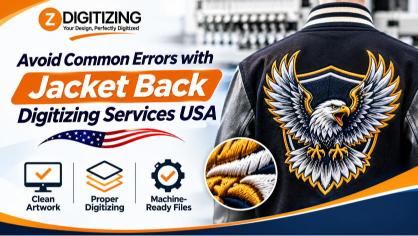
Large jacket designs can be affected by unclear artwork, poor placement, unsuitable file formats, or a stitch plan that does not account for the fabric. Our Embroidery Jacket Back Digitizing Services USA prepares designs for jacket embroidery with the garment and production details in view. This article covers common issues and practical checks to make before a larger run.
When ordering Embroidery Jacket Back Digitizing Services USA, share the jacket type, fabric, finished dimensions, placement, digitizing style, and machine format along with your artwork. A clear brief helps us understand what you need and gives your embroiderer details to use when setting up the job.
How Jacket Back Digitizing Services USA can prevent placement errors
Mistake 1: Treating the jacket like a flat panel
A jacket back has a curved shape and may include a yoke, center seam, pockets, lining, or other construction details. A design that looks centered in an image may sit too high, too low, or too close to a seam on the garment. Measure the actual back panel and mark the intended placement before the file is prepared.
The service page includes size and placement examples for leather, denim or canvas, fleece or softshell, bomber or varsity, and work jackets. Use the ranges as a starting reference, then confirm the usable area on your specific garment. Jacket patterns and sizes vary, so the actual panel is the reliable guide.
Mistake 2: Ignoring fabric behavior
Fabric affects how stitches sit. ZDigitizing’s jacket page notes tighter fills for denim, lighter density for leather, and underlay for fleece to help keep stitches from sinking. A file intended for one material should not be assumed to perform identically on another.
Our Jacket Back Digitizing Services USA consider the garment material, so tell us the exact jacket fabric if known. If you have not chosen the garment, wait to confirm the final material or include multiple options for review. Ask the embroidery shop whether it can sew the jacket and what stabilizer or setup it recommends for the selected fabric.
Mistake 3: Sending an unclear design brief
A low-resolution image may not show the exact shape of small lettering, narrow gaps, or fine outlines. If exact wording matters, provide it in text. Include a higher-quality logo or reference if you have one. Tell us which parts can be simplified and which need to remain recognizable.
Avoid vague instructions such as “make it bigger” or “put it at the top.” Provide a target width and height, and identify placement from a fixed point such as the yoke or center line. Marking a photo of the jacket can make the position easier to understand.
Mistake 4: Choosing the wrong machine format
Embroidery formats are not interchangeable in every machine setup. The jacket service page lists formats such as DST, EXP, PES, VP3, EMB, JEF, and HUS. Ask the person who will run the design which format they need, then specify that exact file type in the order.
If the file is intended for a shop, ask whether it wants the design sent to you or directly to the production operator. Provide the dimensions and placement notes alongside the file so the team can set up the jacket correctly.
Mistake 5: Skipping a sew-out
A file preview cannot show every effect of the actual garment and embroidery setup. A test sew-out lets you see how the design sits on the jacket, whether the text is legible, and how the fabric responds to fills and outlines. It can also reveal alignment issues around seams or the shoulder yoke.
The service page recommends securing the hoop, supporting the jacket so its weight does not hang, and marking the center for alignment. For fleece, it suggests a topping to help prevent stitches from sinking. Ask the embroiderer to apply appropriate production practices and review a sample before starting the batch.
How Jacket Back Digitizing Services USA benefit from a complete brief
Mistake 6: Assuming revisions will solve an incomplete brief
A minor revision can address a specific issue, but missing information at the start can create extra review. Provide the final garment, target size, placement, fabric, and machine format before digitizing. If you are still deciding on these details, explain what is provisional so the production team knows what may change.
Our jacket page states that minor revisions are included and lists delivery timing of 4–12 hours, with urgent orders in 1–4 hours; complex designs may take longer. Confirm the terms for your order and send clear feedback if a change is needed.
A quick pre-production checklist
Before approving the job, confirm:
- The artwork version and exact wording are correct.
- The jacket material and usable back panel have been checked.
- The design width, height, and placement are approved.
- The requested stitch style and machine format are clear.
- The embroiderer has a plan for hooping and supporting the jacket.
- A sew-out has been reviewed before producing a larger quantity.
These checks help connect the digitized file with the actual garment and production setup. If you change jacket material or size after digitizing, ask whether the file needs review before sewing.
Our Jacket Back Digitizing Services USA help you prepare large designs with fewer avoidable questions about fabric, size, placement, and machine compatibility. Share your approved artwork and production details with us so we can understand the project before digitizing.
At ZDigitizing, we digitize jacket-back designs for materials such as denim, leather, fleece, and more. Send us the artwork and jacket requirements to request a machine-ready file for your next project.
Frequently asked questions
How do Jacket Back Digitizing Services USA address puckering risks?
Puckering can be related to the fabric, stitch coverage, hooping, stabilizer, or machine setup. The service page notes that denim, leather, and fleece may need different digitizing considerations. Test the design on the intended jacket and review the full setup with your embroiderer if the fabric wrinkles.
How can I prevent jacket-back designs from being misaligned?
Measure the panel, mark its center, and identify the intended distance from the yoke or another fixed point. The jacket service page recommends marking the jacket center and hooping securely. A test sew-out can help confirm placement before a larger run.
Does jacket fabric affect stitch density?
Yes. The service page notes tighter fills for denim and lighter stitch density for leather, while fleece may need underlay to help prevent sinking. The digitizing plan should consider the material and design. Tell us the fabric and have your embroiderer test the file on the garment.
Can I use a small chest-logo file for a jacket back?
A chest design and a large back design have different sizes and coverage. Do not assume a small logo file can simply be enlarged without affecting stitch quality. Provide the intended back dimensions and ask for the design to be digitized for that size and placement.
What should I do if the sew-out looks different from the preview?
Take a clear photo and describe what differs, such as placement, text clarity, fabric response, or stitch coverage. Include the jacket material and production setup details. We can review the specific concern with you and determine whether the file or sewing setup needs attention.

Leave a Reply
You must be logged in to post a comment.