

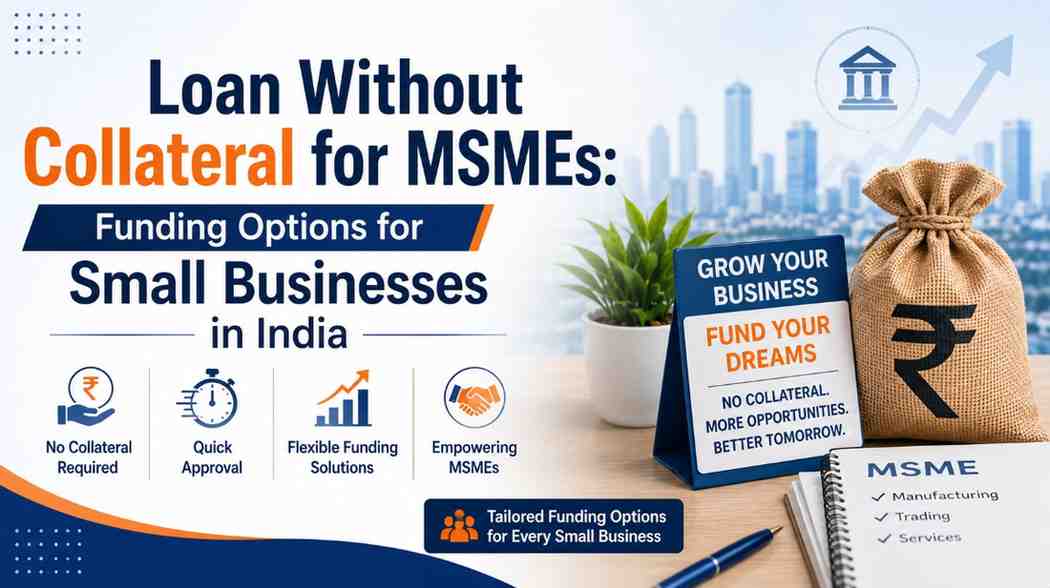
For any business, having enough funds at the right time is important for smooth operations and growth. MSMEs often need finance for purchasing raw materials, managing inventory, paying suppliers, hiring employees, and expanding their business. However, many small businesses face difficulties when they approach traditional lenders because they may not have assets like property or machinery to offer as security.
A loan without collateral provides a solution for such businesses. It allows MSMEs to access funds without pledging any asset as security. Instead of focusing only on available assets, lenders evaluate factors like business performance, credit history, income, and repayment capacity.
In India, the demand for collateral-free financing has increased as more small businesses look for flexible ways to manage their financial needs. Various banks, NBFCs, government-backed programs, and digital financing platforms provide funding options that help MSMEs access credit without asset security.
Understanding how these loans work, eligibility requirements, and available funding options can help small businesses make better financial decisions.
A loan without collateral is a type of business loan where the borrower does not need to provide any asset or security to the lender. These loans are also called unsecured business loans.
In traditional secured loans, businesses need to provide security such as land, buildings, machinery, or other valuable assets. The lender uses this security as protection against repayment risk. However, in a collateral-free loan, approval depends on other business factors.
For MSMEs, lenders generally consider:
For example, a small manufacturing business may have regular orders and stable income but may not own commercial property. A loan without collateral can help such a business access funds based on its financial strength rather than asset ownership.
Many MSMEs operate with limited resources. A newly established business or a small trading unit may not have enough assets to pledge against a loan.
Due to this limitation, some businesses struggle to access traditional financing options. Collateral-free loans help bridge this gap by allowing businesses to get financial support without offering security.
Working capital is essential for running daily business activities. Businesses often require funds to manage expenses such as:
Delayed customer payments can create cash flow problems even when a business is profitable. A loan without collateral helps MSMEs maintain smooth operations during such situations.
Small businesses require additional funds when they want to increase production, purchase new equipment, hire more employees, or expand into new markets.
Access to timely finance allows MSMEs to take advantage of growth opportunities without waiting to build assets for loan security.
The process of getting a collateral-free loan is similar to applying for other business loans, but lenders focus more on the financial health of the business.
The general process includes:
The business owner submits a loan application along with required business and financial details. The application includes information about the business, loan requirement, and purpose of funding.
The lender reviews factors such as business income, bank statements, credit score, repayment history, and financial documents.
Since there is no collateral involved, the lender carefully evaluates whether the business can repay the loan on time.
If the business meets the eligibility requirements, the loan is approved. After completing the required process, the funds are transferred to the business account.
The loan amount, interest rate, and repayment period depend on the lender’s policies and the financial profile of the business.
Eligibility requirements may vary between lenders, but some common factors include:
Businesses should have proper registration and documentation. Common business proofs include:
Proper registration improves trust and helps lenders verify business operations.
Lenders usually check how long the business has been operating. A stable business history shows that the company has regular operations and income sources.
Businesses with consistent performance may have better chances of loan approval.
Credit history plays an important role in collateral-free loans. Since lenders do not have asset security, they depend more on repayment behaviour and financial discipline.
A good credit score indicates responsible financial management and improves the chances of getting better loan terms.
Regular revenue and healthy cash flow are important factors for loan approval. Lenders check whether the business generates enough income to repay the borrowed amount.
Maintaining proper financial records helps lenders understand the business position.
Common documents required for MSME loans without collateral include:
MSMEs can explore multiple financing options based on their requirements.
Unsecured business loans are designed for businesses that need funds without providing collateral. These loans can be used for expansion, purchasing equipment, managing operations, or meeting other business needs.
The approval mainly depends on the business’s financial performance and repayment ability.
Working capital loans help businesses manage short-term financial requirements. They are useful for handling regular expenses and maintaining business continuity.
MSMEs can use these funds for:
Invoice financing helps businesses access funds against unpaid invoices. Many MSMEs face cash flow issues because customers take time to complete payments.
Through invoice financing, businesses can unlock money stuck in outstanding invoices and continue their operations without waiting for payment cycles to complete.
Invoice trading is another financing option that helps MSMEs raise funds against their approved invoices.
Through a TReDS platform, MSMEs can upload their invoices and get access to financiers who provide funds against those invoices. This helps businesses improve cash flow without depending only on traditional loans.
Receivables Exchange of India Limited (RXIL) is one such TReDS platform that enables MSMEs to convert their unpaid invoices into working capital.
The Indian government has introduced several initiatives to improve credit availability for MSMEs.
Pradhan Mantri Mudra Yojana provides financial support to small businesses and entrepreneurs.
Similarly, Credit Guarantee Fund Trust for Micro and Small Enterprises (CGTMSE) supports collateral-free lending by providing credit guarantees to eligible MSMEs.
These programs help small businesses access formal finance with easier conditions.
The biggest advantage is that businesses do not need to risk their property or other valuable assets to get funding.
Small businesses that have limited assets but good business potential can access funds based on their financial performance.
These loans provide financial support during periods of delayed payments or increased business expenses.
MSMEs can use the funds for business growth activities such as increasing production, entering new markets, or improving operations.
Unlike equity financing, loans allow business owners to maintain complete ownership while accessing required funds.
Businesses can improve their loan approval chances by following some simple steps:
A loan without collateral provides MSMEs with an opportunity to access funds without pledging assets. It helps small businesses manage working capital needs, handle operational expenses, and support growth plans.
With multiple financing options available, including unsecured business loans, working capital loans, invoice financing, and government-supported schemes, MSMEs can choose solutions based on their business requirements.
Maintaining strong financial records, planning borrowing needs, and selecting the right financing option can help businesses use these loans effectively and build long-term growth.
Submit guest articles that reach decision-makers, influencers, and professionals. Yarabook offers a trusted platform for quality content, strong backlinks, and SEO-driven visibility. Pay. Publish. Promote.