

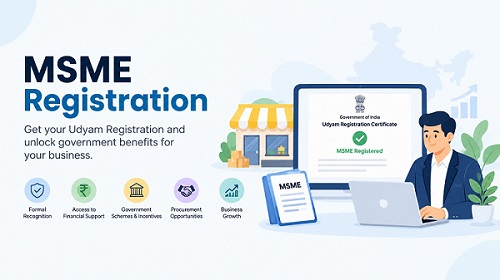
MSME Registration is a government recognition provided to eligible Micro, Small, and Medium Enterprises through the Udyam Registration system. It is administered by the Ministry of Micro, Small and Medium Enterprises (MSME), Government of India.
The registration gives an enterprise a permanent Udyam Registration Number and an electronic certificate. It helps businesses establish their MSME status and access various government initiatives, financial support programmes, and business development opportunities, subject to the applicable scheme conditions.
MSME Registration is available to businesses engaged in manufacturing, services, and other eligible activities. The process is completely online, paperless, and free on the official government portal.
From 1 April 2025, the Government of India revised the investment and annual turnover limits for MSME classification. An enterprise is classified based on both investment in plant and machinery or equipment and annual turnover.
The revised classification is as follows:
| Enterprise Category | Investment Limit | Annual Turnover Limit |
|---|---|---|
| Micro Enterprise | Up to ₹2.5 crore | Up to ₹10 crore |
| Small Enterprise | Up to ₹25 crore | Up to ₹100 crore |
| Medium Enterprise | Up to ₹125 crore | Up to ₹500 crore |
Both investment and turnover criteria must be considered for classification. If an enterprise crosses the prescribed ceiling in either criterion, it may move to the next higher category. The classification rules also provide for downward movement when the applicable limits are met.
Businesses meeting the prescribed MSME classification criteria can apply for Udyam Registration. The following entities may generally obtain registration:
Sole proprietorship firms
Partnership firms
Limited Liability Partnerships (LLPs)
Private Limited Companies
Public Limited Companies
One Person Companies (OPCs)
Hindu Undivided Families (HUFs)
Cooperative societies, trusts, and other eligible entities
The basic eligibility requirements include:
The business must qualify as a micro, small, or medium enterprise under the prescribed investment and turnover limits.
The applicant must provide the Aadhaar details of the appropriate proprietor, managing partner, or authorised representative, as applicable.
PAN details must be provided for the enterprise.
GSTIN must be furnished wherever GST registration is applicable.
The applicant must provide accurate information about the business, its activities, investment, and turnover.
Both newly established and existing eligible enterprises can apply. Retail and wholesale traders are also permitted to register, although the benefits available to them are subject to specific government restrictions.
Obtaining MSME Registration can help businesses access several government-supported benefits and business opportunities. Some major advantages include:
Udyam-registered enterprises may become eligible for various credit facilities and government-supported lending schemes. These initiatives can improve access to institutional finance for working capital and business expansion.
Banks classify eligible MSME lending under the Priority Sector Lending framework. Udyam recognition helps businesses establish their MSME status when applying for relevant financial assistance.
Eligible micro and small enterprises can receive protection under the MSMED Act, 2006. Buyers are required to make payments within the agreed period, which cannot exceed 45 days from acceptance or deemed acceptance of goods or services. Delayed payments may attract statutory interest provisions.
Eligible MSMEs may receive certain benefits under applicable public procurement policies, such as tender fee exemptions, earnest money deposit exemptions, or procurement preferences, subject to the relevant conditions.
Registered enterprises may apply for suitable government initiatives relating to credit support, technology development, skill enhancement, quality improvement, and market access.
An Udyam Registration Certificate provides formal recognition of an enterprise as an MSME. It can help businesses establish their eligibility when dealing with banks, government departments, and other institutions.
Udyam Registration is based on self-declaration, and applicants are not required to upload supporting documents during the online registration process. However, certain details should be available before starting the application.
Commonly required information includes:
Aadhaar number of the proprietor, managing partner, or authorised signatory, as applicable
PAN card details of the enterprise or applicant
GSTIN, wherever applicable
Business or enterprise name
Business address and contact details
Bank account number and IFSC code
Date of commencement of business
Nature of business activity
NIC code for the relevant manufacturing or service activity
Number of employees
Investment and turnover information
The portal retrieves relevant PAN- and GST-linked information from government databases wherever applicable.
The MSME Registration process is straightforward and can be completed through the official Udyam Registration Portal. The general steps are as follows:
Visit the official Udyam Registration website of the Ministry of MSME. Select the option for new entrepreneurs who are not registered yet as MSMEs.
Provide the Aadhaar number and name of the appropriate applicant, such as the proprietor in a proprietorship firm or managing partner in a partnership firm. Complete the OTP verification process.
Enter the PAN details and complete the required verification. For companies, LLPs, and other eligible entities, the relevant organisation details and authorised signatory information must be furnished.
Enter the enterprise name, business address, commencement date, bank details, and other requested information. Select the appropriate business activity and NIC code.
Provide the applicable information regarding investment in plant and machinery or equipment and annual turnover. Relevant details may be retrieved from government databases based on PAN and GST information.
Review the information carefully and submit the application after completing the required verification. Since registration is based on self-declaration, applicants should ensure that all details are accurate.
After successful completion of the registration process, the enterprise receives a permanent Udyam Registration Number and an electronic Udyam Registration Certificate.
MSME Registration through the official Udyam Registration Portal is completely free of cost. There is no government application fee for obtaining the certificate.
The Udyam Registration Number is permanent, and the certificate does not require periodic renewal. However, enterprises should update their information when necessary and ensure that their PAN, GST, investment, and turnover details remain accurate.
Businesses should use the official government portal for registration and avoid websites that falsely claim to be authorised government MSME registration portals.
Applicants should take care to avoid the following mistakes:
Entering incorrect Aadhaar or PAN details.
Selecting an unsuitable NIC code.
Providing inaccurate business information.
Incorrectly reporting investment or turnover.
Failing to provide GSTIN where applicable.
Creating multiple Udyam registrations for the same enterprise.
Not updating business details when required.
One enterprise should generally have only one Udyam Registration. Multiple business activities, including manufacturing and services, can be included under the same registration.
MSME Registration in India helps eligible businesses obtain formal recognition and access various government-supported opportunities. With revised classification limits effective from April 2025, more growing businesses can qualify under the MSME framework. The online Udyam process is free, paperless, and based on self-declaration, making registration accessible to entrepreneurs across India.
Businesses should verify their eligibility, prepare the required information, and complete registration through the official Udyam portal. Professional assistance can also help applicants understand the registration requirements, select appropriate business activities, and avoid common application errors.
1. Is MSME Registration mandatory in India?
MSME Registration is generally voluntary. However, obtaining Udyam recognition can help eligible enterprises access applicable government schemes and benefits.
2. Is MSME Registration free?
Yes. Udyam Registration is completely free on the official government portal.
3. Can a new business apply for MSME Registration?
Yes. Individuals intending to establish an eligible micro, small, or medium enterprise can apply through the Udyam portal.
4. How long is an MSME Registration certificate valid?
The Udyam Registration Number is permanent, and the certificate does not require renewal. Businesses should update relevant information when necessary.
5. Can a service-based business apply for MSME Registration?
Yes. Eligible service-based businesses can apply for Udyam Registration, provided they meet the applicable classification criteria.
6. Can one business obtain multiple Udyam registrations?
No. One enterprise should have only one Udyam Registration. However, multiple manufacturing and service activities can be included under the same registration.
Submit guest articles that reach decision-makers, influencers, and professionals. Yarabook offers a trusted platform for quality content, strong backlinks, and SEO-driven visibility. Pay. Publish. Promote.