

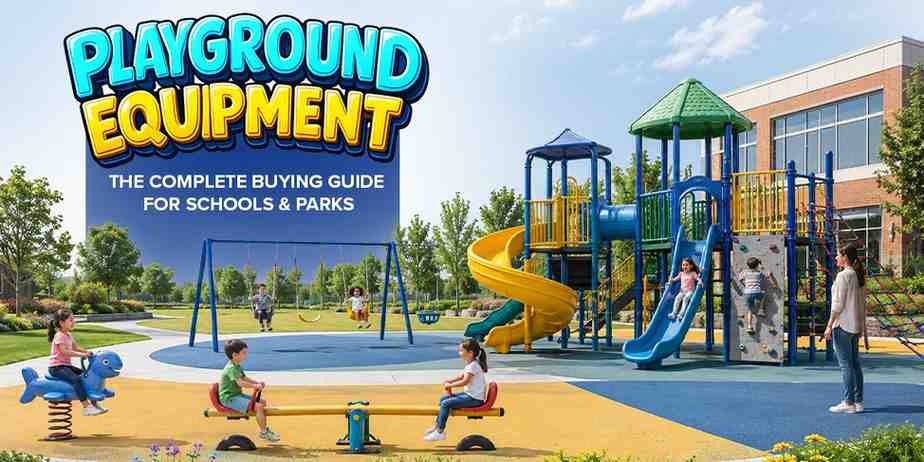
Selecting the right playground equipment manufacturer is a critical decision that directly impacts the safety, quality, and longevity of your school playground, public park, or commercial recreation project. This compressed guide outlines the essential factors to evaluate before investing, ensuring your project achieves long-term success.
Understanding how your partner operates is crucial before making a procurement decision:
Suppliers typically purchase components from third-party entities and resell them, which can limit design modifications and obscure accountability.
Direct Manufacturers design, engineer, manufacture, and test all equipment completely in-house.
Partnering directly with a manufacturer like Arihant Play delivers greater structural transparency, flexible customization, direct technical support, and seamless access to future replacement components.
A dependable manufacturer should readily share case studies, client testimonials, and site photographs. For instance, Arihant Play brings over 45 years of manufacturing experience, managing more than 875 major projects and 250,000 installations globally. In-house production ensures absolute control over manufacturing quality, consistent material standards, and streamlined timelines.
Outdoor playground equipment must withstand harsh weather conditions and heavy daily usage. Look for high-performance materials such as:
High-Density Polyethylene (HDPE): Selected for activity panels and slides due to its exceptional weather resistance, low maintenance requirements, and impact resistance.
Galvanized & Powder-Coated Steel: Forms the structural backbone, protected by hot-dip galvanization and premium powder coating to resist rust, moisture, and UV degradation.
Rather than relying on generic catalogue options, leading manufacturers adapt play spaces to fit specific site limits and user profiles:
Age-Based Zone Planning: Creates separate play spaces for toddlers and older children to prevent overcrowding and enhance overall safety.
Site-Specific Layouts: Tailors equipment to functional use in tight, narrow, or irregular landscape boundaries.
Theme-Based Concepts: Integrates custom colour schemes, branding elements, or unique architectural concepts.
Safety is the absolute priority to protect children and eliminate legal or financial risks for developers. Ensure the equipment strictly complies with national and international standards:
India: IS 15567 (Bureau of Indian Standards).
International: EN 1176 (European Standard) or ASTM F1487 (American Standard).
B2B Procurement Tip: Always ask potential partners for third-party verification documents and structural load-test reports upfront. If a supplier cannot provide these, it is best to look elsewhere.
Before finalizing your layout, ensure these technical elements are fully integrated:
Fall-Zone Surfacing: Hard surfaces like concrete must never be exposed under play structures. Use compliant shock-absorbing materials like rubber safety flooring, engineered wood fibre, or sand at regulated depths.
Structural Integrity: Verify the use of reinforced joints, robust assemblies, and smooth welds engineered to handle continuous physical loads.
Hardware Quality: Fasteners should be stainless steel or zinc-coated to resist corrosion, with all exposed bolt ends safely covered to prevent clothing snags.
Entrapment Prevention: All openings must be carefully sized according to international safety dimensions to completely eliminate head or neck entrapment hazards.
Reliable equipment undergoes strict factory checks before dispatch, including structural load testing, thorough surface inspections for sharp edges, hardware torque checks, and precise fall-zone measurements.
| Application Sector | Core Requirements & Solutions |
| Schools & Institutions | Compact multi-play structures that optimize limited space while promoting physical and social development during breaks. |
| Public & Municipal Parks | Ultra-durable, low-maintenance hardware engineered for continuous public traffic and built using sustainable practices. |
| Housing Societies | Attractive layouts that complement the surrounding landscape, using age-appropriate zones to enhance community value. |
| Commercial Resorts | Custom-themed designs and premium materials that maintain structural integrity under heavy visitor traffic to encourage repeat visits. |
| Inclusive Playgrounds | Accessible play zones featuring wheelchair ramps, sensory elements, and transfer platforms so children of all abilities can play together. |
Playground pricing is influenced by equipment complexity, material grades, production scale, and required site preparation. Use these budget guidelines during early planning stages:
Define Specs Early: Outline your precise space dimensions, target age groups, and budget expectations before requesting formal quotes.
Demand Itemized Quotes: Ensure your proposal clearly separates equipment costs, freight charges, civil foundation expenses, and professional installation fees.
Prioritize Lifetime Value: High-quality steel and HDPE setups built to last 12–15 years deliver far greater long-term value than cheaper alternatives that require premature replacement.
Leverage Bulk Ordering: Take advantage of commercial pricing and manufacturing efficiencies if purchasing multiple units across phased developments.
The process begins with thorough site levelling, drainage tracking, and foundation planning. Assembly teams secure the support posts, fix the structural decks, mount the play components, and verify all hardware torque settings. Once complete, a safety inspection is carried out before handing over comprehensive maintenance manuals and warranty certificates.
To preserve product warranties and ensure child safety, establish a structured inspection routine:
Weekly: Visual checks for loose hardware, vandalism, or obvious structural damage.
Monthly: Operational checks on moving components, structural anchors, and site drainage stability.
Annually: Comprehensive professional audits conducted by certified specialists to detect hidden wear.
Before signing a contract with any manufacturer, verify these 9 crucial points:
Do you manufacture your products completely in-house or outsource production?
What are the exact material specifications for your steel and plastics?
Which specific national or international safety standards do your products comply with?
Can you provide recent local project references or arrange actual site visits?
Will you provide a fully transparent, itemized quotation?
Who manages the installation process, and what are their qualifications?
What explicit warranty coverage is provided for structural versus plastic parts?
Are genuine replacement components and technical support easily accessible after handover?
Can you fully customize the design layout to fit our precise site themes and space limits?
Submit guest articles that reach decision-makers, influencers, and professionals. Yarabook offers a trusted platform for quality content, strong backlinks, and SEO-driven visibility. Pay. Publish. Promote.