

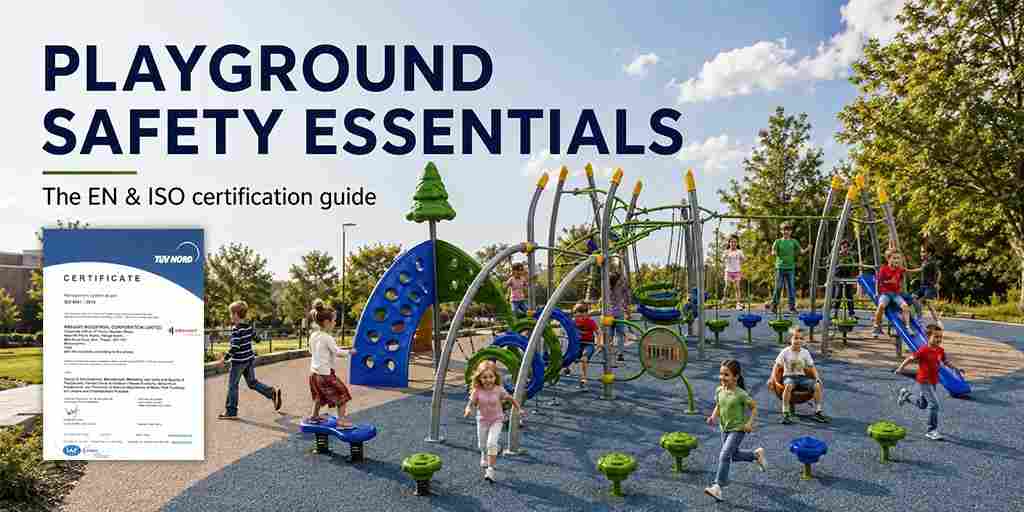
Many playground equipment suppliers describe their products as “certified.” The important questions are what that certification covers, which standard applies, whether the certificate is current, and how it can be verified. For school administrators, municipal authorities, housing society committees, and developers, unclear certification can create concerns around liability, insurance, and tender eligibility.
Institutional procurement teams must balance budgets, compliance requirements, and safety expectations. Playground safety standards certification is therefore an important part of the purchasing process. Tenders and RFPs may require EN or ISO-related compliance, while insurers can request evidence that playground installations meet recognised safety requirements.
This guide explains what EN safety standards and ISO certification mean, how they differ, and what institutional buyers should request from vendors. It also connects certification with the selection of playground equipment by age so that safety and developmental needs are considered together.
For private buyers, certification may offer additional reassurance. For institutions, it can be part of formal compliance requirements.
Liability is a key concern. Schools, municipalities, and housing societies need to demonstrate that reasonable care was taken when selecting playground equipment. Maintaining current certification records helps document that recognised safety requirements were considered.
Insurance is another factor. Insurers covering play areas may request proof that installed equipment meets relevant safety standards. Having the correct documents available can support the claims process following an incident or accidental damage.
Tender and RFP compliance also matters. Public and institutional procurement processes may specify certification as mandatory. Vendors unable to provide current, product-specific certificates may therefore face difficulties during evaluation.
For institutional buyers, certification can have legal, financial, insurance, and procurement implications rather than serving merely as a marketing claim.
EN, or European Norm, safety standards establish technical requirements covering areas such as playground equipment design, construction, and safety. Three important areas include:
Structural requirements concern the strength and construction of playground equipment. This includes load-bearing capacity, materials that can withstand repeated stress, and secure welds, joints, and connections designed to reduce structural failure during normal use.
Fall-height requirements determine how far a child could fall from a piece of equipment. This directly influences the protective surfacing required underneath and around the equipment.
EN requirements also address gaps and openings that could trap a child’s head, limbs, fingers, or clothing. This includes spaces around rungs, railings, and moving components.
Entrapment assessment can be highly technical, and some problems may not be obvious during a basic site inspection. This is a high-level overview, so buyers should confirm the applicable standard numbers, clauses, and certification scope with the vendor and review current documentation.
EN standards focus primarily on the safety and performance of the relevant product. ISO certification generally concerns the manufacturer’s quality management system and production processes.
An ISO-certified quality management system indicates that documented procedures may be in place for sourcing, manufacturing, inspection, and quality control. This can support consistency across production.
This distinction matters because testing or certifying a particular product does not automatically demonstrate that every later unit will be produced identically. Controlled manufacturing processes can help maintain consistency from one order to the next.
In simple terms, EN certification relates to the product’s requirements, while ISO certification relates to the manufacturer’s quality management processes.
Certification claims should be supported by documentation and checked as part of procurement due diligence.
Clear, traceable documentation makes vendor verification easier and reduces ambiguity during procurement.
Certification needs to be considered alongside the other major decisions in playground projects. Equipment selection and protective surfacing work together to create the actual safety environment.
Choosing the appropriate types of playground equipment by age is an important part of this process. Equipment is designed and assessed for particular user groups, so using it outside its intended age range can undermine the assumptions behind its safety assessment.
Our guide to choosing playground equipment by age group and space explains the selection of swings, climbers, see-saws, spring riders, thrillers, and merry-go-rounds according to age and available space.
Surfacing is equally important. Certified equipment installed over an unsuitable surface, or on flooring that does not match its fall-height requirements, can create a gap between product certification and actual site safety.
Our guide on playground flooring and fall-safety standards compares rubber flooring, sports courts, and jogging tracks against the requirements of their intended applications.
Treat playground safety standards certification, equipment selection, and flooring as connected parts of the same project. Keeping them aligned can simplify inspections, documentation, and insurance reviews while helping avoid avoidable compliance gaps.
Requirements vary according to location, project type, and applicable regulations. Private installations may have different obligations from institutional playgrounds. Even when certification is not mandatory, buyers may still choose certified equipment for additional safety assurance and documentation. Speak to our team via a request for a quote for guidance specific to your project.
Renewal periods vary by certificate type and certifying organisation. Always check the validity dates and conditions on the specific certificate rather than assuming a fixed renewal period. Our certifications page has current details for our product range.
EN standards primarily address equipment design and construction, while proper installation is a separate but connected requirement. Factors such as surfacing, fall zones, and safety clearances also need to be addressed. See our flooring and fall-safety guide.
EN standards relate to the applicable product’s design, safety, and performance. ISO certification generally relates to the manufacturer’s quality management processes. They address different areas and should not automatically be treated as substitutes.
Yes. ISO and EN certification assess different aspects. A manufacturer can have an ISO-certified quality management system without every product necessarily meeting a specific EN product standard. Buyers should verify each requirement separately.
Request the relevant certificates directly from the vendor and, where practical, verify the information with the issuing organisation. For our equipment, you can get in touch with our team, who will provide all the information you need for your play equipment requirements.
Submit guest articles that reach decision-makers, influencers, and professionals. Yarabook offers a trusted platform for quality content, strong backlinks, and SEO-driven visibility. Pay. Publish. Promote.