

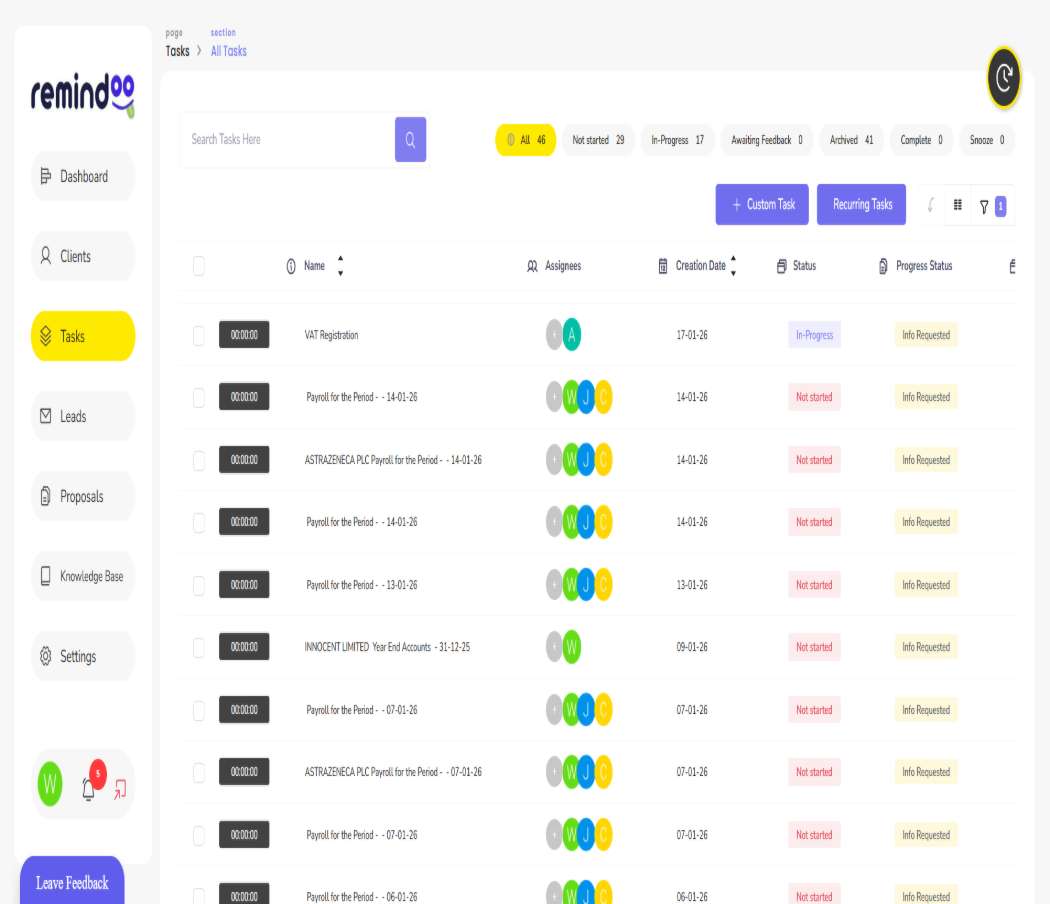
Accounting firms run on information. Client records, tax returns, year-end accounts, VAT filings, payroll runs, deadlines, messages and documents all move through a practice every day, and the way a firm organises that work decides how much time its people spend on real accounting and how much they lose to searching, chasing and rework. Task tracking software for accountants gives every job an owner, a stage and a due date in one view, so the whole team works from the same picture of the workload instead of each person keeping a separate list.
In a firm without a central view, the same client information lives in several places at once. The accounts senior keeps a spreadsheet of jobs. The manager keeps a separate list of deadlines. Client emails sit in individual inboxes. When someone is away, a colleague who picks up their work has to start by finding out where everything is. A shared task list changes that. Each job sits in one place, with its client, its owner, its stage and its due date, so any team member can open the list and answer a progress question from the same information.
The stages matter as much as the dates. In one view, jobs in preparation, jobs in review and jobs waiting for client documents are visible together. A manager can see where work is building up and rebalance it before a deadline arrives, rather than discovering the pressure when it is too late to act. A job that has been waiting for client information for two weeks is visible as a job waiting for client information, not simply as a late job. That distinction matters, because the action is different: chase the client, rather than rush the preparer.
Deadlines in accounting also arrive in clusters. Self assessment season, VAT quarters and year ends all create peaks where the volume of work rises sharply and the cost of a missed deadline is real. Firms need to see the whole workload before the peak arrives, not discover it during the peak. When every job has a due date in one view, a manager can plan the weeks ahead, spread the work across the team, and see which jobs are at risk while there is still time to act. Planning around HMRC deadlines, and the government’s Making Tax Digital programme, is easier when those dates are tracked centrally rather than held in separate diaries and spreadsheets.
Much of an accountant’s week is spent chasing documents. A tax return cannot be finished until the client sends the last missing statement. A set of accounts waits on one signed document. The work itself may take an hour; the wait can take weeks. A client portal changes the shape of that problem, giving clients one secure place to upload documents, see what is outstanding and check what they have already sent. The firm can see at a glance which items are still missing and send a reminder for exactly those items, and the task itself can stay in the waiting stage until the documents arrive, so no one mistakes a waiting job for a job that is being worked on.
Most accounting work is repeatable. A self assessment return follows the same broad steps every year. A VAT return follows the same checks every quarter. The steps are known; the risk is that a step is missed when the firm is busy. Structured workflows turn each job into clear steps with an owner and a deadline, and task tracking shows which step each job has reached. A new member of staff can follow the same steps as an experienced colleague, and a manager can see at a glance where each job stands. Delays show up early, while there is still time to act, and checks that should happen on every job happen on every job, because they are part of the workflow rather than a matter of memory.
Task tracking also makes handovers simpler. When a team member is on holiday or off sick, a colleague can open the job list and see the owner, the stage and the due date of each job, instead of searching through spreadsheets and email inboxes to work out where things stand. Cover becomes practical, and the firm keeps working even when someone is away. Clear ownership means nothing is left waiting because no one knew it was theirs, and clear stages mean a colleague picking up a job can see what has been done and what remains, rather than starting again from the beginning.
The gains are practical rather than dramatic. Less time searching for information. Less time chasing documents. Fewer missed steps. A clearer view of the workload. Simpler handovers. None of that replaces professional judgement. Software does not prepare accounts, advise a client or spot a problem in a set of figures. What it does is clear away the administrative work that gets in the way of those things, so that the firm’s people spend more of their day on the work only they can do. Remindoo is a practice management software platform built for UK accountants, bookkeepers and tax firms, bringing client management, task tracking, workflow automation, deadline monitoring, proposals, AML processes, client portals and reporting into one central system.
Submit guest articles that reach decision-makers, influencers, and professionals. Yarabook offers a trusted platform for quality content, strong backlinks, and SEO-driven visibility. Pay. Publish. Promote.