

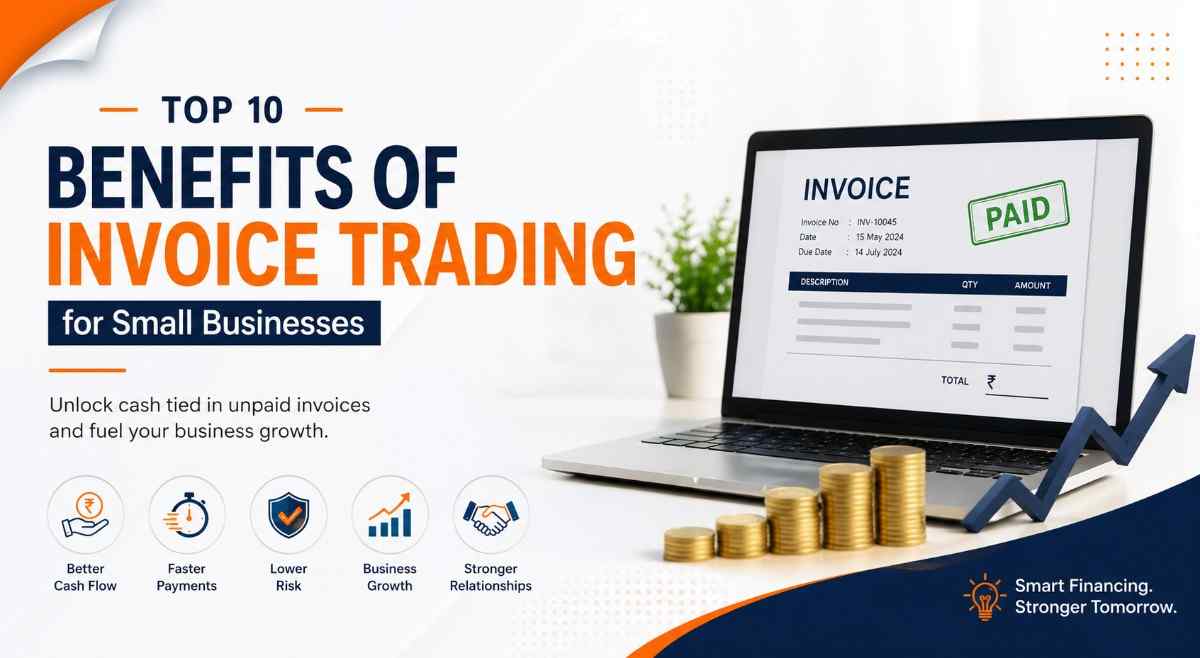
Running a small business in India is not easy. Most MSMEs face one common issue — delayed payments from buyers. Sometimes payments get stuck for 30, 60, or even 90 days. Meanwhile, salaries, raw material costs, rent, and GST payments don’t wait.
This is where invoice trading is helping many small businesses today.
Instead of waiting for buyers to clear invoices, businesses can sell their unpaid invoices on an invoice trading platform and get funds quickly. It helps improve working capital without taking a traditional loan.
Over the last few years, invoice trading has become popular among MSMEs, especially through TReDS platforms in India.
In this blog, let’s understand the top benefits of invoice trading and why more businesses are using it to manage cash flow better.
Invoice trading is a process where MSMEs can sell their unpaid invoices to financiers or banks and receive early payment.
For example, if your buyer will pay after 60 days, you don’t need to wait that long. You can upload the invoice on an invoice trading platform, and financiers can fund it after deducting a small discounting fee.
It is a simple way to unlock cash stuck in receivables.
Invoice trading is commonly used by:
One of the biggest benefits of invoice trading is faster access to working capital.
Many small businesses struggle because money gets blocked in unpaid invoices. Invoice trading converts those invoices into immediate cash.
This helps businesses:
Healthy cash flow keeps the business running smoothly.
Getting a business loan from banks can take time. Documentation, collateral requirements, approvals — the process is often lengthy for small businesses.
Invoice trading is much simpler compared to traditional financing.
Instead of taking a loan, businesses use their existing invoices to get funds. This reduces dependency on:
It becomes a smarter way to manage working capital.
Most MSMEs face difficulty because banks ask for collateral like property or fixed assets.
With invoice trading, the invoice itself acts as the basis for financing. In many cases, businesses don’t need heavy collateral security.
This is especially useful for:
Businesses can access funds without risking valuable assets.
Sometimes MSMEs lose good business opportunities simply because they don’t have enough working capital.
Suppose a large buyer places a big order. The supplier may need immediate money for raw materials, labour, logistics, or production.
Invoice trading helps businesses take up larger orders confidently because future receivables can be converted into quick funds.
This supports business expansion and growth.
Working capital is the backbone of every small business.
Poor working capital management can affect daily operations, vendor relationships, and even employee salaries.
One of the practical benefits of invoice trading is that businesses can maintain a stable cash cycle.
Instead of waiting for payments, businesses can:
This creates better financial discipline over time.
Traditional financing usually involves paperwork and multiple branch visits.
Today, invoice trading platforms have made the process much faster and digital.
Businesses can:
Digital invoice trading saves time and reduces manual hassle.
In India, TReDS platforms are playing a major role in simplifying receivables financing for MSMEs.
Delayed payments are one of the biggest challenges for MSMEs in India.
When businesses rely only on buyer payments, operations may suffer due to unpredictable delays.
Invoice trading reduces this pressure because businesses receive funds earlier against approved invoices.
This gives more financial stability and reduces dependency on payment cycles.
It also helps businesses focus more on operations instead of constantly following up for payments.
Compared to unsecured loans or informal borrowing, invoice trading often comes with better financing rates.
Why?
Because financing is linked to approved invoices from credible buyers.
This lowers risk for financiers, which can help businesses get competitive rates.
Over time, businesses can save money on financing costs while maintaining smooth cash flow.
Cash flow problems can impact relationships with vendors and suppliers.
If payments are delayed regularly, trust issues may arise.
With invoice trading, businesses get quicker access to funds and can pay suppliers on time.
This helps in:
Strong financial management creates stronger business relationships.
Small businesses need consistent liquidity to survive and grow.
Invoice trading supports business growth by ensuring funds are available when needed.
Businesses can use the money for:
Many MSMEs today are using invoice trading as a regular working capital strategy instead of using it only during emergencies.
India’s MSME sector contributes significantly to the economy, but delayed payments remain a major concern.
To improve MSME financing, platforms under the TReDS ecosystem are helping businesses access receivables financing in a more transparent and digital way.
Awareness about invoice trading is increasing because businesses now understand that unpaid invoices are not just pending payments — they are financial assets.
More companies are adopting digital financing solutions to improve liquidity and reduce operational stress.
Invoice trading can be useful for businesses that:
Industries where invoice trading is commonly used include:
Before selecting any invoice trading platform, businesses should check:
Choose a trusted and regulated platform.
A larger financier network can help get better rates.
Simple onboarding and online processing save time.
Understand all applicable fees clearly.
Good support is important during transactions.
The benefits of invoice trading go far beyond just faster payments. It helps MSMEs manage working capital better, reduce financial pressure, and grow with more confidence.
For small businesses dealing with delayed receivables, invoice trading can become a practical financial tool instead of relying completely on traditional loans.
As more MSMEs adopt digital financing platforms in India, invoice trading is slowly becoming an important part of modern business cash flow management.
Yes, invoice trading is especially useful for MSMEs and small businesses facing delayed payments and cash flow issues.
Businesses can receive funds against unpaid invoices instead of waiting for buyer payment cycles to complete.
No, invoice trading is different from a traditional loan. Businesses receive financing against invoices raised on buyers.
In many cases, heavy collateral is not required because financing is based on approved invoices.
Yes, startups and growing businesses can also use invoice trading if they deal with buyers on credit terms.
Submit guest articles that reach decision-makers, influencers, and professionals. Yarabook offers a trusted platform for quality content, strong backlinks, and SEO-driven visibility. Pay. Publish. Promote.