

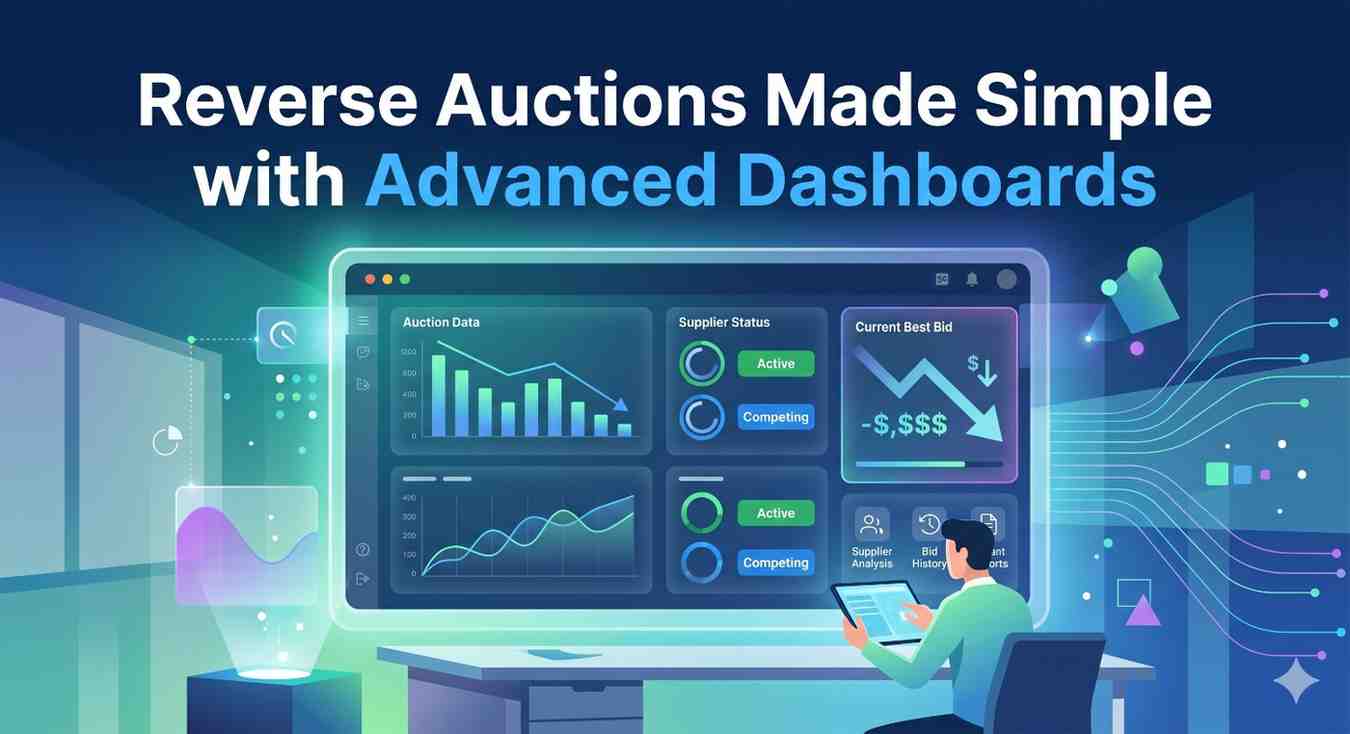
Managing a reverse auction can feel like trying to track a storm. You have multiple suppliers who submit bids at different times, prices fluctuate, and vast amounts of data come in every round. Without the right tools, it may easily feel overwhelming- losing track of patterns, missing opportunities, and wasting hours manually analyzing spreadsheets.
Thanks to technologies like modern reverse auction management software. One of the coolest features? Heat maps that make bidding trends immediately visible. You can view competitive suppliers, track pricing, and make informed sourcing decisions in real-time.
In this post, we will dig into how heat maps transform reverse auction dashboards from just another tool into a real strategic advantage. First, we will examine the drawbacks of traditional reverse auctions.
Before we talk about heat maps, let us be real. Traditional reverse auctions can be tricky. Why? Here, buyers invite suppliers to bid, and suppliers outbid each other by submitting the lowest bids. Sounds simple. But in reality, it can get messy fast. Monitoring multiple suppliers, comparing bids in real time, and keeping up with deadlines can feel overwhelming.
To manage bids, many teams use spreadsheets or generic ERP systems. The results?
Trying to manage bids manually may feel like trying to read a map with half the landmarks missing. This is where heat maps in reverse auction systems come in. They give you a clear picture without all the manual guesswork.
Let us check out what exactly a heat map is.
It is like a color-coded snapshot of your data. The best (lowest) bids stand out in green, mid-range bids show up in yellow, and the highest bids are highlighted in red. At just one glance, you can understand what is happening.
|
Supplier |
Round 1 |
Round 2 |
Round 3 |
Trend Insight |
|
Supplier A |
🟡 |
🟢 |
🟢 |
Aggressively improving |
|
Supplier B |
🔴 |
🟡 |
🟡 |
Gradual adjustment |
|
Supplier C |
🟢 |
🟢 |
🟡 |
Strong early, slowing |
|
Supplier D |
🔴 |
🔴 |
🔴 |
Non-competitive |
In the above heat map, the colors represent the suppliers’ bids.
🟢 Green = Most competitive (lowest bids)
🟡 Yellow = Mid-range bids
🔴 Red = Least competitive (highest bids)
By simply taking a glance, buyers can see which suppliers are competitive, which ones are improving, and which ones are lagging.
Reasons why heat maps work well in reverse auctions.
You can tell at a glance which suppliers are consistently low or high in pricing.
When suppliers adjust their bids, heat maps show who is moving strategically and who is lagging.
It is easy to see which suppliers consistently meet deadlines, bid aggressively, or require follow-up.
Next, we will look at how heat map dashboards differ from traditional ones.
Let us put it side by side- traditional dashboards versus heat map-enabled dashboards.
|
Feature |
Traditional Dashboard |
Heat Map Dashboard |
|
Bid Tracking |
Manual, text-heavy |
Visual, color-coded trends |
|
Error Detection |
Slow, prone to mistakes |
Immediate pattern recognition |
|
Insights |
Reactive |
Proactive and actionable |
|
Decision Time |
Lengthy analysis |
Fast, confident decisions |
You can visualize this way. Heat maps turn a messy spreadsheet into a live map of what is going on. You do not have to look around for insights. So, you always know where to focus. This visual clarity saves time and empowers procurement teams to make smarter decisions faster.
This is how you can use heat maps in your reverse auction in procurement.
You can start by connecting all bid data from suppliers into your reverse auction system.
You need to decide what you want to visualize- price trends, supplier reliability, bid frequency, or all three.
It is necessary to ensure everyone knows how to read and act on the visuals.
Many platforms allow automatic notifications for unusual trends or spikes, so your team can respond proactively.
The following practical tips will help to implement smoothly.
Inconsistent formatting can make heat maps confusing.
Make sure every supplier submits information in the same way to make the visual comparison accurate.
Highlight important trends with bright colors and keep less critical data muted. Too much color can be just as confusing as none at all. Highlight high-priority trends with bright colors and lower-priority data with muted shades to avoid visual overload.
Once it is running, the heat map does most of the heavy lifting.
Heat maps help in analyzing bids. But it does more than this. When you combine reverse auction management with real-time visual analytics, it provides many advantages to procurement teams, such as-
Teams can identify which suppliers are both cost-effective and reliable.
Teams can spot patterns and make smarter, better negotiations.
Historical bid trends help predict future supplier behavior and plan future auctions more effectively.
The most significant benefit of heat maps is that they make the procurement process proactive rather than reactive. Instead of waiting for problems to appear, such as delayed bids, pricing spikes, or supplier drop-offs, you can anticipate them and act before they impact operations.
And the best part? Regardless of size- whether a small startup that runs occasional auctions or a large enterprise managing complex, multi-region procurement, the platform scales as your organization grows.
The main takeaway is that heat maps convert messy bid data into clear, actionable insight. As these maps make bidding trends visible,
They also make reverse auctions in procurement less stressful. Instead of juggling numbers and chasing trends, your team sees the full picture at a glance. Patterns, anomalies, and opportunities are all visible in color-coded clarity.
In short, heat maps turn a traditional auction from a process into a strategy tool. If your team still relies on manual tracking or generic dashboards, adding a heat map to your reverse auction management software can make a huge difference. It can save hours of work, improve accuracy, and give you a real competitive edge.
For organizations looking to optimize their auctions, choosing the best online auction software ensures these heat map capabilities are fully leveraged.
Concluding Remarks
Heat maps are a must-have in procurement processes. They are a tool that gives a glance at what is happening in your auctions. It helps you spot patterns early and supports better decision-making.
If you have not included heat maps in your reverse auction process yet, now is the time to start. A small visual upgrade can make a huge difference. It can turn complex data into clear insights in minutes and give clarity to your procurement process.
Submit guest articles that reach decision-makers, influencers, and professionals. Yarabook offers a trusted platform for quality content, strong backlinks, and SEO-driven visibility. Pay. Publish. Promote.