

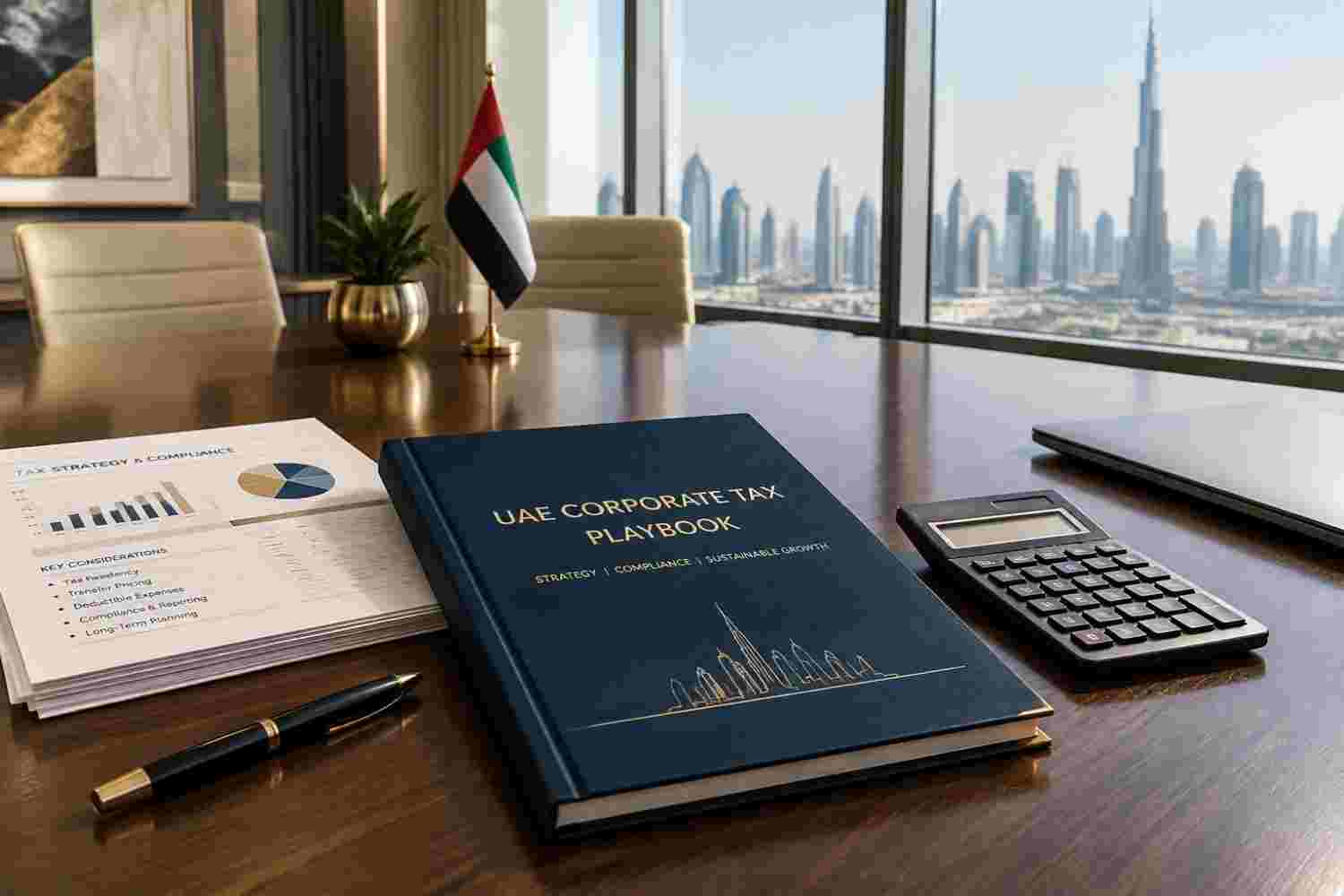
Every business leader in the UAE now answers to a new line on the profit and loss statement. It is small next to the tax lines in many other countries, but it brings a set of duties that need an owner, a calendar and a budget. Companies that treat it as a finance project run by one person tend to feel the pinch at filing time.
This playbook is written for owners, CEOs and finance heads who want the full picture without the legal jargon. It covers the numbers, the decisions that matter most and a 90-day plan you can hand to your team.
The rate is modest, so the risk is rarely the tax bill itself. The real exposure sits in the process around it. A missed registration, a free zone assumption that does not hold or an undocumented intercompany charge can cost more than the tax on a year of ordinary profit.
There is a positive side too. A clear tax position makes due diligence smoother, supports lender conversations and signals that the business is run with care. Investors and banks notice when the paperwork is in order.
Take a company with AED 2,000,000 in taxable profit. The first AED 375,000 sits at 0%, and the remaining AED 1,625,000 is taxed at 9%, which gives AED 146,250. That is the baseline before any credits, adjustments or reliefs.
Taxable profit starts from financial statements prepared under internationally accepted accounting standards. Understanding how that number is built is the first job of any finance lead. A good guide from one of the corporate tax consultants in UAE can help your team map accounting profit to taxable profit and spot the adjustments that apply to your sector.
The corporate tax consultants in UAE you choose should be able to explain each step of that mapping in plain language. If they cannot, keep looking.
Free zone companies that meet the Qualifying Free Zone Person conditions can apply 0% to qualifying income. The conditions include real substance in the zone, audited financial statements, transfer pricing compliance and a limit on non-qualifying revenue. Income outside the qualifying definition is taxed at 9%.
Mainland companies follow the standard regime. If your group holds both kinds of entity, map each income stream and decide where it belongs. Moving activity between entities for tax reasons needs a sound business purpose, because the anti-abuse rules look at substance, not labels.
Resident businesses with revenue of AED 3 million or less can elect Small Business Relief and be treated as having no taxable income for a period. The election is made in the return, it does not replace registration and filing, and it is tied to revenue, not profit. The availability period has been extended, so confirm the current end date with the Federal Tax Authority before you plan around it.
For growing businesses the decision can be tactical. A company close to the revenue line should look at when its income arrives and whether it will lose access to the relief in the next period.
Transactions with related parties must be priced as if the parties were independent, and the paperwork follows the OECD Transfer Pricing Guidelines. Management fees, intercompany loans, shared staff and licences of brands or software are the common items. Each one needs an agreement and a short note on how the price was set.
Leaders sometimes assume this only affects large groups. In reality, even a two-company structure with a shared director has related-party deals. Build the habit while the volume is small.
Companies under common ownership can register as a tax group and be taxed as one unit. Losses can be used across members, and the number of returns shrinks. Dividends and capital gains are generally outside the tax base, subject to conditions, which supports holding structures, and no withholding tax is imposed.
The right choice depends on where profits and losses sit, and a short modelling exercise will show it. Run that before you reorganise anything.
Good tax outcomes come from boring routines. Close the books every month, reconcile bank accounts, keep contracts and invoices in one place and have someone review related-party entries each quarter. Assign a named owner for the registration, the filing calendar and the records.
Fines and penalties are not deductible, entertainment spending is only partly deductible and interest deductions are limited. Brief your team on these points so that coding errors do not creep into the return.
Your 90-day plan
|
Window |
Focus |
Output |
|
Days 1 to 30 |
Registration, financial year end, roles |
Confirmed registration, named owner, calendar |
|
Days 31 to 60 |
Accounts, free zone check, related-party list |
Clean books, income map, deal register |
|
Days 61 to 90 |
Pricing files, relief decision, draft computation |
Agreements, election decision, first draft |
Many leadership teams bring in a tax and VAT advisor in UAE for the first cycle so that registration, computation and filing are handled by people who do them every day. Ask for a written scope, a timeline and the list of documents they need from you. It is also worth asking how they handle queries from the authority after filing.
Keep ownership of decisions inside the business. An advisor can model options and prepare the return, but your board still decides the structure.
Submit guest articles that reach decision-makers, influencers, and professionals. Yarabook offers a trusted platform for quality content, strong backlinks, and SEO-driven visibility. Pay. Publish. Promote.