

Big business decisions are happening every day 🤩
→ What should we launch next?
→ Will demand go up or down?
→ How will customers react?
Most business owners still depend on guesswork or past data to answer these.
That’s where prediction platforms come in, helping businesses use collective opinions to understand what’s likely to happen next.
👉 So how do businesses actually benefit from building prediction platforms?
In this blog, we’ll break down the key advantages in a simple way.
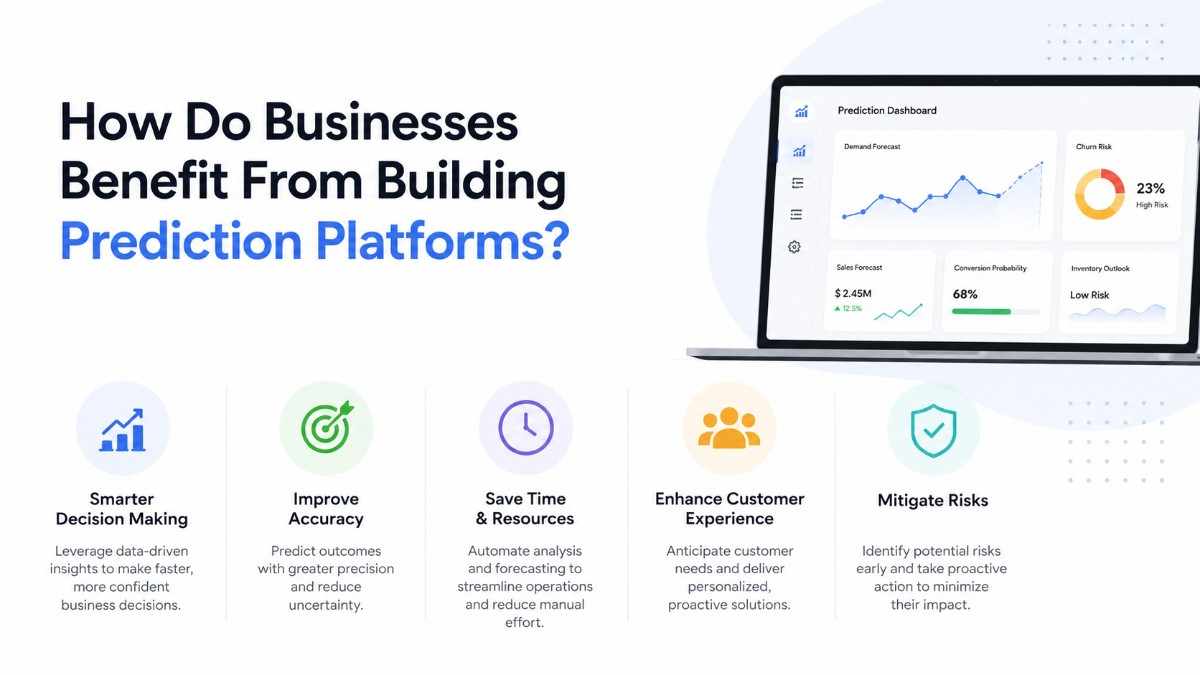
Businesses benefit from prediction platforms in several clear and practical ways. Instead of depending only on internal reports or past data, they can use collective input from users, employees, or communities to understand what is likely to happen next.
This creates a more dynamic way of decision-making where businesses are no longer guessing in isolation but learning from real-time collective intelligence.
Prediction platforms can generate income through transaction fees, premium insights, participation fees, or data analytics products. Similar to exchange-style systems, every interaction on the platform can become a potential revenue stream. Over time, this can evolve into a strong digital business model that scales with user activity.
Prediction platforms like internal forecasting systems or market-based tools help business owners make faster and more confident decisions by turning opinions into measurable signals. Instead of relying only on reports or assumptions, leaders can see what the “crowd probability” suggests and act accordingly.
This reduces uncertainty in strategic decisions such as pricing, expansion, and product launches.
Businesses can better predict product demand, customer preferences, and seasonal trends. This is similar to how retail and e-commerce platforms test market interest before launching new products.
For example, a business can understand whether a product idea is likely to succeed even before production begins, saving both time and cost.
By tracking crowd expectations, companies can identify risks early. Whether it is a new product failing, a marketing campaign underperforming, or a market shift happening, prediction platforms help businesses react faster and reduce potential losses.
This makes business planning more proactive instead of reactive.
Tools like enterprise forecasting platforms or internal prediction systems help leadership teams plan resources, supply chains, hiring, and expansion strategies more accurately.
When decisions are backed by collective forecasting data, businesses can reduce inefficiencies and improve long-term planning outcomes.
Gamified prediction systems encourage participation from users, employees, or communities. This creates active engagement, stronger retention, and continuous feedback loops.
Over time, the platform becomes not just a forecasting tool but an interactive ecosystem where users return regularly to participate and share insights.
Prediction platforms are not just theory — they can be used in real business situations to make better decisions across different areas.
Businesses can use prediction platforms to understand which product ideas customers are more likely to buy. For example, a fashion brand can test new designs before production and reduce the risk of failed launches.
Companies like supermarkets or online stores can predict which products will be in high demand during festivals or weekends. This helps in better stock planning and avoids overstock or shortages.
Sales teams can use prediction platforms to estimate deal closures or revenue outcomes more accurately instead of relying only on pipeline assumptions.
Delivery companies can predict high demand areas and time periods, helping them optimize staffing, routes, and delivery efficiency. This leads to better resource utilization and reduced operational costs.
Large companies can use internal prediction markets to gather employee insights on business decisions, project outcomes, or strategic moves. This helps leadership teams make more balanced and informed choices.
Building a prediction market platform needs clear planning from the start.
Businesses should first define why they want a prediction platform. It could be for better forecasting, improving decision-making, or creating a new revenue stream. A clear goal helps shape the entire product.
Not every business needs the same type of prediction market. Some may use it for product demand forecasting, while others may focus on employee insights or market trends. Choosing the right use case is important for success.
If the platform is too complex, users will not participate. Businesses should keep the system simple and easy to understand, even for non-technical users.
A prediction market is only useful when outcomes are clear and trustworthy. Businesses should define proper rules for how predictions are settled and validated.
As usage grows, the platform must handle more users and real-time activity without slowing down. Scalable architecture is important from the beginning.
Experienced teams like Hashcodex help build scalable, real-time prediction platforms faster while ensuring strong architecture, reliability, and performance.
Prediction market platforms are becoming a powerful tool for modern businesses. They help turn opinions into real insights, improve forecasting, and support faster, more confident decision-making.
From understanding customer demand to reducing business risks, these platforms offer practical value across many areas. They also create opportunities for engagement and new revenue models, making them useful beyond just forecasting.
In simple terms, businesses that start exploring prediction platforms today can stay ahead of uncertainty and make smarter decisions for the future.
Submit guest articles that reach decision-makers, influencers, and professionals. Yarabook offers a trusted platform for quality content, strong backlinks, and SEO-driven visibility. Pay. Publish. Promote.