

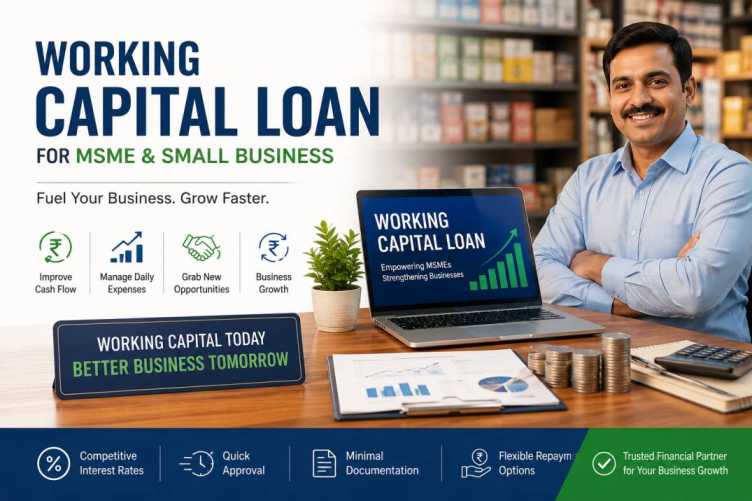
Micro, Small, and Medium Enterprises (MSMEs) play an important role in India’s economy. From manufacturers and wholesalers to retailers, service providers, traders, and technology companies, MSMEs operate across almost every sector.
However, maintaining adequate working capital remains one of the biggest challenges for many growing businesses.
A company may have strong sales and profitable operations but still experience cash-flow pressure because customers pay after 30, 60, or 90 days while suppliers, employees, utilities, rent, taxes, and other expenses must be paid much sooner.
This is where a working capital loan for MSME can become an important financing option.
A working capital loan can provide short-term funds to help an MSME manage day-to-day business expenses, bridge temporary cash-flow gaps, purchase inventory, pay suppliers, fulfill customer orders, and maintain operational continuity.
Unlike long-term business loans that are generally used for assets such as property, machinery, or major infrastructure, working capital financing is primarily designed to support the ongoing operating cycle of a business.
This comprehensive guide explains what a working capital loan for MSME is, how it works, why businesses need it, eligibility factors, documentation, benefits, costs, types of working capital facilities, application considerations, and strategies for using working capital efficiently.
A working capital loan for MSME is a financing facility designed to provide businesses with funds for their short-term operating requirements.
Working capital is generally associated with the funds required to run the everyday activities of a business.
A simplified calculation is:
Working Capital = Current Assets − Current Liabilities
Current assets may include:
Current liabilities may include:
When a business does not have enough readily available funds to cover its operating cycle, working capital financing can help bridge the gap.
MSMEs often operate with relatively limited financial reserves compared with larger corporations.
At the same time, they may face several cash-flow challenges:
For example, a distributor may purchase inventory today but sell it over the next several weeks. If customers purchase on credit, the distributor may not receive payment for another 30 or 60 days.
The business therefore needs capital to finance the period between purchasing inventory and collecting customer payments.
A working capital loan for MSME can potentially help finance this operating cycle.
The exact process depends on the lender and financing product, but the general process usually involves several stages.
The business first determines why additional funds are needed.
Common requirements include:
The lender may review the business’s financial performance and cash-flow position.
This can include:
Based on the business’s financial position and the lender’s criteria, a financing limit may be established.
The amount can vary significantly depending on:
After the lender completes its assessment, the business may receive a sanction or financing offer subject to applicable conditions.
Once the required documentation and conditions are completed, the funds can be made available according to the loan structure.
Repayment depends on the type of working capital facility.
Some facilities have fixed repayment schedules, while others may operate as revolving limits where the borrower can draw and repay funds according to the agreed terms.
There is no single type of working capital financing.
Different businesses may require different structures.
A working capital term loan provides a specific amount for business operating requirements.
The borrower generally repays the loan through scheduled installments.
This can be suitable when an MSME has a clearly defined short-term funding requirement.
Cash credit is a commonly used working capital facility where the business can draw funds up to an approved limit, subject to the lender’s terms and security requirements.
The borrowing base may be linked to eligible inventory and receivables.
This structure can provide flexibility because businesses can use funds when required rather than taking the entire amount at once.
An overdraft facility allows a business to withdraw funds beyond the available bank balance up to an approved limit.
Interest is generally calculated based on the amount utilized rather than the entire sanctioned limit, subject to the specific terms.
An overdraft can be useful for short-term cash-flow fluctuations.
Invoice financing allows a business to access funds against eligible outstanding invoices.
This can be useful for MSMEs that have strong sales but must wait for customers to make payments.
Under receivables financing, accounts receivable can support a financing facility.
This may help businesses unlock working capital tied up in unpaid customer invoices.
Bill discounting allows businesses to obtain funds against eligible bills or invoices before their maturity.
The financing provider deducts applicable charges and provides the business with funds earlier.
Some businesses need funds to fulfill a confirmed purchase order.
Purchase order financing can potentially provide funding to cover costs associated with fulfilling eligible orders, subject to lender criteria.
Trade finance facilities can help businesses manage transactions involving suppliers, buyers, imports, exports, and other commercial activities.
The exact facility may include instruments such as letters of credit, bank guarantees, or other trade-related financing.
The primary purpose of working capital financing is to provide liquidity when operating cash is temporarily insufficient.
A business can use the funds to manage expenses while waiting for customer payments.
An MSME may need to pay:
Working capital financing can help manage these short-term requirements when cash flow is tight.
Retailers, manufacturers, wholesalers, and distributors may need to purchase inventory before receiving customer payments.
A working capital facility can help businesses maintain adequate stock levels.
A company may receive a large order but lack sufficient cash to purchase raw materials or inventory.
Working capital financing can potentially help bridge this operational gap.
Business expansion requires more than investment in long-term assets.
A growing business may also need additional funds for:
Working capital financing can support these ongoing requirements.
Some businesses generate a significant portion of annual revenue during particular seasons.
For example, retailers may need additional inventory before major festivals or seasonal sales.
A working capital loan can potentially help finance the temporary increase in operating requirements.
Paying suppliers on time can be important for maintaining reliable supply chains.
Adequate working capital can help MSMEs meet supplier obligations even when customer collections are delayed.
A revolving working capital facility can provide access to funds when needed, depending on the terms.
This can be particularly useful when cash requirements fluctuate throughout the month.
A working capital loan for MSME can play an important role in maintaining liquidity and supporting business operations.
For MSMEs, the challenge is often not a lack of sales but a mismatch between the timing of expenses and customer payments. Inventory must be purchased, employees must be paid, suppliers must be managed, and operating expenses must be covered before every customer invoice is collected.
Working capital financing can help bridge this timing gap.
When used responsibly, it can help businesses:
However, financing should always be aligned with the company’s actual cash-flow requirements and repayment capacity.
Before choosing a working capital loan for MSME, compare the interest rate, total financing cost, repayment terms, collateral requirements, fees, flexibility, and lender conditions.
The best financing strategy is one that provides enough liquidity to support growth without creating unnecessary debt pressure.
For MSMEs looking to grow sustainably, effective working capital management combined with appropriately structured financing can create a stronger foundation for long-term business success.
Submit guest articles that reach decision-makers, influencers, and professionals. Yarabook offers a trusted platform for quality content, strong backlinks, and SEO-driven visibility. Pay. Publish. Promote.