

Learning objectives give direction to every educational experience. They tell learners what they should achieve and help educators decide how to teach and assess a topic. However, objectives can be difficult to measure when they use vague words such as “know,” “understand,” or “learn.” Bloom’s Taxonomy verbs provide a practical solution by turning general goals into clear, observable actions.
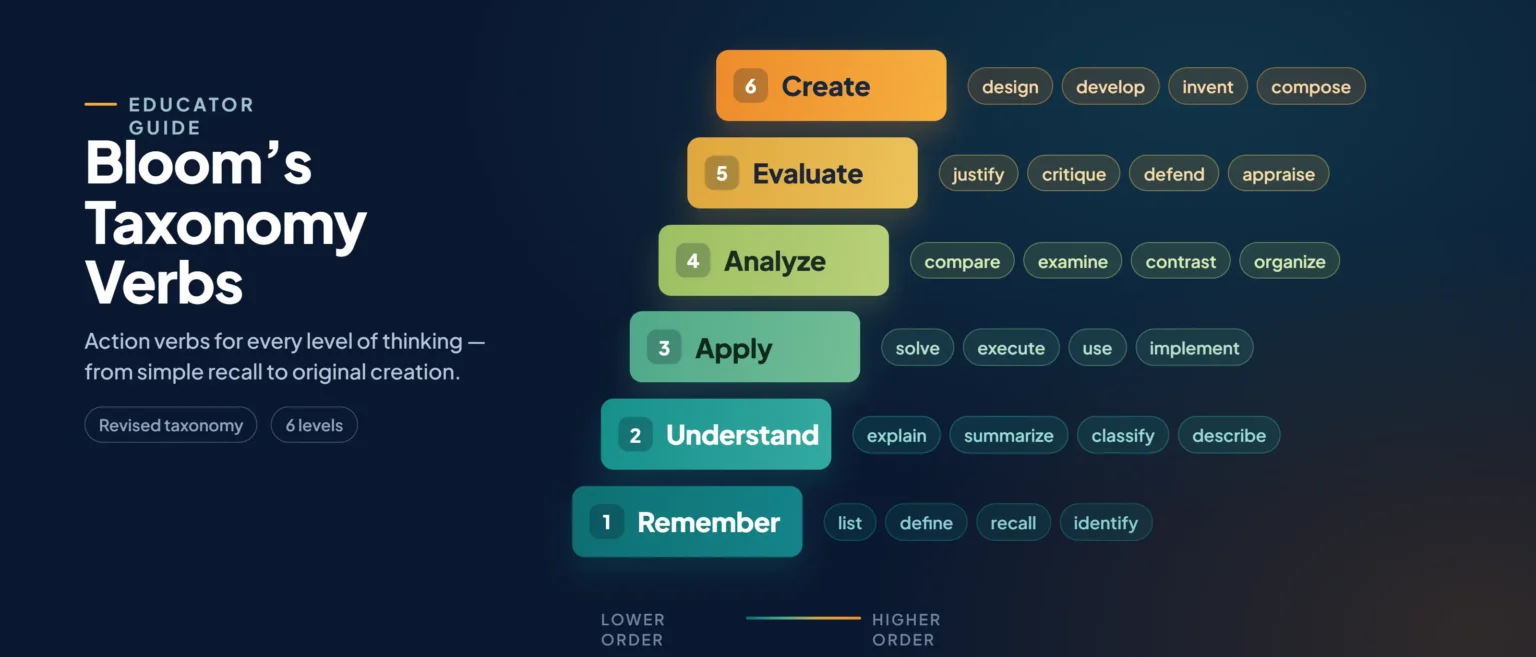
Bloom’s Taxonomy is a framework that organizes learning. The version has six stages: Remember, Understand, Apply, Analyze, Evaluate, and Create.
For teachers, instructional designers, trainers, and eLearning developers, these levels can help create learning objectives that are easier to teach and measure.
Remember is the foundation of learning. At this stage, learners recall facts, terms, definitions, and basic information. Useful verbs include define, identify, list, name, recall, recognize, select, and state.
For example: “Learners will identify the main stages of the water cycle.” This objective can be measured through a quiz or short activity.
Understanding goes beyond simply remembering information. Learners should be able to explain an idea, summarize information, or interpret a concept in their own words.
Common verbs include explain, describe, summarize, compare, classify, interpret, illustrate, and paraphrase.
For example: “Learners will explain how evaporation contributes to the water cycle.” This shows that the learner can communicate the concept rather than simply recall its definition.
The Apply level focuses on using previously learned information in a practical situation. It is useful when learners need to demonstrate a skill or solve a problem.
Helpful verbs include apply, use, solve, demonstrate, calculate, implement, operate, and modify.
An objective might state: “Learners will apply the correct formula to solve practical problems.” The assessment can then require learners to use the formula independently.
Analysis requires learners to break information into parts and explore relationships between those parts. This level encourages deeper thinking and helps learners understand how different elements are connected.
Useful verbs include analyze, examine, differentiate, categorize, contrast, investigate, organize, and distinguish.
For example: “Learners will analyze two business strategies and identify their key differences.” This can be assessed through a case study or comparison task.
At the Evaluate level, learners use evidence, standards, or criteria to make judgments. They are expected to support their conclusions rather than simply state an opinion.
Common verbs include evaluate, assess, justify, critique, defend, recommend, judge, and prioritize.
For instance: “Learners will evaluate two proposed solutions and justify the most suitable option.” This encourages critical thinking and evidence-based decision-making.
Create is the highest level in the revised taxonomy. Learners combine their knowledge and skills to develop something original, such as a plan, product, design, or solution.
Useful verbs include create, design, develop, formulate, construct, generate, propose, compose, and invent.
An example is: “Learners will design an online activity that teaches a selected concept to beginners.” The learner must use existing knowledge to produce a new outcome.
The right action verb makes a learning objective observable and measurable. Instead of saying that learners will “understand digital marketing,” an educator could state that learners will “analyze a company’s digital marketing strategy.” The second objective clearly identifies the expected performance.
These verbs also help align objectives, learning activities, and assessments. If an objective asks learners to analyze information, the related activity and assessment should give them an opportunity to perform analysis. This creates a more consistent learning experience.
Bloom’s Taxonomy is useful when developing online courses, interactive lessons, assessments, and corporate training programs. An eLearning course can introduce a concept at the Remember level, ask learners to explain it at the Understand level, and then provide scenarios where they apply or analyze their knowledge.
Higher-level activities can include simulations, case studies, problem-solving exercises, projects, and scenario-based questions. These approaches encourage learners to use knowledge rather than simply memorize content.
Start with one clear action verb for each objective. Choose the verb according to the type of thinking you want learners to demonstrate. Avoid vague terms such as “know,” “learn,” “understand,” and “be aware of” when they cannot be directly assessed.
It is also important to match the difficulty of the assessment with the objective. A higher-order objective should not be measured only through a basic recall question. Keeping objectives, activities, and assessments aligned can make learning more purposeful.
Bloom’s Taxonomy verbs offer a simple way to create stronger learning objectives. By selecting precise verbs across Remember, Understand, Apply, Analyze, Evaluate, and Create, educators and instructional designers can define learner expectations more clearly and build measurable outcomes.
For a detailed reference with action verbs organized by each level, explore the complete Bloom’s Taxonomy verbs guide from GravEiens. It can be useful when planning lessons, developing eLearning content, or designing effective assessments.
Submit guest articles that reach decision-makers, influencers, and professionals. Yarabook offers a trusted platform for quality content, strong backlinks, and SEO-driven visibility. Pay. Publish. Promote.