

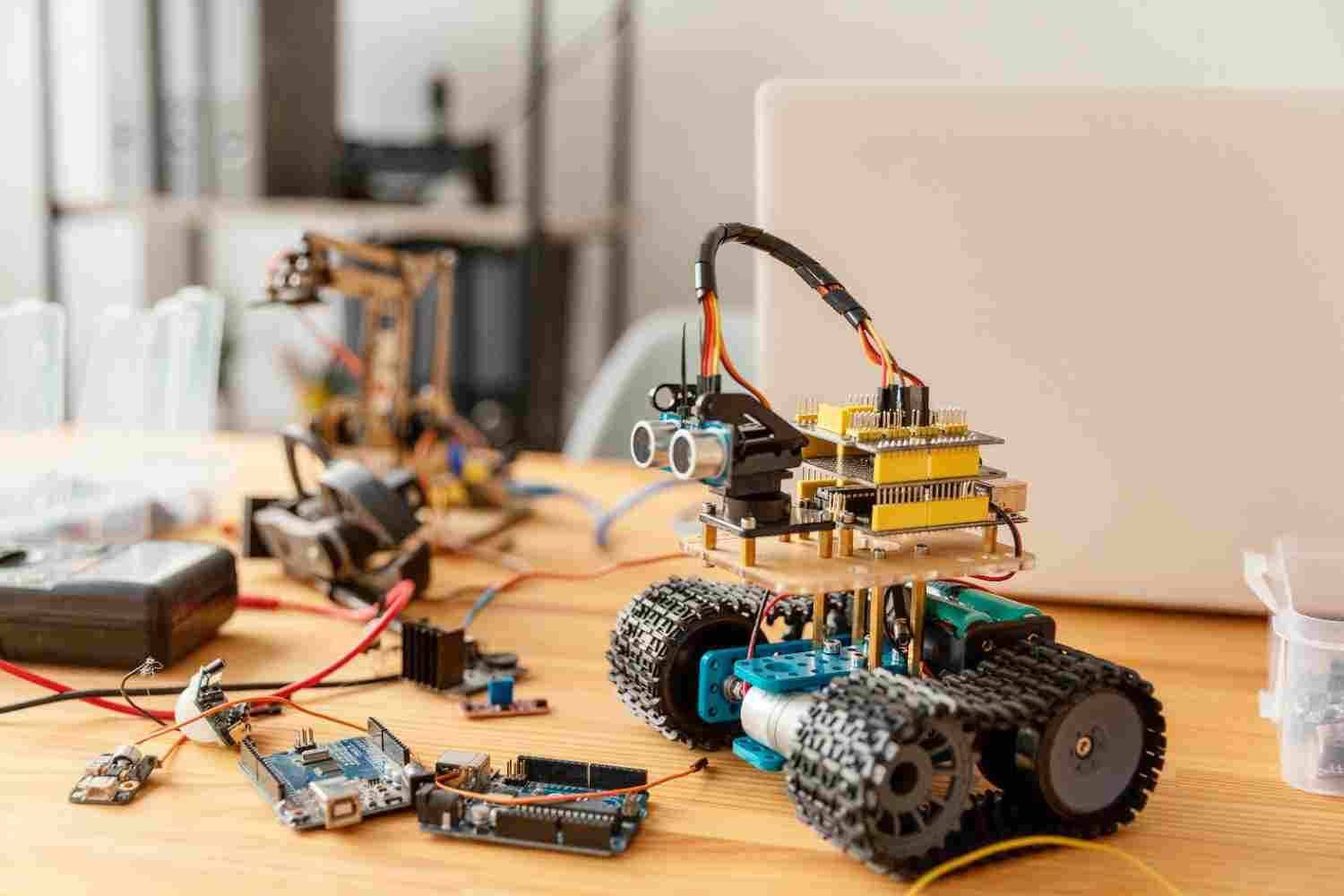
Robotics and artificial intelligence are transforming the way industries design, manufacture, deliver services and solve complex problems. From automated production lines and autonomous vehicles to intelligent healthcare systems and smart infrastructure, robotics is increasingly connected with AI-driven decision-making. For students interested in technology, this creates an exciting opportunity to build a career at the intersection of robotics, artificial intelligence, automation and programming.
At Guru Kashi University, the Bachelor of Vocational in Robotics and Artificial Intelligence is designed around this intersection. The three-year graduate programme combines robotics engineering concepts with intelligent system design and introduces learners to areas such as automation, sensors, actuators, embedded systems and AI-powered robotics.
A degree in robotics engineering prepares students to understand how machines can sense their surroundings, process information, make decisions and perform physical tasks. Unlike a conventional programme focused on a single engineering discipline, robotics draws knowledge from mechanical engineering, electronics, electrical systems, computer programming, control systems and artificial intelligence.
Modern robotics also depends heavily on software. A robot may have sophisticated mechanical components, but its usefulness depends on the ability to interpret sensor information, execute instructions, respond to changing conditions and interact with other systems.
This makes robotics education particularly relevant for students who want careers involving AI, automation and intelligent machines.
Traditional automation generally follows predetermined instructions. AI introduces another layer by enabling systems to analyse information, recognise patterns and support more adaptive behaviour.
Consider a manufacturing robot. Basic automation may instruct the machine to move an object from one location to another. An AI-enabled robotic system can potentially use cameras or other sensors to identify objects, interpret their position and select an appropriate response.
The same principle can be applied across sectors. Robotics and AI are increasingly relevant to manufacturing, healthcare, defence, logistics, agriculture, drones and smart-city technologies. Guru Kashi University’s programme specifically identifies these areas as part of the wider context for the growing demand for professionals capable of integrating AI with automation.
A strong robotics education needs to go beyond theoretical concepts. Students need to understand how individual components work together to create a functioning robotic system.
The B.Voc in Robotics and Artificial Intelligence at Guru Kashi University covers several practical and technical areas.
Students develop an understanding of robotic design, control and automation. These concepts establish the foundation for understanding how robots are constructed, controlled and used in real-world applications.
AI becomes particularly valuable when robotic systems need to respond intelligently to information. Students are introduced to the application of AI algorithms for intelligent robotic behaviour, providing a foundation for further learning in intelligent automation.
Programming is an essential part of modern robotics. The programme identifies Python, C++ and ROS among the technologies and programming environments students work with. These skills can support the development and control of robotic applications.
A robot needs to sense and interact with its environment. Sensors provide information, actuators enable physical movement, and control systems coordinate operations. Understanding these components helps students approach robotics as an integrated engineering discipline rather than simply as computer programming.
Simulation can provide a controlled environment for developing and testing robotic systems. Guru Kashi University’s programme includes exposure to MATLAB, Gazebo and robotic simulation platforms, helping students understand how robotic behaviour can be modelled and evaluated.
One of the defining characteristics of robotics education is the relationship between theory and application. Knowing how a sensor works is useful; understanding how to integrate that sensor into an autonomous system is considerably more valuable.
Students therefore benefit from approaching learning through projects, experiments, simulations and prototypes. A project might involve programming a robot to follow a defined path, developing a sensor-based response system, creating an automated mechanism or experimenting with AI-based recognition.
This project-oriented approach can also help students develop problem-solving, debugging, teamwork and technical communication skills—abilities that remain important regardless of the specific robotics career eventually chosen.
A robotics qualification can lead to several technology-oriented career paths. The exact role depends on a graduate’s technical strengths, project experience and additional specialisation.
Potential career directions include:
These roles reflect the multidisciplinary nature of robotics. Some professionals may focus more heavily on mechanical and control systems, while others may specialise in programming, AI, computer vision, automation or research.
Students sometimes view robotics and artificial intelligence as separate fields. In practice, they can complement each other closely.
AI provides computational intelligence, while robotics provides a physical platform through which that intelligence can be applied. A robotic system can use sensors to gather information, software to process it and actuators to respond to the environment.
For a student interested in AI careers, learning robotics can therefore provide a broader understanding of how intelligent systems operate beyond software alone.
Students can strengthen this pathway by developing skills in Python programming, machine learning fundamentals, computer vision, data handling, robotics operating systems, control systems and embedded technologies.
Robotics can suit students who enjoy combining technology with practical problem-solving. It is particularly relevant for learners interested in:
At Guru Kashi University, eligibility for the B.Voc in Robotics and Artificial Intelligence includes 10+2, with Physics, Mathematics or Computer Science preferred, alongside a stated minimum aggregate range of 45–50%. Technical aptitude and an interest in robotics are also identified as desirable.
Students should always verify the current admission requirements before applying, as eligibility conditions can change.
Automation is changing the nature of many technical occupations rather than simply replacing individual tasks. As organisations introduce increasingly sophisticated automated systems, there is a corresponding need for people who can design, configure, operate, maintain, improve and integrate those systems.
This creates opportunities for professionals who understand both technology and application.
The future of robotics is also unlikely to be limited to traditional factory environments. Intelligent machines can contribute to healthcare, agriculture, logistics, infrastructure, security, transportation and other specialised applications. This broadening application landscape makes multidisciplinary technical education increasingly relevant.
Robotics is not only a route into employment. It can also provide a foundation for research and entrepreneurship.
Students can identify real-world problems and explore whether automation or intelligent machines can provide practical solutions. A relatively simple prototype can become the starting point for a more advanced research project, product or technology venture.
Guru Kashi University’s stated programme outcomes include innovation and research, including prototype development and applied research, as well as entrepreneurship skills aimed at encouraging start-ups in automation and robotics.
This aspect can be particularly valuable for students who want to move beyond conventional employment and explore technology-led innovation.
When comparing robotics courses, prospective students should look beyond the programme title. Important considerations include the curriculum, programming exposure, robotics laboratories, simulation tools, practical projects, industry exposure, research opportunities and the scope for developing interdisciplinary skills.
A programme should provide a logical progression from fundamentals to application.
At Guru Kashi University, the B.Voc in Robotics and Artificial Intelligence is structured as a three-year graduate programme and includes robotics fundamentals, AI integration, programming, mechatronics, simulation, industrial applications, innovation and entrepreneurship among its stated outcomes.
A degree in robotics engineering can provide a strong foundation for students who want to work with intelligent machines and automation. By bringing together programming, sensors, actuators, control systems, simulation, robotics and artificial intelligence, the field offers multiple routes into emerging technology careers.
The B.Voc in Robotics and Artificial Intelligence at Guru Kashi University provides a three-year pathway covering these interconnected areas, with stated career options ranging from robotics and automation to AI robotics development, drone technology and research.
For students planning their future in AI, the most important step is to develop the ability to turn ideas into working systems. Robotics provides an opportunity to do exactly that—combining engineering knowledge, software skills and artificial intelligence to build technologies designed for the real world.
Explore the Bachelor of Vocational in Robotics and Artificial Intelligence programme at Guru Kashi University and review the current eligibility and admission information before making your academic decision.
Submit guest articles that reach decision-makers, influencers, and professionals. Yarabook offers a trusted platform for quality content, strong backlinks, and SEO-driven visibility. Pay. Publish. Promote.