

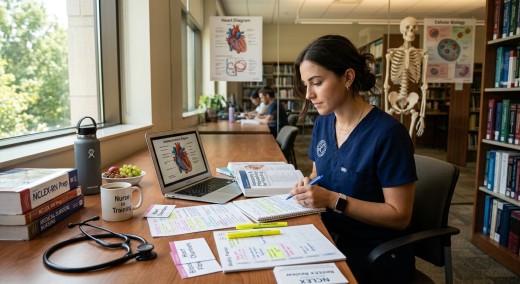
How to Get Better Grades in Nursing School Without Burnout is a detailed guide that shows you the steps you can take to enhance your scores in nursing school.
Nursing school is a very rewarding educational career but also one of the most challenging educational careers. Students learn the intricate medical challenges, have to pass difficult examinations, undergo demanding clinical rotations and assume the duties of a student. So, it is not unexpected that a significant number of nursing students suffer from stress, exhaustion and loss of academic performance.
Thankfully, there’s no need to compromise on your health or hours of studying to make better grades. Effective study habits, use of time and maintaining a balance in school and personal life is what helps you to achieve success in nursing school.
From beginning to end of your nursing career, or even while you’re in the midst of a nursing program such as Capella RN To BSN, these are simple strategies to help you excel without burning out.
A lot of nursing students think that they will get higher grades if they study for 10 or 12 hours a day. In fact, studying for an extended period of time but with little purpose can cause you to lose attention and get weary.
Don’t assess how many hours you spend with your books open, but rather productive study sessions. Spend 45- to 60-minute chunks of learning with the occasional small breaks. This will make the brain able to retain knowledge more effectively and at the same time, avoid brain exhaustion.
It is probably better to study a little each day, than to study the entire day, just one day.
One of the top factors for achieving success in nursing school is organization. Cram sessions typically cause stress and don’t help you to retain information.
Make a weekly plan for you to include:
Maintain a routine and this helps to remove anxiety as you know what to do each day.
Rereading textbooks is not the best way to obtain knowledge of the concepts of nursing. Rather, interact with the material or by actively participating.
There are some proven techniques such as:
So the more you’re getting active learning, it is encouraging your brain to think, but it’s not recognizing.
Nursing exams are not a test of recall! It is important to be familiar with the definitions, as this will be useful in simple quizzes, but not in full exams.
When learning about a disease or procedure:
If you have an idea of what you are doing, then you will be more confident if you come across some questions that you don’t recognize in the examination.
The main reason is due to the lack of time management. Students frequently postpone the study until it is necessary for them.
We have a lot of little things that make a big difference:
Little and regular tasks help to avoid last minute panic and will enhance long term learning.
It is the key nursing students who do well who spend more time solving practical problems than reading their books.
Practice questions will provide you with the opportunity to:
Carefully consider both correct and incorrect answers to each question after giving it your answer. It is important to learn the reasons an answer is wrong, as well as the reasons it is right!
There are many times when it has been shown that reviewing the new information immediately after learning it is an important part of learning.
In 24 hours review lectures spending 30-20 minutes per 2-3 hours of lectures. Provide emphasis, rephrase confusing passages and make links to previous lessons.
This little habit will have a positive effect on the amount of study needed prior to the exams.
Successful students of nursing do not only have to be motivated, but they have regular routines as well.
Helpful habits include:
Practice helps to make progress and makes a study less daunting.
Your brain will work best when your entire body is healthy. Putting off your health demands and needs can have the effect of reducing your academic achievement.
Prioritize:
Walking, even a 20-minute walk, will increase concentration, memory and stress management skills.
Each student who has undertaken nursing studies is unique and learns in his or her own way. It appears that some of the other classes are somehow different from the rest – one gets it immediately, another needs to be reviewed.
This can be achieved through making comparisons with others and can be demoralizing.
Rather, make comparisons between what you are doing now, and what you did before. Be happy about any improvement, no matter how small it may seem.
Learning is a personal affair.
Burnout is an experience that doesn’t occur in a single instant. It typically takes time to build up and is caused by repeated stress and lack of rest.
You might well have the following:
Don’t delay when these symptoms occur. Take back time, get together with friends, participate in relaxation activities and simply forget about studying all night.
Taking breaks is not a waste of time, it’s a way of maintaining productivity over a longer period of time.
Your professors are wonderful outside of class!
Do not hesitate to:
Faculty will have the ability to provide insights which textbooks will not.
Good communication skills also demonstrate good professionalism, an important aspect of nursing work.
In such cases, where students are feeling the pressure, and deadlines are looming, students may seek advice they can obtain from online sources. There could be offers for you to Buy Coursework or you might also have Coursework submitted for you.
These services may be tempting for some at times of stress, but they can be a violation of academic integrity policies and may also limit the opportunity to learn a nursing skill and/or develop critical thinking skills. In the field of nursing education, it’s far more important than getting quick answers to know clinical information skills that will help them to make informed decisions in the real world, decisions that will affect patient safety.
Ask for assistance in the form of tutoring, feedback from instructors, writing centers or study groups, but not anything that will hurt your educational process.
With a good plan of action, it’s possible to raise your grades in nursing school without becoming exhausted. Good study skills, effective learning strategies, time management and healthy lifestyle habits provide a solid basis for success in school. Don’t study longer, study smarter, review, think critically and ask for assistance when needed.
No matter if you are starting your nursing degree studies or going further in your career with a degree such as Capella RN to BSN, it is important to remember that a successful career is balanced. Maintain their physical well-being and mental well-being, be honest with their learning and don’t take shortcuts such as purchasing coursework that could impact their learning. You can use positive behaviors now to not only be successful in your schoolwork but also to have the knowledge, confidence and resilience necessary to be successful and have a rewarding nursing career.
Submit guest articles that reach decision-makers, influencers, and professionals. Yarabook offers a trusted platform for quality content, strong backlinks, and SEO-driven visibility. Pay. Publish. Promote.