

The term submissive meaning is widely searched by people looking to understand its definition, origin, and correct usage. While the word submissive is often associated with personality traits and relationships, its meaning extends to various contexts, including workplaces, education, psychology, and animal behavior.
Understanding the submissive meaning can help improve your English vocabulary and ensure you use the word appropriately in everyday conversations. In this article, we’ll explore its definition, origin, synonyms, antonyms, and practical examples.
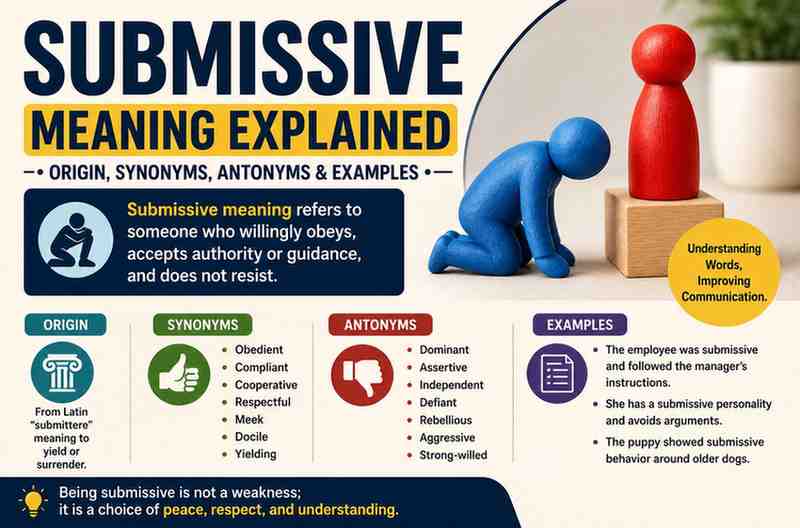
The submissive meaning refers to a person or behavior that willingly obeys, accepts guidance, or yields to the authority or wishes of another without resistance.
A submissive individual often:
It’s important to understand that being submissive does not always indicate weakness. In many situations, it simply reflects a respectful, cooperative, or peaceful attitude.
The word submissive originates from the Latin word submittere, meaning “to place under,” “yield,” or “let down.” It later entered English through Old French and has been used for centuries to describe someone who willingly accepts authority or direction.
Today, the word is commonly used in literature, psychology, education, workplaces, and everyday English.
The submissive meaning can vary depending on the situation in which it is used.
A submissive personality generally describes someone who is gentle, cooperative, and less likely to engage in confrontation.
Example:
She remained submissive during the meeting and listened carefully to everyone’s opinions.
In professional settings, a submissive employee may prefer following instructions and maintaining harmony within the team.
Example:
He accepted his manager’s feedback with a submissive and respectful attitude.
In relationships, the term may describe someone who willingly allows their partner to take the lead in certain decisions. Healthy relationships are built on mutual trust, communication, and respect, regardless of individual personalities.
Teachers may describe students as submissive when they are disciplined, respectful, and willing to follow classroom rules.
The word is also frequently used in animal studies to describe behavior that avoids aggression or conflict within a social group.
Example:
The younger dog displayed submissive behavior around the older dog.
Several words share a similar meaning with submissive.
Some common synonyms include:
The best synonym depends on the specific context in which the word is used.
Understanding opposite words makes the submissive meaning even clearer.
Common antonyms include:
These words describe individuals who are more likely to lead, challenge authority, or express their opinions openly.
Here are some examples that demonstrate how the word is used in everyday English.
These examples show that the word can describe respectful and cooperative behavior rather than weakness.
One of the biggest misconceptions is that submissive always means weak or powerless. In reality, this isn’t true.
A submissive person may simply choose cooperation instead of confrontation. Likewise, someone can be confident, capable, and independent while still behaving submissively in certain situations.
The meaning always depends on the context.
When using the word submissive, keep these points in mind:
Using the word thoughtfully helps ensure clear and respectful communication.
The submissive meaning refers to someone who willingly obeys, cooperates with, or accepts another person’s authority or guidance without resistance.
It depends on the context. It can describe someone who is respectful, cooperative, and patient, but excessive submissiveness may sometimes be viewed negatively.
Common synonyms include obedient, compliant, cooperative, respectful, yielding, meek, docile, accommodating, and dutiful.
Common antonyms include assertive, dominant, independent, defiant, rebellious, aggressive, and strong-willed.
Yes. A submissive personality generally refers to someone who is calm, cooperative, respectful, and less likely to engage in conflict.
No. The word is also commonly used in workplaces, schools, psychology, literature, animal behavior, and everyday communication.
Understanding the submissive meaning helps you use the word correctly in a variety of situations. Whether you’re learning English, improving your vocabulary, or writing professionally, knowing its definition, origin, synonyms, antonyms, and examples provides a clearer understanding of the term.
By recognizing that the submissive meaning changes depending on context, you can communicate more accurately and avoid common misunderstandings. Whether describing personality traits, workplace behavior, or everyday interactions, the word submissive is best understood through balanced and thoughtful usage.
Submit guest articles that reach decision-makers, influencers, and professionals. Yarabook offers a trusted platform for quality content, strong backlinks, and SEO-driven visibility. Pay. Publish. Promote.