

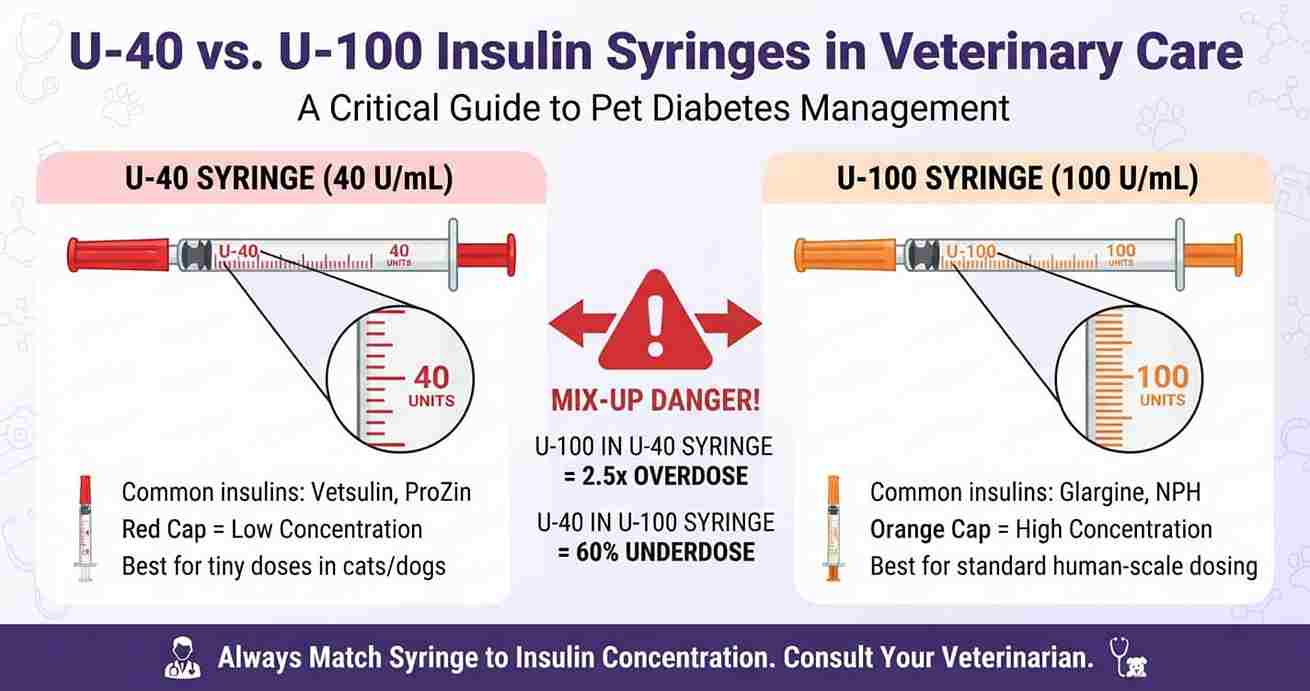
Diabetes management in dogs and cats depends on one detail that trips up even experienced pet owners: insulin concentration. A mismatch between the insulin strength and the syringe scale is one of the most common—and most dangerous medication errors in veterinary practice. This guide breaks down the U-40 vs. U-100 insulin syringe difference in plain language so veterinary teams, vet students, and pet owners can get every dose right, every time.
The “U” number on an insulin syringe refers to units per milliliter (U/mL) the concentration of insulin in the liquid, not the size of the syringe itself.
That means U-100 insulin is 2.5 times more concentrated than U-40. A syringe is calibrated to match one specific concentration, so the markings on a U-40 barrel and a U-100 barrel are not interchangeable, even if the syringes look nearly identical in size.
Dogs and cats typically need very small insulin doses compared to people. Using a lower concentration (U-40) allows for a larger liquid volume per unit, which makes it easier to measure tiny doses accurately with a standard syringe. This is why most veterinary-labeled insulins such as Vetsulin (Caninsulin) and ProZinc are formulated at U-40 strength, while most human insulins, including NPH, glargine, and detemir, are formulated at U-100 strength.
In short: the concentration was chosen for precision, not convenience, and it reflects real differences in canine and feline dosing needs versus human dosing needs.
| Feature | U-40 Syringe | U-100 Syringe |
|---|---|---|
| Concentration match | 40 units/mL insulin | 100 units/mL insulin |
| Cap color (common standard) | Red | Orange |
| Common insulins used with it | Vetsulin, ProZinc | Glargine, NPH, Humulin, Novolin |
| Unit markings on barrel | Fewer, more spread out | More, closer together |
| Typical sizes available | 0.3 mL, 0.5 mL, 1 mL | 0.3 mL, 0.5 mL, 1 mL |
| Best suited for | Small-dose precision in cats/dogs | Standard human-insulin dosing |
The cap-color convention (red for U-40, orange for U-100) is widely used by manufacturers to help prevent mix-ups, but color should never replace reading the label—always confirm the printed “U-40” or “U-100” marking before drawing up a dose.
Because U-40 and U-100 syringes hold the same physical volume but represent different unit totals, the spacing of the lines on the barrel is different:
This means the same visual “fill line” can represent a completely different dose depending on which syringe is in hand. Veterinary staff should always double-check with pet owners that they can correctly read their specific syringe type ideally by having them draw up a sample dose during the appointment, under supervision.
Using the wrong syringe with the wrong insulin concentration causes a dosing error of 2.5 times the intended amount, in one direction or the other:
Both situations are medically significant. Signs of insulin overdose in pets include weakness, disorientation, tremors, and collapse, and require emergency veterinary attention. Underdosing, on the other hand, may not cause an immediate crisis but leads to poor long-term diabetes control and ongoing clinical symptoms.
| Insulin | Concentration | Required Syringe |
|---|---|---|
| Vetsulin (Caninsulin) | U-40 | U-40 |
| ProZinc | U-40 | U-40 |
| Glargine (Lantus) | U-100 | U-100 |
| NPH (Humulin N, Novolin N) | U-100 | U-100 |
| Detemir (Levemir) | U-100 | U-100 |
Veterinarians should clearly document the exact insulin brand and concentration on every prescription label, and reinforce it verbally at dispensing, since many owners are unfamiliar with insulin strength differences when a pet is first diagnosed.
Clinics sometimes face a situation where a client has run out of the correct syringe type. While matching insulin and syringe concentration is always the safest approach, a conversion is possible in a true emergency, using the 2.5x relationship between the two scales. This should only be done under direct veterinary guidance, with the dose recalculated and confirmed by clinical staff—never attempted independently by a pet owner without professional instruction. Clear, written emergency conversion charts, supplied by the clinic, reduce the risk of a miscalculated dose under stress.
Sourcing matters as much as selecting the correct type. Clinics and pet owners should buy insulin syringes only from verified veterinary suppliers to avoid counterfeit, expired, or mislabeled stock. DVM Central is a trusted veterinary products marketplace that stocks both U-40 and U-100 insulin syringes alongside other essential diabetic-care supplies for clinics and pet owners alike. Browsing their Veterinary Supplies section makes it easy to compare syringe sizes, needle gauges, and insulin-matched options in one place, which is especially useful for clinics stocking both concentrations for different patients.
For broader professional context on insulin therapy protocols and diabetic monitoring, the American Animal Hospital Association (AAHA) Diabetes Management Guidelines remain a widely cited clinical reference for practicing veterinarians.
Only with a veterinarian-calculated conversion. Never estimate this on your own, since the risk of a 2.5x dosing error is high.
U-40 allows more precise measurement of the small doses typically needed for cats and dogs.
Check the insulin vial label for “U-40” or “U-100” and match the syringe exactly your veterinarian will specify this on the prescription.
Pricing is generally similar and depends more on syringe size and needle gauge than on the unit scale itself.
Clinics commonly turn to a dedicated veterinary products marketplace to keep consistent, verified stock of both U-40 and U-100 insulin syringes on hand.
Submit guest articles that reach decision-makers, influencers, and professionals. Yarabook offers a trusted platform for quality content, strong backlinks, and SEO-driven visibility. Pay. Publish. Promote.