

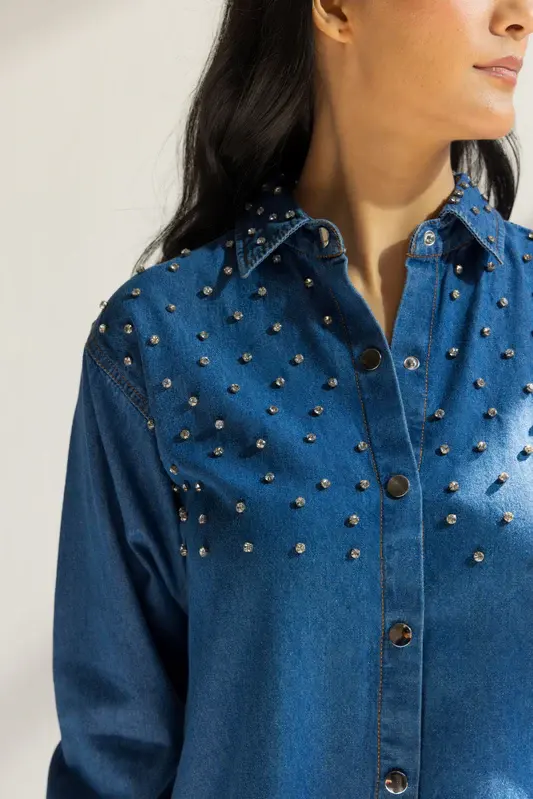
The single biggest reason a denim dress goes unworn after one outing isn’t colour, print, or even price — it’s fit. Denim, more than most fabrics, holds its shape rigidly enough that an ill-fitting cut becomes obvious in a way a flowier fabric might forgive. Understanding which silhouettes work with which proportions turns denim dresses for women from a hit-or-miss purchase into a genuinely reliable wardrobe category.
For a fuller bust or broader shoulder line,
a button-down silhouette with a defined waist seam tends to balance proportions more comfortably than an unstructured shift cut. The vertical line created by the button placket draws the eye downward, while a waist seam — even a subtle one — prevents the dress from reading as boxy across the chest and shoulders. Button-down denim dresses for women specifically tend to perform well here because the front opening can be adjusted to sit comfortably regardless of bust size, unlike a fixed pullover silhouette.
For a smaller frame or petite proportions,
an A-line cut with some flare from the waist down adds visual presence without overwhelming a smaller body. Ankle-length or below-the-knee hems generally work better than full-length silhouettes on petite frames, since extensive fabric length can visually shorten the leg line. A cropped or three-quarter sleeve also helps maintain proportion, where a full long sleeve on a petite frame can read as visually heavy.
For a pear-shaped figure, with more volume through the hip and thigh,
an A-line or fit-and-flare denim dress that skims rather than clings through the hip tends to flatter more reliably than a straight, column silhouette. A defined waist with volume released gradually below it creates a balanced overall line. Darker washes through the hip and thigh area, even within the same dress, can also create a subtly slimming effect compared to lighter, more reflective washes.
For an apple-shaped figure, carrying more volume through the midsection,
an A-line silhouette that skims rather than belts tightly at the natural waist usually photographs and feels more comfortable than a fitted, cinched style. A dress with some structure through the bodice — rather than soft, clingy fabric — holds its shape away from the body slightly, which tends to be more flattering than fabric that follows every contour.
For an hourglass figure,
a fitted, body-conscious denim dress with genuine stretch fibre in the fabric is one of the few body types that can wear this silhouette comfortably across a full day, since the natural waist definition is already present without needing the dress to create it artificially. A button-down style cinched at the waist also works well here, offering structure without restricting the natural shape.
Long denim dresses for women deserve a specific note across all body types: a full-length denim silhouette generally works best with at least a small heel or wedge, since flat shoes paired with a floor-grazing hem can visually shorten the body regardless of actual height. A denim full length dress in particular benefits from a slight front slit or asymmetric hem, which prevents the silhouette from reading as overly heavy on any frame.
The most universally reliable fit indicator, regardless of body type, is how the dress sits at the shoulder seam.
A shoulder seam that sits exactly at the natural shoulder point — not sliding down the arm, not pulling up toward the neck — indicates a correctly sized dress more reliably than waist or hip measurements alone, since shoulder width varies far less with weight fluctuation than other measurements.
Height interacts with body type in ways that are easy to overlook when shopping by silhouette description alone.
A petite hourglass figure and a tall hourglass figure may both suit a fitted, body-conscious silhouette in principle, but the proportional placement of the waist seam, hem length, and even sleeve length needs different calibration between the two. Taller frames generally have more flexibility with longer hemlines and fuller silhouettes without the visual shortening effect that affects shorter frames; petite frames generally benefit from higher-rise styling and hems that hit at or above the narrowest point of the leg, regardless of which body-shape category they otherwise fall into.
A few common fit mistakes are worth naming directly, since they recur across nearly every body type.
Sizing up specifically to accommodate the hip or bust, without checking whether the resulting shoulder and waist fit is correct, often produces a dress that’s correctly sized in one area and noticeably oversized in others — a tailor can sometimes correct this, but it’s worth recognising before purchase rather than after. Choosing a silhouette based purely on how it looked on a model in product photography, without accounting for how that model’s specific proportions differ from one’s own, is the single most common reason a denim dress disappoints after arrival despite looking appealing online.
Maternity and changing body considerations deserve a brief, practical note.
A-line and button-down silhouettes, given their inherent adjustability and room through the midsection, tend to accommodate body changes considerably better than fitted styles, making them a more practical choice for anyone anticipating their proportions may shift over the time they expect to wear the dress. This is a genuinely underused piece of practical fit advice, since most body-type guidance focuses on a fixed body shape rather than one in transition.
Working with a tailor for minor adjustments is worth considering more often than most shoppers default to.
Denim, being a relatively easy fabric to alter compared to more delicate materials, takes well to minor adjustments — taking in a waist seam, shortening a hem, adjusting sleeve length — at relatively low cost, which can transform an almost-right fit into a genuinely well-fitted piece. Factoring a small tailoring budget into the overall cost of a denim dress purchase, particularly for pieces bought online without a fitting room, often produces a better final result than continuing to search for a perfect off-the-rack fit that may not exist for every body type and brand combination.
The full range of denim dresses for women spans button-down, A-line, fitted, and full-length silhouettes specifically because no single cut serves every body — finding the right one is a fit exercise first, a style exercise second.
A final note on shopping with confidence rather than hesitation:
body type guidance is a useful starting framework, not a rigid rulebook. Personal comfort and how a silhouette genuinely feels in movement should always outweigh a generic body-type recommendation when the two are in tension, since the most flattering outfit is reliably the one worn with confidence.
Quick Answers
What’s the most universally flattering denim dress silhouette?
A button-down style with an adjustable front placket tends to accommodate the widest range of body types, since it isn’t a fixed, single-fit silhouette.
Does height affect which denim dress length works best?
Yes — taller frames generally suit longer hemlines and fuller silhouettes more easily, while petite frames often benefit from hems hitting at or above the narrowest point of the leg.
Is it worth tailoring a denim dress that’s almost the right fit?
Often yes — denim takes well to minor alterations at relatively low cost, and a small tailoring investment frequently outperforms continuing to search for a perfect off-the-rack fit.
Submit guest articles that reach decision-makers, influencers, and professionals. Yarabook offers a trusted platform for quality content, strong backlinks, and SEO-driven visibility. Pay. Publish. Promote.