You bought it because of the character. The worn edges, the uneven tone, the scuffs that caught light in just the right way. It looked lived-in and real. Then somewhere between regular conditioning and everyday wear, that rugged texture started to fade. The jacket looks flat now. Too clean. Too smooth.
This is more common than most leather owners expect, and the fix is actually pretty straightforward once you understand what caused the fade in the first place.
Why a Distressed Jacket Loses Its Look Over Time
Distressed leather gets its character from surface variation. Some areas are lighter, some darker. Some spots are slightly rough and others are smoother. All of that depth comes from the finishing and aging process applied during manufacturing or genuine wear over years.
Here is what strips that character away:
- Over-conditioning is the biggest culprit. Heavy conditioner fills in the natural pores and surface grooves that give distressed leather its textured look
- Using the wrong leather cleaner can strip the matte or semi-matte finish and leave a uniform sheen that erases tonal variation
- Direct heat and sunlight bleach the surface unevenly and can flatten the finish completely over time
- Wax-based polishes intended for smooth leather should never be used on distressed finishes. They fill the surface and kill the texture instantly
A few things worth knowing before you start restoration:
- Distressed leather finishes are applied in thin layers during manufacturing, which means aggressive cleaning can remove them within a few treatments
- Most restoration products marketed for smooth leather are not suitable for pull-up or distressed finishes as their formulas do not account for intentional surface variation
- Leather care professionals report that over-conditioning is responsible for roughly 40 percent of finish loss complaints on distressed jackets
How to Restore the Distressed Look: Step by Step
Step 1: Stop All Conditioning for Now
Before you add anything to the jacket, stop adding conditioner. Give the leather a few days to breathe. Over-conditioned leather needs time to release some of that moisture before any restoration product can do its job properly.
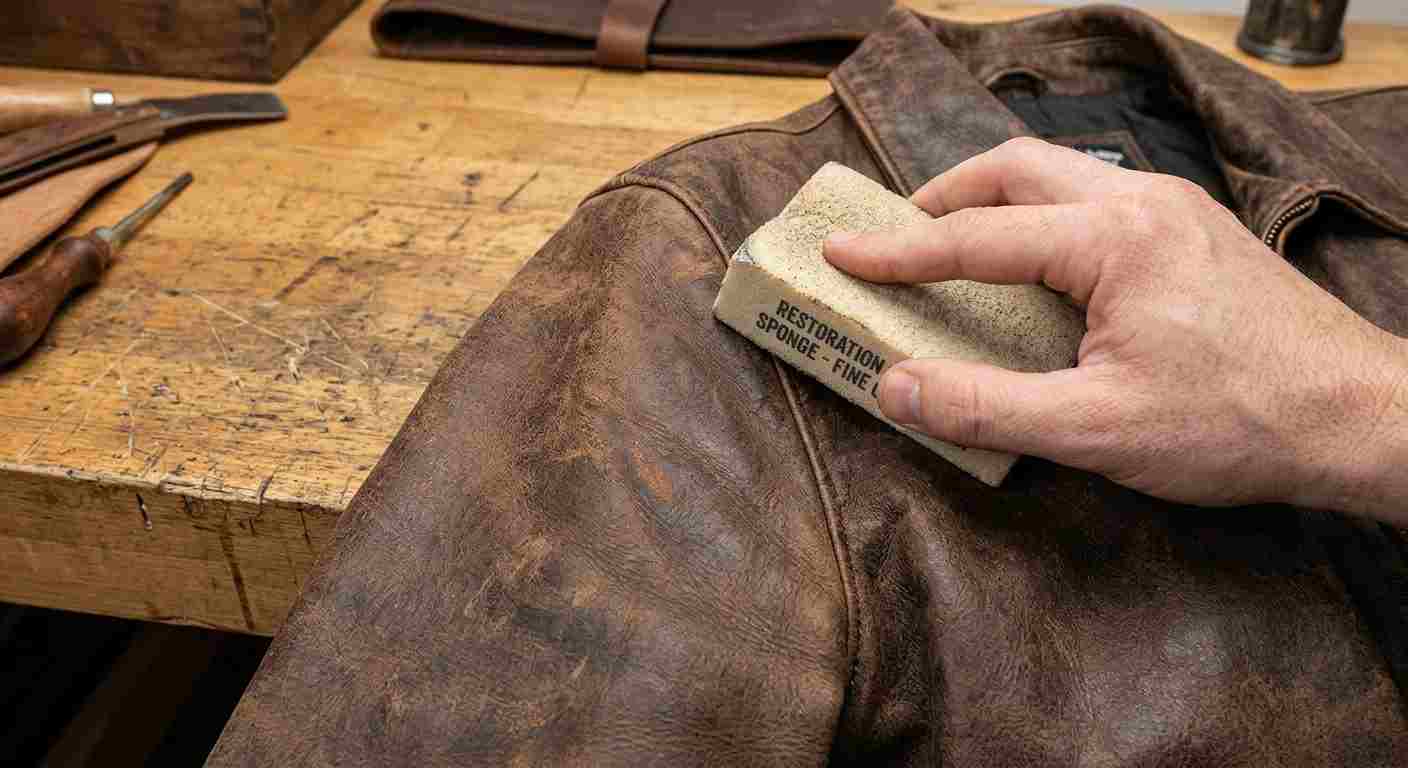
Step 2: Light Surface Abrasion
- Use a very fine grit sanding sponge (around 400 to 600 grit) or a worn-down loofah pad
- Rub very lightly across the high-contact areas: shoulders, cuffs, elbows, and the lower back
- Work in short, varied strokes rather than long uniform passes. Random motion creates natural-looking wear
- Check your progress every 30 seconds. You are scuffing the surface finish slightly, not sanding through to the leather base
Step 3: Restore Tonal Depth With Pull-Up Effect
If the jacket has gone uniformly flat in color, you can bring back tonal variation using this method:
- Apply a very thin layer of neatsfoot oil or a light leather treatment oil to specific zones only, not the whole jacket
- Focus on edges, seams, and fold lines where real wear would naturally darken the leather
- Wipe off any excess immediately. You want subtle darkening in strategic spots, not an overall color shift
Step 4: Work In Real Wear
No restoration product replaces genuine use. After the above steps, wear the jacket through real activity for a few days. Sitting, bending, reaching. The leather will continue to crease and mark naturally, rebuilding the character that got polished away.
What About Cat Scratches and Surface Scuffs?
On a regular leather jacket, a scratch is damage. On a distressed jacket, it is sometimes character. The key is knowing which scratches to leave and which ones to treat.
- Light surface scratches that only catch the top coat can actually add to the worn look of a distressed jacket. Rub the area gently with a clean fingertip. Warmth alone often blends shallow marks back in
- Deeper scratches that go into the leather fiber need a leather repair compound in a matching color to prevent the scuff from spreading or cracking further
- For pet-related scratch clusters, apply a small amount of leather conditioner to the affected patch only, let it absorb, then blend the edges outward with your finger. This softens the scratch line without flattening the surrounding distress finish
- Avoid rubbing aggressively. On distressed finishes, hard rubbing removes more of the surface variation you are trying to protect
Does the Cut of Your Jacket Affect How the Distress Wears?
Yes, noticeably. A jacket with more structure and surface area shows distress patterns differently depending on the cut.
- Biker-style and moto cuts develop the most character at the shoulder, elbow, and cuff because of how the arms move during riding and everyday wear. If yours falls into this category, the restoration steps above will have the most visible impact. You can find quality options built with restoration in mind at Leather Jacket Black’s Brown distressed motorcycle jacket collection, where the finish is designed to age the right way with wear rather than fade flat
- Slim or cafe racer cuts show distress most prominently along the spine and forearms since those areas flex constantly with movement
- One thing that often gets overlooked is sleeve length. A sleeve that is too long gets folded or pushed up constantly, which adds wear in unnatural places. If your sleeves are running long and bunching oddly, the leather jacket sleeve shortening guide from Leather Jacket Black covers exactly how to fix that without disturbing the jacket’s overall finish
What Not to Do When Restoring Distressed Leather
- Do not use shoe polish. It coats the surface with a hard wax layer that covers the distress pattern permanently
- Do not use silicone-based sprays. They leave a synthetic shine that looks nothing like natural distressed leather
- Do not steam the entire jacket to soften it. Targeted moisture is fine but steaming the whole surface can alter the shape of the jacket and cause the lining to shrink
- Do not apply any product across the full jacket at once during restoration. Work in sections and assess after each one
Frequently Asked Questions
Can I distress a plain leather jacket at home to look worn?
You can, but the results vary a lot depending on the leather type. Full-grain and vegetable-tanned leather respond well to manual distressing. Bonded or corrected-grain leather often cracks or peels instead of developing a natural worn look.
How long does it take for distressed leather to look good again after restoration?
With the steps above, you should see a visible difference within one or two treatments. Getting back to full character depth takes a few weeks of regular wear after that.
Is distressed leather more fragile than smooth leather?
Not necessarily. The surface finish is thinner in some spots by design, but if the base leather is high quality full-grain, the jacket itself is just as durable. The finish requires more careful product choices, but the leather underneath is the same.
What if my jacket has gone too light in patches?
Light patches from sun exposure or over-cleaning can be addressed with a leather recoloring balm matched to your jacket’s original tone. Apply sparingly to only the faded areas. Let it dry and blend the edges outward. This takes patience but it works.
Can conditioner really ruin a distressed leather jacket?
Yes, if used too often or in too large an amount. A light application two to three times a year is enough for a distressed jacket. More than that starts filling the surface pores and flattening the textural variation that makes the jacket look the way it does.
Final Thought
A distressed leather jacket is supposed to look better with age, not worse. If yours has gone flat, that is not permanent damage. It is a care issue with a clear fix. Work through the steps, give it some real wear, and the character will come back.
The whole point of a jacket like this is that it is supposed to carry a story. Make sure yours keeps telling one.