

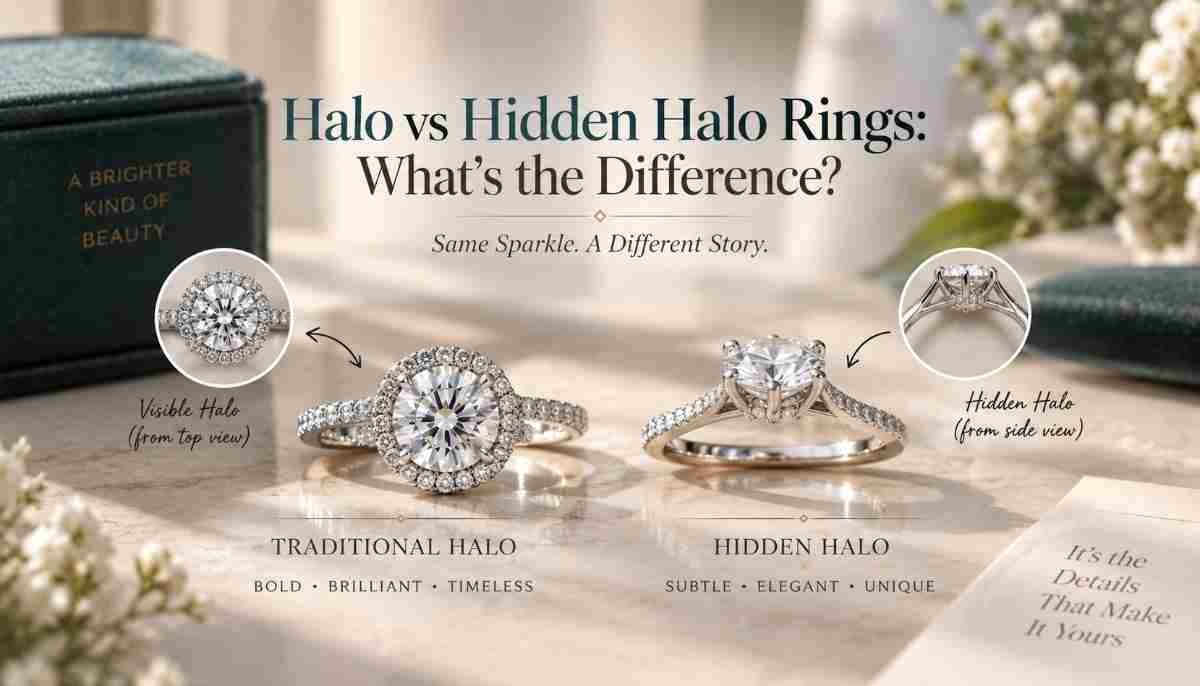
Both styles add extra sparkle around a center stone, but they do it in genuinely different ways, and from most viewing angles, they can look almost entirely different from each other. Understanding exactly what separates a traditional halo from a hidden halo helps you choose between them based on real differences, not just similar-sounding names.
A traditional halo surrounds the center stone with a visible ring of smaller accent diamonds, clearly seen from every angle. A hidden halo places those same accent stones beneath the center stone instead, visible mainly from the side or at certain angles, creating a subtler, more solitaire-like appearance from straight on. Both add brilliance and perceived size, but a hidden halo does it more discreetly, while a traditional halo makes that added spark the ring’s obvious, central feature.
A traditional halo sets a ring of smaller accent diamonds directly around the center stone, at the same level, fully visible from a straight-on, top-down view. This is the design most people picture immediately when they hear the word “halo,” and it’s been the dominant version of this style since halo settings first gained widespread popularity.
The visual effect is immediate and obvious: the center stone appears larger, surrounded by a clear, continuous ring of additional sparkle that’s impossible to miss from any typical viewing angle.
A hidden halo places the same basic concept. Small accent diamonds surrounding the center stone, slightly beneath it instead, tucked under the edge of the center stone rather than positioned at the same level around it. From directly above, the ring can look almost like a plain solitaire, with the accent of stones only becoming visible from a side angle or when the hand catches certain light.
This construction requires more precise setting work than a traditional halo, since the accent stones need to be positioned carefully enough to add a genuine glimpse of extra sparkle without being either invisible or awkwardly exposed.
Factor |
Traditional Halo |
Hidden Halo |
|
Visibility of accent stones |
Fully visible from every angle |
Visible mainly from the side or at an angle |
|
Overall appearance |
Clearly a halo design |
Closer to a solitaire, with a subtle surprise |
|
Perceived size boost |
Strong, immediately obvious |
More modest, less immediately apparent |
|
Best suited for |
Buyers wanting maximum visual presence |
Buyers wanting subtlety with a personal detail |
|
Construction complexity |
Standard halo setting work |
Requires more precise, careful placement |
A hidden halo appeals to buyers who love the idea of a classic solitaire but want a small, personal detail that isn’t immediately obvious to everyone who sees the ring. It offers a bit of a “surprise” element, a glimpse of extra sparkle that only reveals itself from certain angles, which some buyers find more meaningful than an immediately obvious design choice.
It also suits buyers whose personal style leans minimal day to day, but who still want a bit of hidden extra brilliance for themselves, a ring that reads as understated in professional or everyday settings while still carrying that additional detail underneath.
A traditional halo suits buyers who want maximum visual size and brilliance clearly on display, without any subtlety involved. If the whole point of choosing a halo setting is to make a center stone look as large and bright as possible, a traditional halo delivers that goal far more directly and completely than a hidden version can.
Halo rings for women in the traditional style remain the more popular choice specifically because most buyers drawn to this setting concept in the first place are looking for that obvious, immediate visual impact, not a subtler variation on the theme.
Beyond appearance, a few practical distinctions are worth understanding before choosing between the two.
Cleaning access differs slightly. A hidden halo’s accent stones sit in a less exposed position, which can make thorough cleaning marginally more involved, since the tucked-under placement offers less direct access than a fully visible traditional halo. Perceived size boost differs meaningfully. Since a hidden halo’s accent stones aren’t visible from the primary viewing angle, the size-enhancing effect is genuinely more modest than a traditional halo provides, worth knowing if perceived size is your main motivation for considering a halo at all. Resizing considerations are generally similar between the two, since both incorporate accent stones requiring careful handling during any future resizing work.
If maximizing visual size and brilliance is your primary goal, a traditional halo delivers that far more effectively, since a hidden halo’s accent stones contribute only a fraction of the perceived size boost a fully visible halo provides. If you’re drawn more to a classic, minimal aesthetic with a personal, somewhat private detail, a hidden halo offers exactly that combination in a way a traditional halo, by design, cannot replicate.
Neither option is objectively better, they’re built around genuinely different priorities. If you’re still unsure, viewing both styles in person or through detailed video, rather than static photos alone, often clarifies the decision faster than reading further comparisons, since the practical size difference is easier to judge visually than to describe.
If you’re planning to Buy engagement ring online and considering either option, ask specifically to see photos or video from multiple angles, particularly a straight-on view for a hidden halo, since this is exactly the angle where its more subtle nature becomes apparent, and where a listing’s more flattering side-angle photos might otherwise create a misleading impression of how visible the accent stones actually are day to day.
1. What is the main difference between a halo and a hidden halo?
Ans. A traditional halo places accent stones visibly around the center stone at the same level, seen from every angle, while a hidden halo tucks those stones beneath the center stone, visible mainly from the side rather than straight on.
2. Does a hidden halo make a diamond look as big as a traditional halo?
Ans. No, generally not as significantly. Since a hidden halo’s accent stones aren’t visible from the primary viewing angle, the perceived size boost is more modest than what a fully visible traditional halo provides.
3. Is a hidden halo harder to clean than a traditional halo?
Ans. Slightly, yes. The tucked-under placement of a hidden halo’s accent stones offers less direct access for cleaning compared to a fully visible traditional halo, though the difference is generally minor with regular care.
4. Why would someone choose a hidden halo over a traditional one?
Ans. Buyers drawn to a classic, minimal appearance who still want a personal, somewhat private detail often prefer a hidden halo, since it offers a subtle surprise element rather than an immediately obvious design feature.
5. Which halo style is more popular?
Ans. Traditional halos remain more popular overall, largely because most buyers considering a halo setting specifically want the maximum, immediately visible size and brilliance boost it provides, which a hidden halo doesn’t replicate to the same degree.
Halo and hidden halo rings share the same underlying concept, accent stones adding brilliance around a center diamond, but deliver genuinely different results. A traditional halo makes that added sparkle the ring’s clear, central feature, while a hidden halo offers a subtler, more private detail beneath an otherwise classic-looking stone. The right choice comes down to whether you want that extra brilliance to be the obvious point of the design, or a quiet detail just for you.
Submit guest articles that reach decision-makers, influencers, and professionals. Yarabook offers a trusted platform for quality content, strong backlinks, and SEO-driven visibility. Pay. Publish. Promote.