
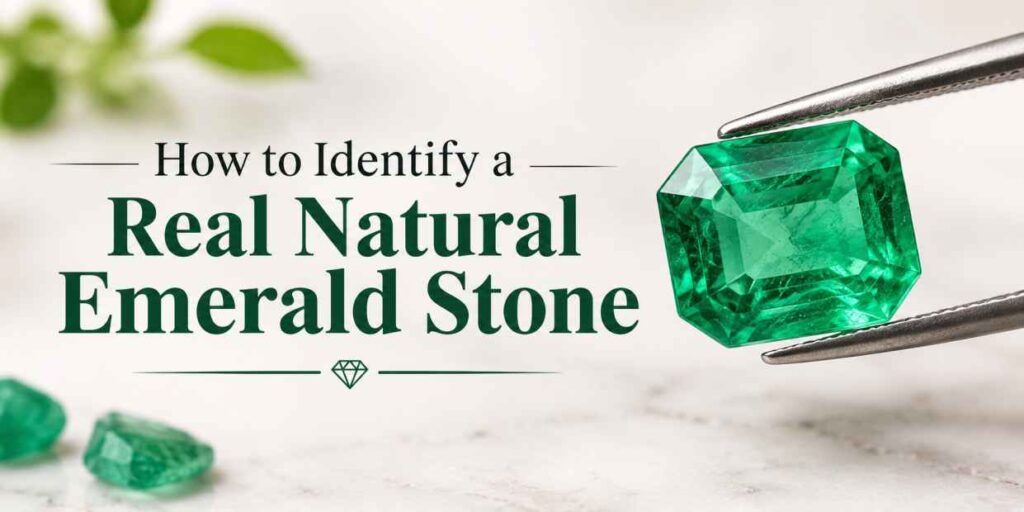
Emeralds are admired for their rich green colour and rarity. Yet not every green stone sold as an emerald is genuine, and genuine stones vary in quality. Before buying, learn a few practical checks and ask clear questions. The safest approach combines visual inspection, gemological testing and reliable documentation. No home test can prove that a stone is natural.
What Is a Natural Emerald?
Emerald is the green variety of the mineral beryl. Its colour comes mainly from trace chromium, vanadium or both. A natural emerald stone forms in the Earth, not in a laboratory. Natural emeralds commonly contain inclusions: tiny crystals, threads, clouds or garden-like patterns known as a jardin.
Inclusions do not prove authenticity. Imitations and laboratory-grown emeralds can also contain features that look convincing. Treat appearance as a clue, not a verdict.
7 Ways to Check an Emerald Before Buying
1. Examine the Colour
A genuine emerald is usually green to bluish-green. Colour varies with origin, trace elements, cutting and treatment. An unusually uniform, vivid colour at a very low price deserves scrutiny. However, colour alone cannot distinguish natural emerald from synthetic material or imitation.
2. Look for Inclusions With a Loupe
Inspect the stone with a 10x jeweller’s loupe. Natural emeralds often contain crystals, fractures or liquid-filled features, sometimes in irregular patterns. But not every natural emerald has obvious inclusions, and laboratory-grown stones may contain them too. Never use inclusions as sole proof.
3. Check for Bubbles
Round gas bubbles are common in glass imitations. If you see obvious bubbles, ask a gemologist to examine the stone. Do not judge by one feature: inclusions can be complex, and a phone photograph cannot replace microscopic examination.
4. Ask Whether the Stone Has Been Treated
Many emeralds are clarity-enhanced with oil or resin to make fractures less visible. This accepted trade practice can affect value and care. Ask whether the stone is untreated, oiled, resin-filled or otherwise treated. The seller should disclose this clearly.
5. Request an Independent Gem Laboratory Report
For a valuable purchase, request a report from a recognised independent gem laboratory. It should identify the material as natural emerald, note detected treatments where possible and include details matching the stone. Verify the report number with the laboratory when possible. A seller’s certificate is not necessarily independent.
6. Compare Weight, Measurements and Price
Check the carat weight and dimensions in millimetres against the listing and report. Price depends on colour, transparency, clarity, cut, weight, origin and treatment. A low price for a large, vivid, clean stone may be a warning, but a high price does not prove authenticity. Compare stones with similar characteristics.
7. Buy From a Seller Who Answers Questions
Choose a seller who provides product details, treatment disclosure, a return policy and documentation. Ask whether an advertised origin is supported by a laboratory opinion. Avoid pressure to buy immediately or promises of guaranteed powers or investment returns. Keep the invoice and report.
Before inspecting a stone, ask whether the description refers to natural emerald, laboratory-grown emerald or an imitation. Also ask whether the price includes a report and whether the report describes treatment. If the seller cannot answer basic questions, pause the purchase. A reputable seller should welcome reasonable checks and give you time to review the details. Remember that origin claims, such as Colombian or Zambian, may require specialist testing and should not be assumed from colour. These questions help you compare stones fairly and make a decision based on evidence rather than sales language and disclosure.
Natural, Synthetic and Imitation Emerald: Know the Difference
A natural emerald forms in the Earth. A laboratory-grown, or synthetic, emerald has essentially the same chemical composition and crystal structure, but is created in controlled conditions. It is emerald, but not natural. An imitation is another material made to look similar, such as green glass, dyed quartz or another green gem.
These categories can look alike to an untrained eye. A gemologist uses magnification and, when needed, instruments that examine optical and physical properties. Ask sellers to use precise terms: “created,” “simulated” and “natural” are not interchangeable.
Can You Identify a Real Emerald at Home?
You can screen for warning signs, but cannot reliably confirm natural origin at home. Avoid scratch tests, heating, chemicals or tapping; they are unreliable and may damage the gem. Colour, bubbles and inclusions offer clues, not proof. For a significant purchase, make the sale conditional on an independent report and reasonable return period.
Why Certification and a Gemstone Recommendation Matter
A sound purchase considers authenticity, treatment, quality, intended use and price. A gemstone recommendation can help narrow choices by budget and preference, but cannot replace verification. If buying for astrological reasons, regard spiritual claims as beliefs, not proven benefits, and still check identity and treatment.
FAQs
1. How can I tell if an emerald is natural?
Visual features can provide clues, but only suitable gemological testing can reliably separate natural emerald from laboratory-grown or imitation material. Request an independent report for confidence.
2. Do real emeralds have bubbles?
Natural emeralds may contain inclusions, but obvious round gas bubbles are more commonly associated with glass. A gemologist should assess the feature under magnification before drawing a conclusion.
3. Are all natural emeralds treated?
No. Some are untreated, while many receive clarity enhancement, often with oil or resin. Ask the seller to disclose the treatment and have it recorded where possible.
4. Is a lab-grown emerald a real emerald?
It is emerald material with essentially the same chemical composition and crystal structure, but it is grown in a laboratory rather than formed naturally. It should be sold clearly as laboratory-grown.

Leave a Reply
You must be logged in to post a comment.