

Standing in a showroom, most buyers stare at a toilet and think about looks — glossy white ceramic, a sleek one piece design, maybe a wall hung toilet seat that “floats” above the floor. Hygiene rarely makes the shortlist, yet the shape of the rim inside the bowl affects how clean your bathroom actually stays. The rimless vs rimmed toilets debate isn’t a marketing gimmick; it comes down to where bacteria can hide and how much water pressure is needed to flush them out.
If you’re choosing between a traditional rimmed model and a newer rimless design for your home or a commercial space, here’s what actually separates them — and which one wins on hygiene.
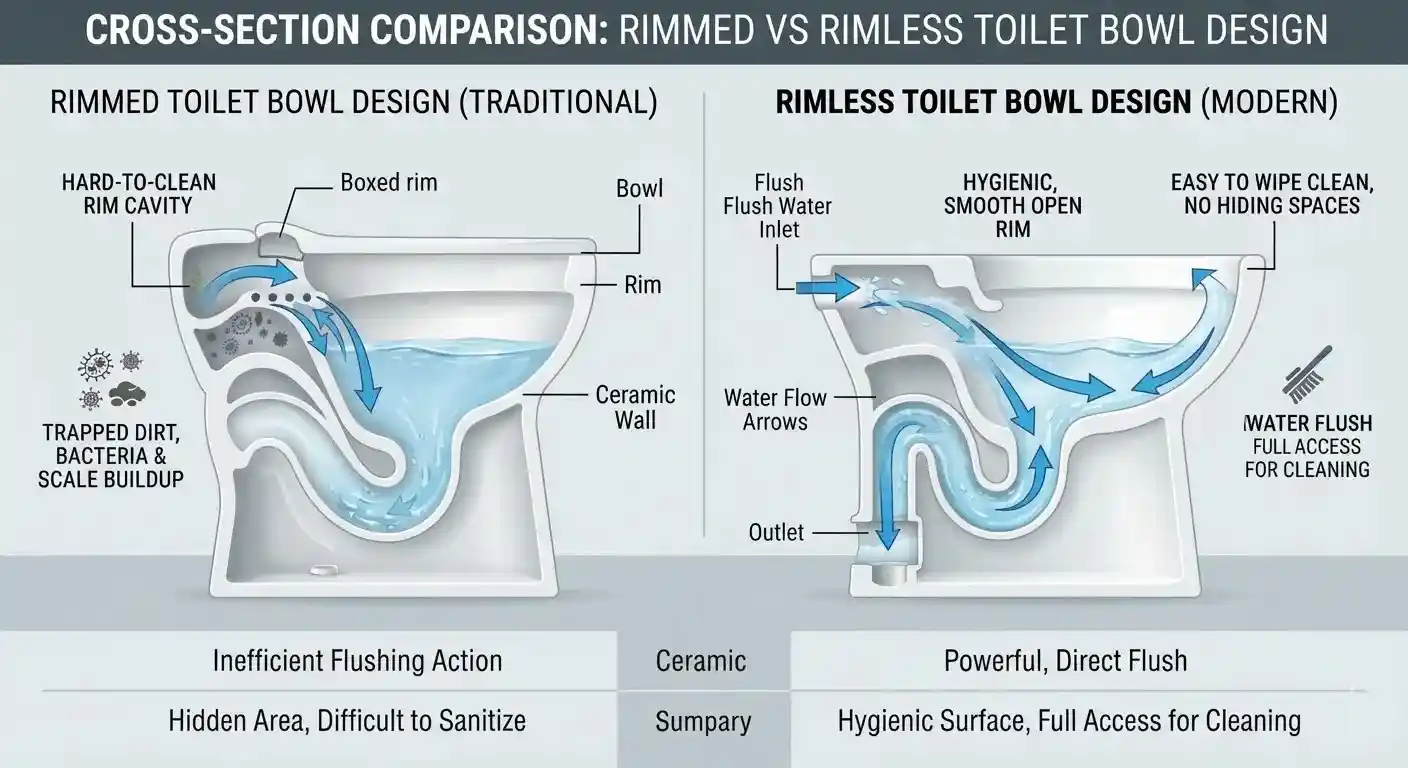
A rimmed toilet is the design most of us grew up with. Water enters the bowl through small holes tucked under a hooded rim around the top edge, then flows down and around to create the flush. That rim looks clean from the outside, but the underside is where the trouble starts.
The enclosed space under the rim is hard to reach with a brush and stays damp between flushes – a combination that limescale, mineral deposits, and bacteria find easy to colonize. Regular commodes, including many one piece commode and single piece toilet models sold across India, still use this rim structure because it’s cost-effective to manufacture and familiar to plumbers.
Rimmed toilets aren’t unhygienic by design fault; they simply demand more frequent, more thorough cleaning to stay that way.
A rimless toilet removes the hooded rim entirely. Instead, water is directed through a specially engineered spray pattern or a jet positioned lower in the bowl, so it washes the entire interior surface — top to bottom — in open view. There’s no hidden ledge for waste, mineral scale, or bacteria to collect in.
This is the design behind most modern smart toilet and premium toilets ranges today. Because every surface is exposed, a quick wipe with a toilet brush reaches everywhere. Kerovit’s rimless models are engineered with this exposed-flush technology as standard, which is one reason they’re increasingly specified in premium bathroom projects, hotels, and hospitals where hygiene standards are non-negotiable.
| Factor | Rimmed Toilet | Rimless Toilet |
|---|---|---|
| Bacteria buildup | Higher — hidden rim traps waste and moisture | Lower — no hidden surfaces to trap residue |
| Cleaning effort | Needs a rim brush and frequent scrubbing | Wipes clean in seconds, fully visible bowl |
| Limescale/staining | More prone, especially in hard water areas | Reduced, due to full water coverage |
| Odor control | Can trap odor-causing bacteria under the rim | Better airflow and visibility reduce odor buildup |
| Water efficiency | Standard flush volumes | Often paired with dual-flush, lower usage |
| Typical price point | Lower to mid-range | Mid to premium range |
For households in hard-water regions – common across much of urban India — the rimless design also reduces the white mineral staining that builds up in rim pockets over time. This matters when you’re comparing western toilets for daily-use bathrooms versus guest or commercial washrooms with heavier footfall.
Rim design and installation type are two separate decisions, and both affect hygiene.
A wall hung toilet seat, sometimes called a wall mounted toilet seat or wall hanging toilet seat, is fixed to the wall with the tank concealed inside it, leaving the floor beneath completely open. This makes mopping faster and prevents grime from collecting around the base – a common problem with floor-fixed models. Pair a wall hung toilet seat with a rimless bowl, and you get the two biggest hygiene upgrades available in toilet design today.
A one piece toilet or one piece commode, by contrast, fuses the tank and bowl into a single unit. It has fewer joints than a two-piece model, which means fewer seams for grime to collect in, but it still sits on the floor. You can find one piece commode models in both rimmed and rimless configurations, so the “single piece” build and the rim design should be evaluated independently when comparing options.
For most Indian households, yes – particularly if the bathroom sees daily heavy use or if cleaning time is a real constraint. The upfront cost of premium toilets with rimless technology is higher than a standard rimmed model, but the ongoing savings show up in three ways:
If budget is the primary constraint, a well-maintained rimmed western toilet is still a safe, hygienic choice – it just needs a stricter cleaning routine, including a rim-specific brush, at least twice a week.
Base the decision on how the space is actually used, not just on trend:
Rim design determines where water reaches, but the ceramic glaze determines how easily dirt lets go of the surface in the first place. A porous or low-grade glaze gives bacteria and limescale something to grip onto even in a rimless bowl, while a dense, high-fired glaze stays smoother at a microscopic level, so waste and water slide off rather than bonding to the surface.
This is why premium toilets and smart toilet ranges are usually built with both upgrades together – a rimless flush path and a nano-coated or antibacterial glaze — rather than one or the other. Kerovit’s premium ceramic lines use high-temperature firing to reduce surface porosity, which keeps the bowl looking newer for longer and cuts down on the frequency of deep cleaning needed between routine wipes.
If you’re comparing a rimmed one piece toilet against a rimless model from a different price tier, ask about glaze quality specifically. A well-glazed rimmed toilet can outperform a poorly glazed rimless one on day-to-day staining, even though the rimless design still wins on where bacteria can physically collect.
Rimless toilets depend on precise jet placement rather than gravity-fed rim holes, so flush performance is more sensitive to water pressure and flush mechanism quality than in a standard rimmed model. In homes with inconsistent municipal pressure, it’s worth checking the manufacturer’s minimum pressure recommendation before installing a rimless unit, particularly for wall hung toilet seat models where the cistern is concealed and harder to inspect later.
Most modern rimless models compensate for this with dual-flush cisterns that combine a full flush (typically 6 litres) with a reduced flush (3–4 litres) for liquid waste, giving households control over both hygiene and water usage. This is a meaningful upgrade over older single-flush rimmed western toilets that use the same water volume regardless of need.
The rimless vs rimmed toilets question ultimately comes down to what’s hidden versus what’s exposed. Rimmed toilets can be kept hygienic, but only with consistent, rim-focused cleaning. Rimless toilets remove that hidden risk at the source, which is why they’ve become the standard in premium toilets, smart toilet ranges, and wall hung toilet seat installations. If you’re upgrading your bathroom and hygiene is a priority, a rimless design — paired with a wall-mounted install where space allows — offers the strongest long-term payoff. Explore Kerovit’s rimless and wall hung toilet collections to compare finishes and flush technologies suited to your bathroom.
Submit guest articles that reach decision-makers, influencers, and professionals. Yarabook offers a trusted platform for quality content, strong backlinks, and SEO-driven visibility. Pay. Publish. Promote.