

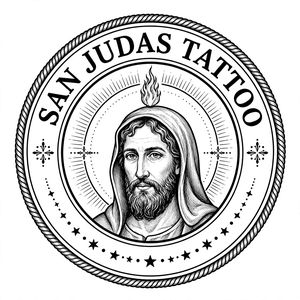
San Judas Tadeo — St. Jude, patron of lost causes — is one of the most requested devotional tattoo subjects in the world, and one of the first decisions every wearer faces is not the drawing itself but where it should live on the body. Placement changes the size, the level of detail, and even the meaning a San Judas tattoo carries. This guide walks through the four most popular placements and what each one does best.
The forearm: the everyday devotional canvas. The forearm is the most chosen placement for a reason. Its long, relatively flat surface suits the vertical composition of a classic San Judas design — the saint’s figure, staff, and medallion read clearly from top to bottom, and the piece stays visible in daily life without being impossible to cover at work. Medium detail survives well here: black and grey shading, fine-line halos, and lettering such as a name or a short prayer fit naturally along the arm. If this is your first devotional piece, the forearm is the most forgiving place to start.
The chest: private, close to the heart. Chest placements carry an explicitly personal meaning — the image sits over the heart, often chosen after a prayer answered or a hardship survived. The chest offers a wide canvas, so larger compositions work: San Judas flanked by roses, candles, or rays of light, sometimes mirrored by a second figure on the opposite side. Because the area is usually covered, chest pieces are also the most private — devotion kept for oneself rather than displayed.
The hand and wrist: small, bold, always visible. Small San Judas tattoos on the hand or wrist trade detail for presence. At this size the design must simplify — a medallion, a flame, the initials of the saint, or a compact portrait with strong outlines. What these pieces lose in detail they gain in constancy: the wearer sees the image every day, which is exactly the point for many devotees. Choose bold linework; delicate fine-line details blur faster on hands than anywhere else.
The full sleeve: a story told in chapters. A sleeve lets a San Judas tattoo become a narrative. The saint anchors the upper arm, while the forearm and inner arm add supporting scenes — church facades, praying hands, rosaries, doves, and dates that mark personal milestones. Sleeves demand planning: the composition should be mapped before the first session so each element connects, and the style — Chicano black and grey is the classic pairing — stays consistent from shoulder to wrist.
Size and detail: the quiet deciding factor. Every San Judas design has a minimum size below which its details stop working. The medallion on the saint’s chest, the folds of the robe and the small flame above his head are what make the image recognizable; shrink the piece too far and those elements merge into a dark shape within a few years as ink settles into the skin. As a rule of thumb, a detailed portrait-style San Judas needs at least a palm-sized area, which is why small placements work best with simplified symbols — a medallion, a flame, or initials — rather than a full figure. Ask your artist to show you the stencil at the exact size you plan to wear; it takes ten seconds and prevents the most common placement regret.
Comfort, work and healing. Placement also decides how the tattoo fits your daily life. Forearm and hand pieces are hard to hide in formal or customer-facing jobs, while chest and upper-arm pieces stay covered by a shirt. Pain differs by area too: the chest and inner arm are generally more sensitive than the outer forearm. Finally, think about the two weeks after the session — a hand tattoo heals while you wash, type and grip all day, and a chest piece rubs under straps and seatbelts. None of this should scare you off a placement you love, but the best choice is the one that still makes sense on an ordinary workday, not just on the day of the appointment.
How to decide. Work backwards from three questions. How visible do you want the piece at work and in formal settings? How much detail does your chosen design need to stay readable in ten years? And is this a public statement of faith or a private one? Your answers point to the placement almost by themselves: visible and detailed means forearm or sleeve; private and large means chest; constant and symbolic means hand or wrist.
Whichever placement you choose, bring your artist reference images and talk through sizing before committing — a design drawn for a forearm will not simply shrink onto a wrist. For a fuller breakdown of sizes, pain levels, and design examples for each area, see the San Judas tattoo placement guide, and for those planning a larger composition, the San Judas sleeve guide collects full-arm concepts and layout advice.
Submit guest articles that reach decision-makers, influencers, and professionals. Yarabook offers a trusted platform for quality content, strong backlinks, and SEO-driven visibility. Pay. Publish. Promote.