

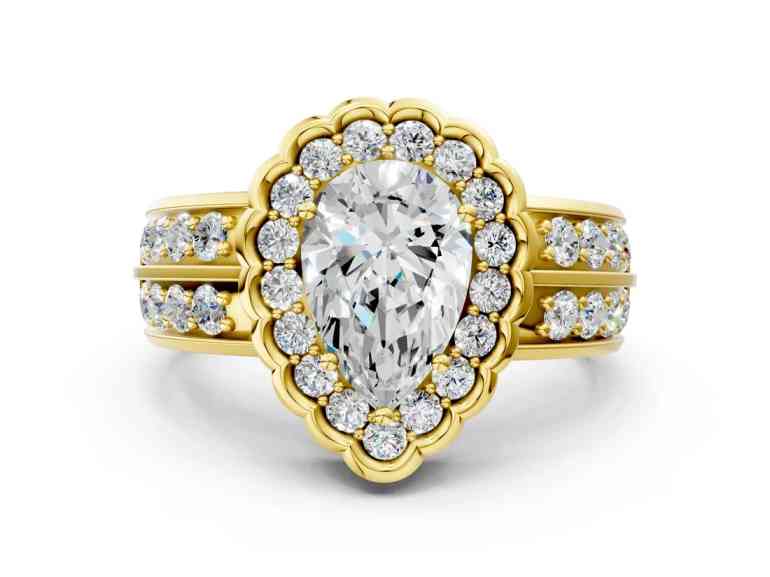
Beyond the visual drama, a split shank is a genuine feat of structural design. Dividing the band into two strands means the metal has to be shaped and soldered with precision at the point where it meets the halo, since that junction bears the weight of holding the entire setting secure while still looking effortless. A poorly executed split shank can feel weak at the seam or look like an afterthought bolted onto a plain band. On the Yellow Gold Pear Cut Halo Diamond Split Shank Ring with Scalloped Prong Setting, the two strands are shaped to taper gradually as they rise, so the transition from a single band to a divided one reads as intentional movement rather than an abrupt fork. This kind of construction is part of why split shank designs are typically hand-finished rather than mass-produced – the curvature has to be judged by eye and adjusted stone by stone.
There’s a reason stylists keep returning to yellow gold for statement halo designs. Yellow gold has a warmth that natural light interacts with differently than it does with white metals – it doesn’t just reflect light, it seems to hold onto a bit of it, giving the metal itself a soft glow alongside the diamonds’ sparkle. When paired with a pear cut center stone, this warmth adds richness without dulling the diamond’s brilliance, since the halo’s white diamonds still provide plenty of cool contrast against the gold. The result is a piece that feels layered in tone rather than monochromatic, which is part of what gives the Yellow Gold Pear Cut Halo Diamond Split Shank Ring with Scalloped Prong Setting its sense of depth even in photographs.
It’s worth dwelling a bit longer on the scalloped prong detail, since it’s easy to underestimate how much a prong shape affects a ring’s overall character. Standard claw prongs are functional but visually sharp – they announce themselves as hardware. Scalloped prongs, by contrast, are shaped to curve gently along the edge of each stone, almost like a wave lapping against the diamond rather than a claw gripping it. This softens the entire setting’s visual language, making the halo look like it was grown around the stones rather than mechanically attached. It also has a practical benefit: the rounded profile is less likely to catch on fabric or hair than a sharper prong style, which matters for a ring meant to be worn daily rather than reserved for special occasions.
A ring with this many design elements – split shank, halo, scalloped prongs, pear cut – could easily tip into looking overwrought. What keeps the Yellow Gold Pear Cut Halo Diamond Split Shank Ring with Scalloped Prong Setting from feeling busy is proportion. Each detail is scaled to support the others rather than compete for attention: the split shank is narrow enough to stay comfortable on the hand, the halo diamonds are small enough to frame rather than overwhelm the center stone, and the scalloped prongs sit low enough not to interrupt the ring’s overall silhouette. This kind of restraint is often harder to achieve than simply adding more detail, and it’s what separates a genuinely well-designed statement ring from one that just looks cluttered.
Because the band splits rather than remaining a continuous circle, split shank rings can sometimes fit slightly differently than a traditional band, particularly for those with narrower fingers where the divided strands have less room to sit flat. It’s a good idea to have this style properly sized rather than estimating from a standard ring size chart, since the width of the split and the angle at which the strands meet the halo can shift how snug the ring feels. Renaissance Jewel’s in-house sizing accounts for this during the fitting process, ensuring the Yellow Gold Pear Cut Halo Diamond Split Shank Ring with Scalloped Prong Setting sits evenly rather than twisting on the finger over time.
Yellow gold is prized for its durability, but the diamonds set within the halo and along the scalloped prongs still benefit from routine care. Lotions, oils, and everyday buildup can dull a halo’s brilliance faster than people expect, simply because there are more facets and more metal surface area for residue to collect on compared to a plain band. A gentle cleaning every few weeks – warm water, mild soap, and a soft brush – keeps the halo’s sparkle consistent, and periodic professional inspection ensures the scalloped prongs remain secure around each stone. This is part of why ongoing prong inspection is included with every purchase, so the ring’s intricate detailing stays intact well beyond the first year of wear.
The Yellow Gold Pear Cut Halo Diamond Split Shank Ring with Scalloped Prong Setting isn’t a design for someone who wants their ring to blend in. It’s for someone who appreciates the craftsmanship behind every curve of the band and every stone in the halo – a ring built to be examined closely, not just glanced at. Explore the Pear Cut Halo Diamond Split Shank Ring with Scalloped Prong Setting and the rest of the Renaissance Jewel collection to see how this piece compares to your current favorites.
Submit guest articles that reach decision-makers, influencers, and professionals. Yarabook offers a trusted platform for quality content, strong backlinks, and SEO-driven visibility. Pay. Publish. Promote.