

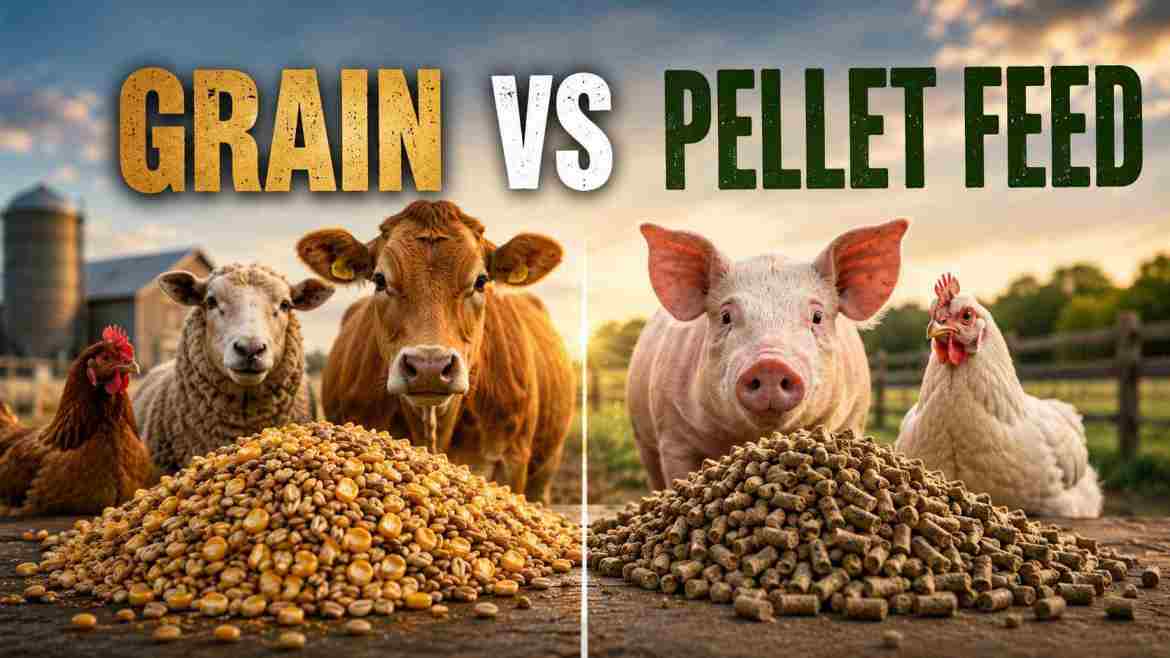
Feed decisions affect almost everything on a farm. Weight gain. Feed conversion. Digestion. Milk production. Egg quality. Even waste management.
Many livestock owners in the USA still ask the same question before buying feed: should you use grain feed or pellet feed?
The short answer is this: pellet feed usually delivers more balanced nutrition and better feed efficiency, while grain feed gives flexibility and lower upfront cost. The better option depends on the animal, production goal, feeding system, and budget.
That is why experienced producers rarely choose feed based on price alone.
A beef producer focused on rapid weight gain may need a different feeding strategy than a poultry farmer managing feed waste. A dairy operation looking for consistent milk production may benefit from precision-formulated pellets, while smaller farms sometimes prefer custom grain mixes.
The real difference comes down to nutrient consistency, digestibility, storage, waste reduction, and animal performance.
This guide breaks down how both feed types work, where each performs best, and what livestock nutrition experts recommend today.
Grain feed refers to loose feed ingredients such as:
These ingredients may be fed individually or blended into custom livestock feed mixes.
Grain feed is commonly used in:
In the USA, corn remains the dominant feed grain because of its high energy value and widespread availability.
According to the United States Department of Agriculture (USDA), corn accounts for the majority of feed grain used in American livestock production.
Grain feed gives producers more control over formulations.
For example:
This flexibility matters when feed ingredient prices change.
Dr. Ron Plain, agricultural economist at the University of Missouri, has repeatedly noted that feed cost remains one of the largest operating expenses in livestock production. Producers often modify grain rations to control margins during volatile commodity markets.
Another advantage is accessibility. Many local feed mills and farms already store raw grain ingredients in bulk.
Pellet feed is manufactured by grinding ingredients into smaller particles, mixing them evenly, then compressing them into dense pellets using heat and steam.
Pellets usually contain:
The goal is nutritional consistency in every bite.
Instead of animals sorting through ingredients and eating only preferred grains, pellet feed ensures balanced intake.
Pellet feed is now widely used in commercial livestock feeds because it improves:
Research from Kansas State University found that pelleting can improve feed efficiency in some livestock systems because animals consume less wasted feed and receive more uniform nutrition.
Pellets also reduce selective feeding behavior, especially in poultry and cattle.
The biggest difference is nutrient consistency.
With grain feed, animals can sort ingredients. Some may consume more energy-rich grains while leaving mineral-rich components behind.
Pellet feed prevents this issue because every pellet contains a formulated nutrient profile.
Here is a practical comparison.
|
Factor |
Grain Feed |
Pellet Feed |
|
Nutrient Consistency |
Variable |
Highly consistent |
|
Feed Waste |
Higher |
Lower |
|
Digestibility |
Moderate |
Often improved |
|
Storage Efficiency |
Moderate |
Better bulk handling |
|
Customization |
High |
Moderate |
|
Upfront Cost |
Lower |
Usually higher |
|
Animal Sorting |
Common |
Minimal |
|
Feeding Convenience |
Moderate |
High |
For cattle feed programs, the answer depends on production goals.
Grain feed works well for:
Many beef operations still rely heavily on cracked corn and grain-based rations because they provide concentrated energy for weight gain.
However, uneven intake can become a problem if cattle sort feed.
Pellet feed often performs better in:
Dr. Rick Rasby, beef specialist at the University of Nebraska–Lincoln, explains that consistent nutrient intake supports more stable rumen function and improved cattle performance.
Pellets can also help include minerals and supplements that cattle might otherwise avoid.
Pellet feed has a strong advantage in commercial chicken feed systems.
Poultry producers often choose pellets because chickens naturally waste large amounts of loose grain feed.
A study published through Auburn University poultry research showed that pelleted diets can improve feed conversion and growth rates in broilers compared to mash or loose grain diets.
Pellet feed helps poultry operations by:
This matters because feed represents nearly 60% to 70% of poultry production costs in many commercial systems.
Even small improvements in feed conversion can significantly improve profitability.
Still, some smaller farms prefer grain feed because it is easier to source locally and may cost less initially.
In many cases, yes.
The grinding and heating process used in pellet production can improve digestibility.
Pelleting changes starch structure and reduces ingredient particle size, making nutrients easier for some animals to absorb.
According to animal nutrition researchers at Oklahoma State University, pelleting may improve nutrient utilization, especially in poultry and swine diets.
However, digestive response varies by species.
Ruminants like cattle still require adequate fiber intake for proper rumen health. Feeding only high-energy pellets without forage balance can create digestive stress.
That is why nutrition balance matters more than feed form alone.
Some producers believe grain feed is more natural because it contains visible whole ingredients.
But nutrition experts focus less on appearance and more on nutrient balance.
Animals do not benefit simply because feed looks less processed.
What matters most includes:
Dr. Temple Grandin, animal science professor at Colorado State University, has consistently emphasized that proper nutrition directly influences livestock health, stress levels, and production outcomes.
Poorly balanced grain diets can create nutritional gaps just as easily as poorly formulated pellets.
This depends on the operation.
Grain feed usually costs less per ton upfront.
But pellet feed may reduce:
That means pellet feed sometimes delivers better overall value despite higher purchase prices.
For example, if poultry waste 10% of loose grain feed but only 3% of pellet feed, the efficiency gain may offset the added cost.
Large commercial operations often calculate feed conversion ratios carefully because small efficiency improvements create major annual savings.
Choosing the wrong livestock feeds can affect:
Common feeding mistakes include:
Too much rapidly fermentable grain can increase the risk of acidosis in cattle.
Animals may receive enough calories but still lack essential vitamins or minerals.
Low-cost feed sometimes creates hidden performance losses.
Chicken feed requirements differ significantly from cattle feed formulations.
Species-specific nutrition matters.
The best decision starts with production goals.
Ask these questions first:
Cattle, poultry, swine, sheep, and goats all process feed differently.
Pellets usually perform better for consistent intake and reduced waste.
Grain feed gives more flexibility for on-farm ration adjustments.
Pellets often simplify large-scale feeding systems.
Regional grain markets heavily influence feed economics in the USA.
Not automatically. Pellet feed is healthier only if the formulation is nutritionally balanced. High-quality grain feed can also support excellent livestock performance.
In some systems, yes. Consistent nutrient intake and reduced feed waste can improve feed efficiency and support weight gain.
Commercial poultry farms use pellet feed because it improves feed conversion, reduces waste, and supports more uniform growth.
Submit guest articles that reach decision-makers, influencers, and professionals. Yarabook offers a trusted platform for quality content, strong backlinks, and SEO-driven visibility. Pay. Publish. Promote.