
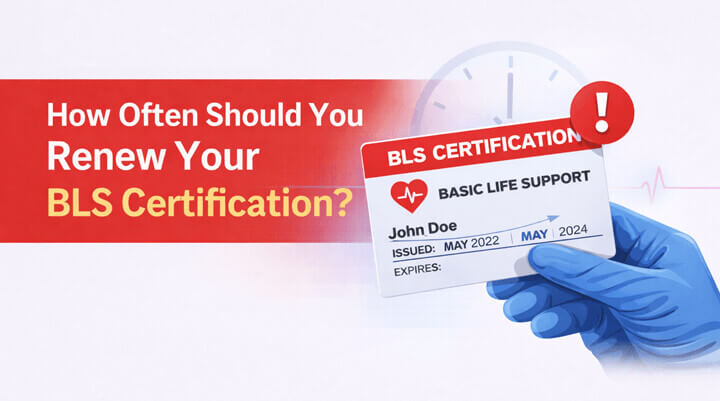
How Often Should You Renew Your BLS Certification?

Table Of Contents
How Often Should You Renew Your BLS Certification

In the fast-paced world of healthcare and emergency response, Basic Life Support (BLS) is the cornerstone of patient survival. However, like any technical skill, your proficiency in CPR and cardiovascular care can diminish over time. To ensure healthcare providers are always equipped with the latest life-saving techniques, certification is not a one-time event.

If you are wondering exactly when you need to head back to the classroom, here is everything you need to know about BLS renewal cycles, industry standards, and the latest guidelines.

The Standard BLS Renewal Cycle

Most Basic Life Support (BLS) certifications, including those from the American Heart Association (AHA) and the American Red Cross, are valid for two years.

  • Expiration Date: Your certification is valid through the end of the month in which it was issued, exactly two years later.
  • The 2-Year Rule: This timeframe is the industry standard designed to balance the logistical demands of healthcare workers with the need for clinical accuracy.

You must renew your BLS certification every two years. Major providers like the AHA and Red Cross issue certifications that expire 24 months from the date of completion. Healthcare professionals should ideally begin the renewal process 60 days before expiration to avoid a lapse in compliance.

Why Does BLS Certification Expire Every 2 Years?

The two-year renewal window isn’t arbitrary. It is rooted in two primary factors:

  1. Skill Decay

Studies by organizations like the Red Cross Scientific Advisory Council show that CPR skill retention begins to decline significantly within just a few months of training. After one year, many participants struggle to pass a hands-on skills test. The two-year mark serves as a critical “reset” to ensure your muscle memory remains sharp.

  1. Evolving Science (2025 Guidelines Update)

Resuscitation science is constantly improving. For example, the 2025 AHA Guidelines for CPR and ECC were recently released, introducing updated algorithms and refined techniques for high-quality chest compressions and ventilation. Regular renewal ensures you are practicing the most current, evidence-based medicine rather than outdated protocols.

Can You Renew an Expired BLS Card?

One of the most common questions is whether there is a “grace period” for an expired card.

  • No Grace Period: Most employers and the AHA do not recognize a grace period. If your card expires on the 31st of the month, you are considered non-compliant on the 1st.
  • Renewal vs. Full Course: If your certification is current or expired by less than 30 days, you are typically eligible for an abbreviated “BLS Update” or “Renewal” course.
  • Lapsed Certification: If your card has been expired for a significant amount of time (usually over 30 days, though some instructors allow up to a year for specific “Challenge” courses), you may be required to retake the full BLS Provider course, which is longer and more expensive.

Common Mistakes to Avoid During Renewal

Many seasoned professionals fail their skills check not because they lack knowledge, but because they have developed “bad habits.” To ensure you pass your 2026 renewal on the first try, avoid these pitfalls:

  • Rushing Compressions: Pushing faster than 120 bpm prevents the heart from filling properly between beats.
  • Leaning on the Chest: Failing to allow full chest recoil between compressions reduces the effectiveness of blood flow to the brain.
  • Ignoring Pediatric Scenarios: Many providers focus only on adult CPR. In 2026, proficiency in infant and child BLS is equally scrutinized during testing.
  • Using Non-AHA Providers: Always verify that your training center is accredited. “Instant” online-only certificates without a hands-on skills check are rarely accepted by hospitals or medical boards.

How to Renew Your BLS Certification in 2026

Renewing your credentials is more flexible today than ever before. You generally have three options:

  1. In-Person Classroom Training: Traditional instructor-led training involving a written exam and hands-on skills practice.
  2. Blended Learning (Highly Recommended): This combines an online, self-paced cognitive portion with a brief in-person “skills check.” This is often the most time-efficient method for busy professionals.
  3. On-Site Corporate Training: Many hospitals and clinics host “Skills Days” where instructors come to the facility to certify staff in bulk.

Requirements for Renewal:

  • A copy of your current (or recently expired) BLS Provider card.
  • Successful completion of the 2025/2026 updated written exam.
  • Demonstration of high-quality CPR, AED usage, and choking relief for adults, children, and infants.

Checklist: Stay Compliant and Prepared

To avoid the stress of a last-minute scramble, follow this timeline:

  • 3 Months Before Expiration: Check your card date and verify your employer’s specific requirements (some high-acuity units like the ICU or ER may require annual drills).
  • 2 Months Before: Sign up for a renewal or blended learning course.
  • 1 Month Before: Complete the online portion (if doing blended learning) and attend your skills session.
  • Post-Course: Save a digital copy of your eCard and provide it to your HR or licensing department immediately.

Conclusion

Renewing your BLS certification every two years is more than just a “check-the-box” HR requirement, it is a commitment to patient safety and professional excellence. By staying updated with the 2025–2026 guidelines, you ensure that when a life-threatening emergency occurs, your response is instinctive, accurate, and effective.

Leave a reply
Leave a Reply
yarabook Articles logo

Submit guest articles that reach decision-makers, influencers, and professionals. Yarabook offers a trusted platform for quality content, strong backlinks, and SEO-driven visibility. Pay. Publish. Promote.

Is Your WhatsApp Number?*