

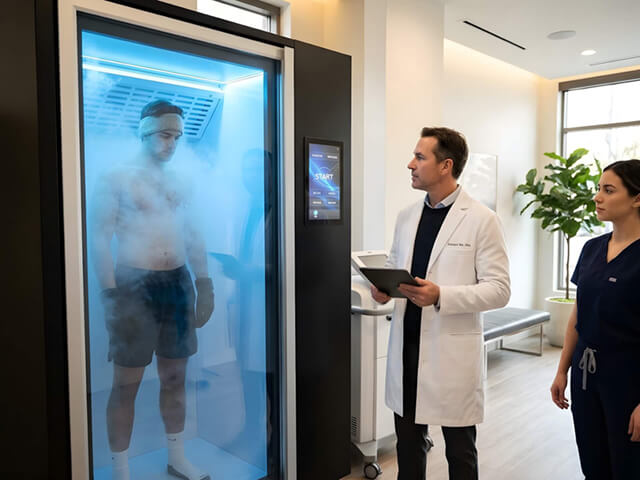

Key Takeaways: Because clients differ in biological sex, body composition, and cold tolerance, a fixed whole-body cryotherapy (WBC) setting is neither safe nor optimal. Operators should calibrate chamber temperature and exposure time using a pre-session health screening and post-session Skin Surface Temperature (SST)—targeting an SST of 10°C–15°C (50°F–59°F) while strictly capping exposure at 4 minutes.
This operational guide outlines how to customize whole-body cryotherapy protocols for diverse user profiles. Designed for cryotherapy studio owners, wellness clinics, and sports recovery centers, these evidence-informed standards improve client comfort, mitigate cold-injury risks, and maximize therapeutic consistency.
Core Principle: Human bodies lose heat at different rates due to variations in subcutaneous fat, muscle mass, vascular reactivity, and cold habituation. Customizing chamber temperature and duration ensures sufficient skin cooling to trigger physiological benefits without causing superficial frostbite or cardiovascular strain.
Relying on a rigid “one-size-fits-all” preset—such as running every client at -130°C for 3 minutes—introduces two operational failures:
Pairing a pre-session vital screening with post-session Skin Surface Temperature (SST) tracking replaces guesswork with measurable, repeatable clinical adjustments.
To establish safe and effective parameters, match the client’s physical profile with objective post-session thermal feedback.
| User Profile | Chamber Temp | Starting Duration | Target Post-Session SST | Clinical & Operational Rationale |
|---|---|---|---|---|
| First-Time Users / Lean Build | -110°C to -120°C (-166°F to -184°F) |
1.5 – 2.0 mins | 12°C – 15°C (54°F – 59°F) |
Lower subcutaneous fat insulation results in faster peripheral heat loss. |
| General Wellness / Pain Relief | -115°C to -130°C (-175°F to -202°F) |
2.0 – 2.5 mins | 11°C – 14°C (52°F – 57°F) |
Balanced thermal stress supports relaxation, sleep, and inflammation control. |
| Experienced Users / Athletes | -125°C to -140°C (-193°F to -220°F) |
2.5 – 3.0 mins | 10°C – 12°C (50°F – 54°F) |
Higher metabolic muscle mass and cold adaptation require deeper cooling. |
Chamber air temperature measures the environment, not the client’s physiological response. Skin Surface Temperature (SST) scanned immediately upon exit serves as your primary calibration metric:
Execute this four-step Standard Operating Procedure (SOP) to personalize every client appointment:
Safety Mandate: Operators must abort a session immediately if the client exhibits signs of cardiovascular distress, acute cold injury, or respiratory discomfort, or once the timer reaches the 4-minute maximum safety cap.
Immediate Termination & Warm-Up Triggers:
- Skin Changes: Localized white, waxy, or hardened skin patches (early indicators of frostbite).
- Neurological Symptoms: Dizziness, lightheadedness, blurred vision, confusion, or presyncope (feeling faint).
- Cardiorespiratory Distress: Chest tightness, heart palpitations, shortness of breath, or cold-induced coughing spasms.
- Uncontrolled Physical Reaction: Severe, uncontrollable shivering, acute stinging pain, or claustrophobic panic.
- Client Request: Any verbal cue or hand signal from the client asking to exit.
Customizing whole-body cryotherapy elevates a generic cold plunge into a safe, repeatable, and results-driven clinical service. By screening vital signs beforehand, matching initial settings to individual body profiles, enforcing strict stop-signals, and calibrating ongoing sessions around the 10°C–15°C Skin Surface Temperature (SST) benchmark, operators protect client safety while delivering superior recovery outcomes.
Begin with a pre-session blood pressure and contraindication check, assign a conservative baseline based on body composition and experience (-110°C to -120°C for 1.5–2 minutes for beginners), and scan Skin Surface Temperature (SST) immediately upon exit. Adjust subsequent sessions in 5°C–10°C or 30-second increments until post-session SST consistently lands between 10°C and 15°C.
For general wellness, stress reduction, or sleep support, 2 to 3 sessions per week is standard. During intensive athletic training or acute recovery phases, athletes typically schedule 3 to 5 sessions per week for 1–2 weeks before transitioning to a maintenance frequency of 1–2 sessions weekly.
Clients must arrive with completely dry skin and hair, avoid heavy workouts or showers within 30–60 minutes prior (to prevent residual sweat), remove all metal jewelry and watches, skip topical lotions or oils on treatment day, and eat a light meal at least 1 hour beforehand to prevent lightheadedness.
Terminate the session immediately if the client experiences dizziness, chest tightness, breathing difficulty, severe uncontrollable shivering, acute stinging pain, visible white or waxy patches on the skin, or makes any verbal or hand request to exit.
Log six core metrics in the client’s profile after every appointment:
Submit guest articles that reach decision-makers, influencers, and professionals. Yarabook offers a trusted platform for quality content, strong backlinks, and SEO-driven visibility. Pay. Publish. Promote.