
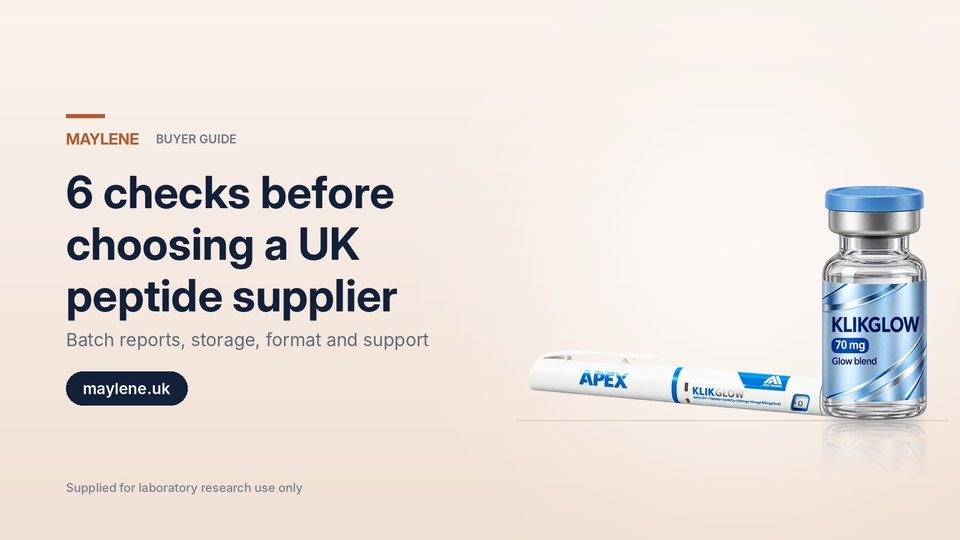
Choosing where to source research peptides shapes everything that follows in a study. A cheap batch with no paperwork can cost weeks of work if results turn out to be unreliable, and a supplier that cannot answer basic questions about a lot leaves a gap in your lab records. The checks below are not about brand loyalty. They are a simple way for UK labs to compare suppliers on the things that affect data quality, compliance and day-to-day workflow.
1. Published batch reports you can check before ordering
Every lot should come with a certificate of analysis. At a minimum that document should show an HPLC purity figure and a mass spectrometry result, together with the lot number and the date of testing. The important detail is timing. A supplier who publishes reports you can match to a lot number before you place an order gives you far more confidence than one who sends a generic PDF on request after delivery.
When you read a report, look past the headline purity figure. Check that the method is stated, that the chromatogram shows one dominant peak, and that the observed molecular mass agrees with the expected mass. A high purity number paired with a mismatched mass means a clean batch of the wrong molecule. Maylene, a UK-based supplier, publishes its batch documents on a public certificates of analysis page, which is the kind of transparency worth looking for whichever supplier you use.
2. Independent testing
Ask who ran the analysis. In-house testing is better than nothing, but results from an independent laboratory add a layer of confidence that the figure reflects the batch rather than a marketing claim. If a supplier names its testing partner, that is a good sign. If it cannot tell you who produced the data, treat the purity figure with caution and consider sending a sample for your own analysis before committing to a larger order.
3. A format that fits your workflow
Research peptides are usually supplied either as lyophilised powder in vials or as pre-filled pens. Each format changes the work at the bench. Lyophilised vials are stable for longer in storage, but every use means weighing out diluent, reconstituting and calculating a concentration, and each of those steps is a chance for error between technicians or between days.
Pre-filled pens move that step upstream. The lab works from a fixed concentration each time, which can make repeated aliquoting more consistent across a long protocol. The trade-off is storage: once filled, a pen belongs in the fridge and should be used within the window stated on its batch sheet. A supplier that stocks both formats lets you choose per protocol rather than adapting your method to whatever is available.
4. Cold-chain handling and storage guidance
Peptides are sensitive to heat, light and repeated temperature changes. Check how products are packed and shipped, whether cold packs are used in warmer months, and what storage temperature is listed on each product page. A batch that sits warm in a delivery van for two days may arrive degraded even if it left the warehouse in perfect condition. Good suppliers give clear storage instructions and are happy to explain how long a product stays within specification once opened.
On arrival, log the date and the condition of the packaging, move products straight into the correct storage, and keep them in their cartons to limit light exposure. These habits matter just as much as the supplier’s own handling.
5. Clear research-use labelling
Reputable suppliers state plainly that their products are for laboratory research only. They avoid dosing guidance, before-and-after claims and any suggestion of human or veterinary use. This is not just a legal formality. A supplier that markets research compounds as treatments is signalling that its priorities are sales rather than scientific accuracy, and that should make you question the rest of its documentation too.
6. UK stock, product information and support
A UK-based supplier shortens delivery times, reduces the time products spend in transit and makes it easier to resolve questions about a batch. Before ordering, check that there is a real contact route, that product pages include full details such as fill amount, format and storage conditions, and that the supplier responds when you ask about a specific lot. A clear, well-organised range of research peptide pens and vials with consistent product information is usually a good indication of how carefully the rest of the operation is run.
Putting the checks together
No single check guarantees quality, but together they give a reliable picture. A supplier that publishes lot-specific reports, names its testing lab, offers formats that suit your protocols, handles the cold chain carefully, labels products responsibly and answers questions promptly is one you can build a study around. Keep a copy of each certificate of analysis with your lab notes, record lot numbers against every experiment, and repeat these checks whenever you trial a new supplier or a new product line.
Maylene is a UK-based supplier of research peptides and laboratory products for scientific and laboratory use.
For laboratory research use only. Not for human consumption or veterinary use.

Leave a Reply
You must be logged in to post a comment.