

Walk into almost any iron foundry in Rajkot, Coimbatore or Kolhapur and you will see heaps of dark, damp sand. That sand is green sand. It shapes most of the gray iron and ductile iron parts made in India, from pump bodies to brake drums.
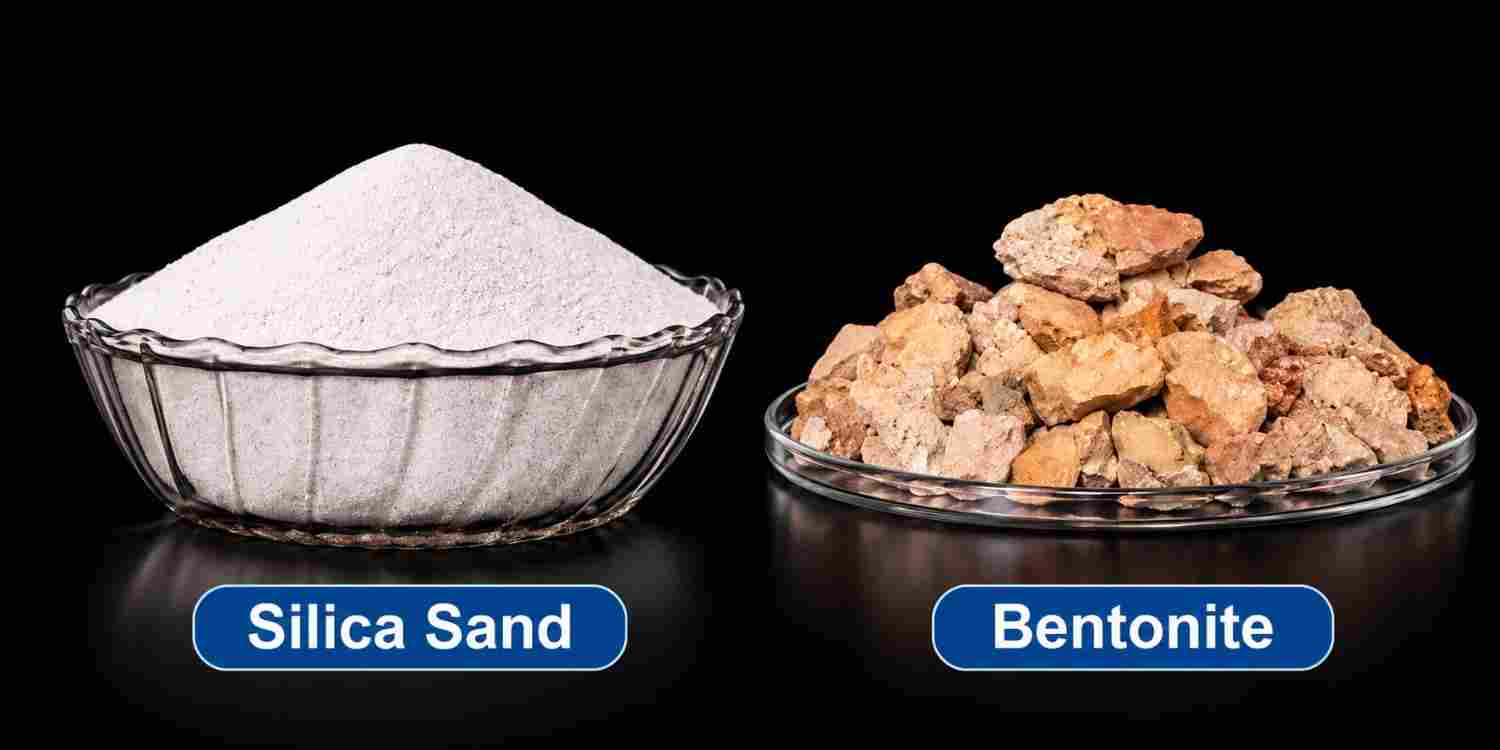
What surprises many people is how simple the recipe is. At its core, green sand is just two minerals plus water. Silica sand gives the mold its body. Bentonite clay holds that body together.
When a casting fails, the cause is very often one of these two minerals. So it pays to know what each one does and how to buy the right grade.
Green sand is a molding sand bonded with clay and water. The word “green” has nothing to do with color. It means the mold is used wet, the same way “green wood” means wood that has not been dried.
The foundry packs this damp sand around a pattern, removes the pattern and pours molten metal into the hollow. Once the metal cools, the mold is broken and most of the sand goes back into the system for the next mold.
This reuse makes green sand cheap and fast. The catch is that some clay burns out every time hot metal touches it, so the mix needs constant care.
Silica sand makes up well over 80% of a green sand mix. It faces the molten metal, so it must survive the heat. Quartz grains melt at around 1,700°C, far above the pouring temperature of iron.
But not every sand works. A foundry looks at three things before it trusts a supply:
Most of the foundry-grade silica sand India relies on comes from Gujarat, Rajasthan and Uttar Pradesh. Washing and screening at the plant matter as much as the deposit itself.
Sand grains alone will not hold a shape. Bentonite is the glue. When wet, its tiny particles swell, coat each grain and lock the sand into a firm mold.
Bentonite is a clay formed from old volcanic ash. Kutch in Gujarat is one of India’s best-known bentonite regions, which is why many bentonite manufacturers are based there.
Foundries use two main types, and each behaves differently:
|
Property |
Sodium bentonite |
Calcium bentonite |
|---|---|---|
|
Swelling |
High |
Low |
|
Strength when the mold is wet |
Good |
Higher |
|
Strength when hot and dry |
Higher |
Lower |
|
Life in a reused sand system |
Longer |
Shorter |
|
Shakeout after casting |
Harder |
Easier |
Many foundries blend the two. Heavy iron castings usually need more sodium bentonite, while light, thin parts can use more calcium bentonite.
When you compare bentonite manufacturers, ask for the swell index, the active clay content (often checked with a methylene blue test) and the moisture level of each lot. These three numbers tell you far more than a brochure.
No two foundries use exactly the same recipe, but most iron foundries stay close to these ranges:
|
Ingredient |
Typical share by weight |
What it does |
|---|---|---|
|
Silica sand |
85% to 92% |
Forms the mold and resists heat |
|
Bentonite |
5% to 10% |
Binds the grains together |
|
Water |
2% to 4% |
Activates the bentonite |
|
Carbon additive (sea coal) |
2% to 6% |
Gives iron castings a cleaner surface |
Keeping these numbers right every shift is the hard part. Sand labs test the mix several times a day for:
Most green sand defects trace back to the sand, the clay or the balance between them:
|
Casting problem |
What it looks like |
Usual cause |
|---|---|---|
|
Gas holes |
Round holes just under the surface |
Too much moisture or low permeability |
|
Rough surface |
Sandy, uneven skin on the casting |
Coarse sand or a weak mold face |
|
Burn-on |
Sand stuck to the casting |
Impure sand or low heat resistance |
|
Expansion defects (veins, scabs) |
Thin fins or raised patches |
Quartz grains expanding with heat, too little good clay |
|
Mold breakage |
Edges crumble before pouring |
Low green strength, not enough active bentonite |
Quartz grains expand suddenly at about 573°C. Healthy bentonite absorbs that movement. Weak or dead clay cannot, and the casting ends up veined.
Consistency is the real goal. Here is a simple checklist I suggest to buyers:
Gujarat has good deposits of both minerals and sits close to major ports. At The Sharad Group, we have mined and processed minerals in Kutch since 1960. Our TSG FoundryFine silica sand is AFS-certified, and our TSG Bfound bentonite is made for bonding foundry molds.
Whether you work with us or another supplier, the rule stays the same. Buy silica sand India’s foundries can rely on lot after lot, and choose bentonite manufacturers who share real test data.
Why is it called green sand? Because the mold is used while still damp. “Green” means not dried or baked, not the color of the sand.
What AFS number should foundry sand have? There is no single answer. Many green sand foundries work somewhere in the 50 to 70 range, and the right number depends on casting size and the surface finish needed.
Is silica sand from India good for foundries? Yes, when it is properly washed and graded. Indian deposits, especially in Gujarat, supply foundries at home and abroad. The key is to check test reports for every lot.
Green sand looks like plain dirt, but it is a carefully balanced material. Silica sand brings heat resistance and shape. Bentonite brings strength and grip. When both are clean, consistent and tested, the foundry gets fewer rejects and smoother castings.
If you run a foundry or buy raw materials for one, start with your sand and clay. Fixing them is often the cheapest way to fix your castings.
Submit guest articles that reach decision-makers, influencers, and professionals. Yarabook offers a trusted platform for quality content, strong backlinks, and SEO-driven visibility. Pay. Publish. Promote.