

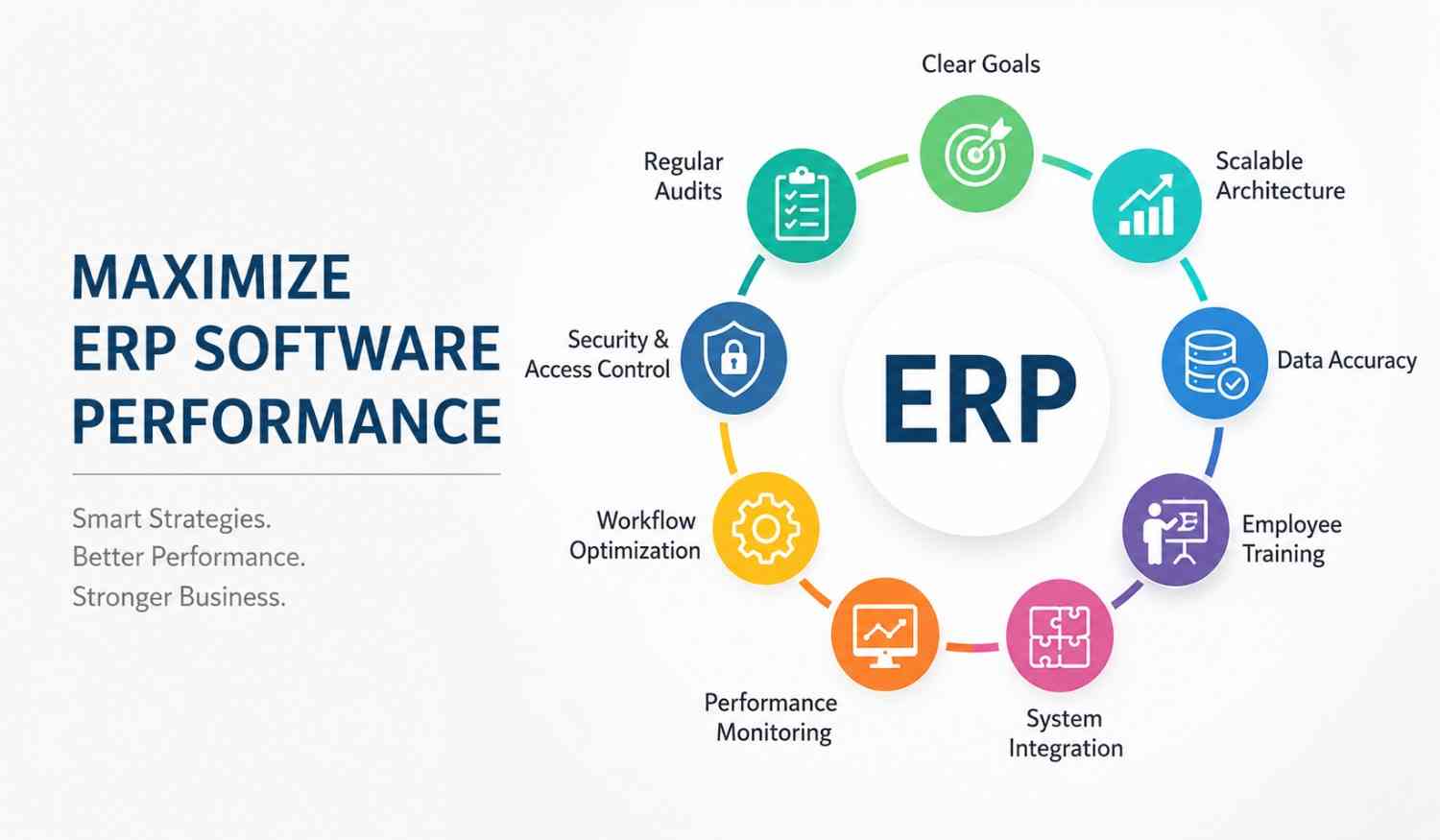
Enterprise systems are a little like office coffee machines — everyone depends on them, nobody reads the manual, and somehow one wrong button can ruin the entire morning. That is exactly why businesses spend so much time figuring out how to improve ERP software performance without turning daily operations into organized chaos.
We have seen companies invest heavily in ERP platforms only to use about 40% of their actual capabilities. The rest sits quietly in the background like unused gym equipment purchased during a motivational phase in January. The issue usually is not the software itself. More often, it is the strategy behind implementation, optimization, training, and long-term management.
And yes, there is always that one department still managing “important” records in spreadsheets even after ERP deployment. Every organization seems to have one.
So, what actually helps businesses maximize ERP efficiency? Let us walk through the strategies that make the biggest difference — without the unnecessary corporate buzzwords that somehow make simple workflows sound like rocket science.
One of the biggest mistakes companies make is implementing ERP systems without defining measurable objectives first. Businesses often focus heavily on features while ignoring operational priorities.
An ERP platform should solve real business problems. That may include reducing reporting delays, improving inventory accuracy, automating accounting workflows, or centralizing customer information. Without clear goals, even the most advanced system becomes expensive digital furniture.
We usually recommend businesses identify three major operational bottlenecks before implementation begins. This creates a practical roadmap for optimization instead of relying on assumptions later.
For example, a manufacturing company may prioritize inventory synchronization, while a healthcare provider may focus on compliance reporting and patient data management. Different industries require different ERP priorities — because no two businesses operate with the same level of beautiful chaos.
This is where experienced teams specializing in custom ERP software development often create a significant advantage by aligning technology with business-specific workflows instead of forcing generic templates onto unique operations.
Businesses frequently outgrow their ERP systems faster than expected. It happens quietly at first — more users, more transactions, more reports, more integrations — until the system starts behaving like an overworked intern on a Monday morning.
Scalability matters because growth changes operational demands rapidly. A company managing 50 employees today may need multi-location support within two years.
Modern ERP strategies should include:
Flexible architecture helps organizations expand without rebuilding their entire system from scratch later. And frankly, nobody enjoys explaining to management why a “future-ready” platform suddenly cannot handle future growth.
Businesses working with an experienced ERP software developer typically gain better long-term adaptability because scalability planning becomes part of the development strategy from day one.
ERP systems are only as reliable as the data stored inside them. Unfortunately, many companies migrate outdated, duplicated, or inconsistent data directly into their new platforms.
That is a little like cleaning a room by stuffing everything into a closet and hoping nobody opens the door.
Before migration begins, businesses should:
Clean data improves reporting accuracy, automation reliability, and system speed. More importantly, it prevents users from losing trust in the ERP platform itself.
We once observed a business spend months blaming their ERP dashboard for incorrect reports — only to discover multiple departments were entering the same customer under slightly different names. Technology cannot solve organizational confusion by itself. Sometimes it simply exposes it faster.
Here comes the part companies often underestimate.
An ERP system can have world-class functionality, but if employees do not understand how to use it properly, performance suffers immediately. Businesses sometimes treat training as a one-time event instead of an ongoing operational investment.
The result?
Employees create shortcuts.
Departments avoid system adoption.
Manual processes quietly return.
And suddenly everyone is emailing spreadsheets again.
Effective ERP training should include:
Finance teams need different workflows than HR or inventory teams. Generic training sessions rarely solve department-specific challenges.
Employees forget processes over time. Regular refresher sessions improve adoption and reduce operational errors.
Simple guides and process documentation reduce dependency on technical teams for every minor issue.
Companies that build ERP literacy internally usually achieve faster ROI because employees become more confident using automation features instead of avoiding them.
ERP software rarely works alone anymore. Businesses depend on CRM platforms, payroll systems, inventory applications, analytics dashboards, ecommerce tools, and communication software.
Poor integrations create data silos and reporting inconsistencies that slow down operations.
Strong ERP integration strategies focus on:
A disconnected business ecosystem creates unnecessary friction. Employees waste time switching between systems instead of focusing on productive work.
And honestly, nothing destroys efficiency faster than entering the same data into five different platforms while silently questioning every career decision that led to that moment.
Modern businesses benefit significantly when ERP systems function as centralized operational hubs instead of isolated software islands.
ERP optimization is not a one-time project. Businesses need ongoing visibility into how their system performs over time.
That means tracking meaningful KPIs such as:
Monitoring helps organizations identify operational bottlenecks before they become expensive problems.
For instance, if reporting delays increase every quarter, businesses can investigate whether database scaling, server performance, or workflow inefficiencies are causing the issue.
Customization can improve ERP performance dramatically when done strategically. However, excessive customization often creates maintenance headaches later.
Businesses should customize processes only when necessary.
There is a difference between:
Smart customization focuses on:
Overcomplicated systems become difficult to update, maintain, and scale. Simplicity usually wins in the long run.
ERP systems contain highly sensitive operational data — financial reports, customer records, employee information, inventory details, and strategic insights.
Security optimization is essential for both performance and compliance.
Businesses should implement:
Too much unrestricted access creates unnecessary risk. Too little access slows productivity. Finding the right balance matters.
We have seen organizations accidentally give temporary interns permission levels that looked suspiciously close to “supreme ruler of the database.” That conversation usually becomes memorable very quickly.
Even successful ERP systems require periodic evaluation. Business processes evolve constantly, and software configurations should evolve alongside them.
ERP audits help organizations identify:
Regular reviews ensure the system continues supporting current business goals rather than outdated operational habits from three years ago.
ERP systems work best when departments operate collaboratively instead of independently.
Finance, operations, sales, HR, and logistics all contribute data into the same ecosystem. Misalignment between departments creates workflow friction that impacts overall performance.
Collaborative ERP strategies improve:
When departments share visibility through centralized systems, businesses reduce duplication and improve accountability.
Maximizing ERP software performance requires far more than simply installing a platform and hoping automation magically fixes operational inefficiencies overnight.
Successful businesses focus on strategy, scalability, employee adoption, data quality, integration management, and continuous optimization. They treat ERP systems as evolving business assets rather than static software purchases gathering digital dust in the background.
The organizations achieving the strongest ERP outcomes are usually the ones willing to invest in long-term operational discipline — not just flashy dashboards and impressive presentations during implementation meetings.
What is the best way to improve ERP software performance?
The best strategy combines clean data management, employee training, scalable architecture, workflow optimization, and regular system monitoring. Businesses should continuously evaluate operational bottlenecks and improve processes over time.
Why do ERP systems slow down over time?
ERP systems often slow down because of outdated integrations, excessive customization, poor database maintenance, duplicated data, or increased user loads without infrastructure upgrades.
How important is employee training in ERP success?
Employee training is critical. Even advanced ERP systems fail to deliver value if employees do not understand workflows, automation tools, or reporting features properly.
Should businesses customize their ERP software?
Customization is beneficial when it supports industry-specific workflows or operational efficiency. However, excessive customization can increase maintenance complexity and reduce scalability.
Submit guest articles that reach decision-makers, influencers, and professionals. Yarabook offers a trusted platform for quality content, strong backlinks, and SEO-driven visibility. Pay. Publish. Promote.