

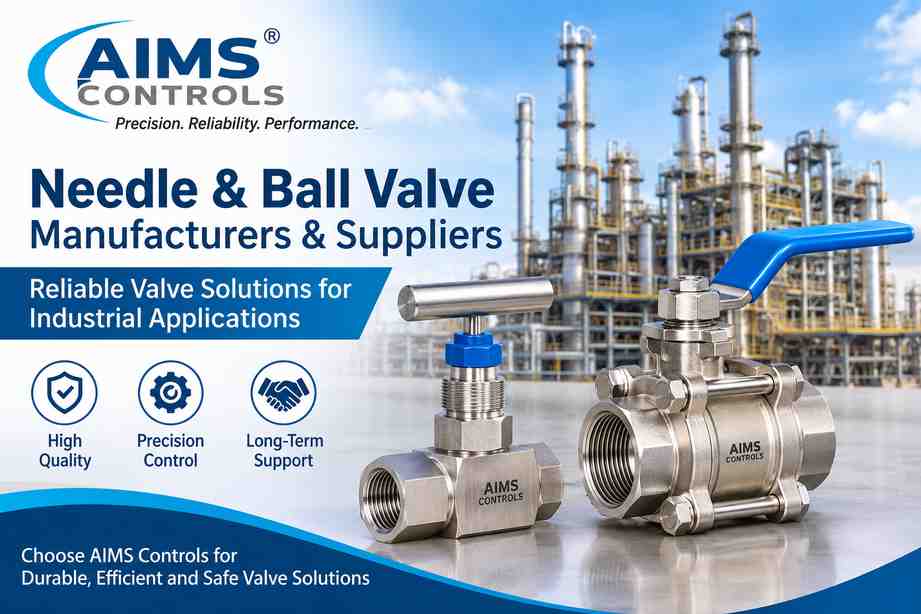
Industrial valves are essential components in manufacturing plants, processing facilities, and industrial instrumentation systems. They help regulate fluid movement, isolate equipment, and manage different process requirements.
However, selecting an industrial valve is not simply about choosing a product based on its size or material. Engineers and purchasing professionals must understand how the valve will function within the system, what operating conditions it will encounter, and which configuration is appropriate for the application.
Needle valves and ball valves are two widely used options in industrial flow-control systems. Understanding their functions and selection requirements can help businesses make better purchasing decisions.
Industrial valves are used to control the movement of liquids and gases through pipelines, instrumentation lines, and process equipment.
Depending on their design, valves may perform different functions, including:
Regulating fluid flow
Isolating equipment during maintenance
Controlling flow direction
Supporting instrumentation systems
Managing connections between process components
The correct valve selection depends on the intended function and the operating conditions of the system.
Needle valves are designed for gradual flow adjustment. Their operating mechanism uses a needle-shaped stem that moves towards or away from a valve seat, changing the available flow passage.
This design makes needle valves suitable for applications where controlled flow regulation is required.
Needle valves are commonly considered for:
Pressure measurement lines
Instrumentation systems
Gas and liquid sampling arrangements
Testing and calibration equipment
Process-control applications
When selecting a needle valve, buyers should evaluate its body material, connection type, operating pressure, temperature, and compatibility with the process fluid.
Stainless steel, brass, and alloy materials may be considered depending on the application and operating environment.
Ball valves use a rotating ball containing a bore to control fluid movement. A quarter-turn operating mechanism generally allows the valve to move between open and closed positions.
They are widely considered for industrial applications requiring convenient flow shut-off and equipment isolation.
Industrial pipelines
Process equipment
Fluid handling systems
Utility connections
Instrumentation assemblies
Different applications may require different flow arrangements.
Two-Way Ball Valves: Commonly used for basic opening, closing, and isolation.
Three-Way Ball Valves: Used in suitable systems where flow needs to be directed between different ports.
Multi-Way Ball Valves: Considered for applications requiring more complex flow arrangements.
The correct configuration depends on the system layout and intended operating function.
Although both valve types are used in industrial systems, their functions are different.
| Comparison Factor | Needle Valve | Ball Valve |
|---|---|---|
| Primary function | Controlled flow adjustment | Flow shut-off and isolation |
| Operating mechanism | Needle-shaped stem | Rotating ball |
| Typical operation | Gradual adjustment | Quarter-turn |
| Common applications | Instrumentation lines | Pipelines and process equipment |
| Selection priority | Flow regulation | Isolation requirements |
A needle valve should not automatically be substituted for a ball valve, or the other way around. The selection must reflect the actual process requirement.
Selecting a suitable valve requires a systematic evaluation of the application.
Determine the normal and maximum expected operating pressure. Check the manufacturer’s specifications to confirm that the selected valve is suitable for the system.
Temperature can affect the suitability of valve materials, seals, and internal components. Consider the complete operating temperature range.
The chemical properties of the liquid or gas must be considered when selecting body and internal materials. Corrosive or otherwise demanding process conditions may require specific material options.
Check the connection requirements of the existing pipeline or instrumentation assembly. Correct connections are important for installation compatibility.
Identify whether the system requires gradual flow adjustment, simple isolation, or a specific multi-port flow arrangement.
Review product specifications and available technical documentation. A knowledgeable supplier can help clarify material options, configurations, and application suitability.
Industrial purchasing decisions can influence equipment maintenance, installation planning, and process operations.
Businesses should evaluate suppliers based on relevant product availability, technical information, manufacturing capabilities, material options, and support.
Instead of selecting a valve solely on price, purchasing teams should compare the product’s suitability with the actual operating requirements.
AIMS Controls is the official trademark of PI Controls Instruments Pvt. Ltd., an Indian manufacturer and supplier of industrial instrumentation and process-control products.
Established in 2018, the company operates from Vapi, Gujarat, with a 3,500 sq. ft. manufacturing facility. Its product range includes:
Needle valves
Ball valves
Valve and manifold assemblies
Pressure gauges and switches
Temperature gauges and switches
Pressure transmitters
Thermocouples and RTD sensors
Level gauges and flow switches
Instrumentation fittings
These products are relevant to applications across oil and gas, petrochemical, steel and power, cement, pharmaceutical, food and beverage, and other process industries.
Businesses looking for Needle & Ball Valve Manufacturers & Suppliers should evaluate product specifications, material compatibility, valve configurations, and operating requirements before making a final decision.
AIMS Controls provides a range of industrial valve and instrumentation products for different process applications.
Explore the available product information here:
https://www.aimscontrols.com/needle-ball-valve-manufacturers-suppliers/
For additional information about the company and its industrial instrumentation range, visit:
Selecting an industrial valve requires more than identifying a suitable product category. Engineers and purchasing professionals must understand the process, operating conditions, material requirements, connection types, and intended valve function.
Needle valves are generally considered for controlled flow adjustment, while ball valves are commonly used for convenient shut-off and isolation. Evaluating these differences helps businesses identify suitable products for their industrial systems.
A well-informed selection process, supported by accurate technical information and appropriate supplier guidance, is an important step towards dependable industrial operations.
Submit guest articles that reach decision-makers, influencers, and professionals. Yarabook offers a trusted platform for quality content, strong backlinks, and SEO-driven visibility. Pay. Publish. Promote.