

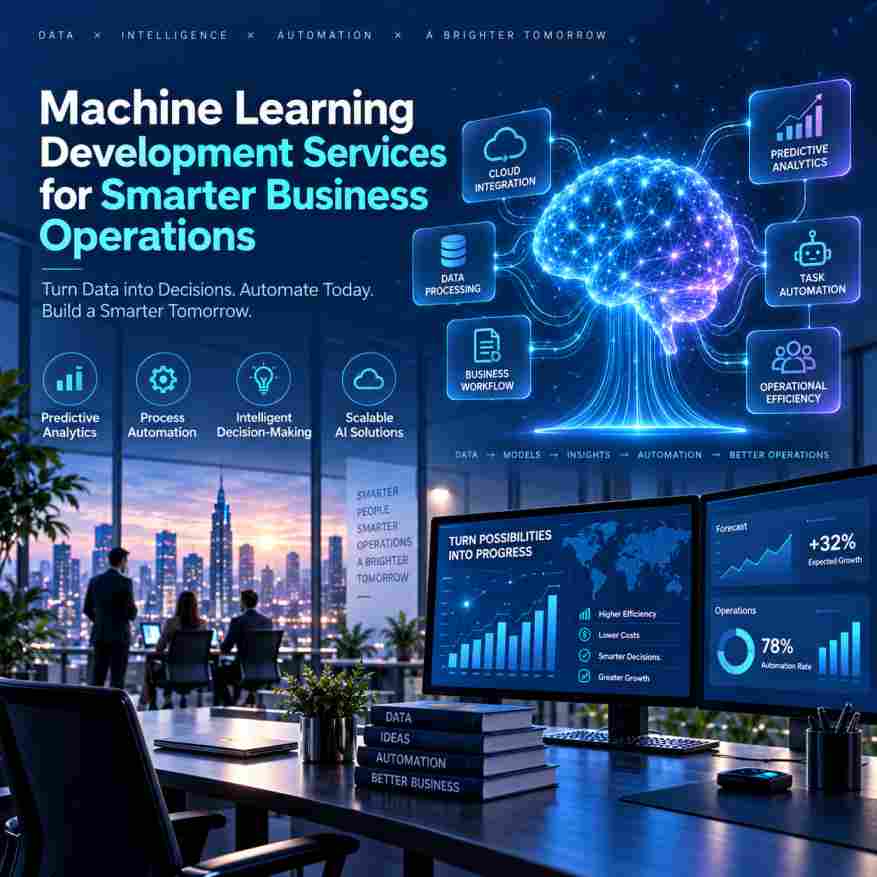
Businesses today generate large volumes of data through customer interactions, sales activities, websites, applications, internal systems, and connected devices. However, data alone does not create value. Companies need intelligent systems that can identify patterns, automate repetitive work, support decision-making, and improve operational efficiency.
This is where machine learning development services become valuable. By building tailored ML solutions, businesses can transform raw information into practical insights and automated processes.
Below are some of the most effective ways machine learning development can help organizations create smarter and more efficient business operations.
Many organizations still depend on employees to perform repetitive activities such as data classification, document processing, record verification, information sorting, and workflow updates.
Machine learning models can automate many of these tasks by learning from historical examples and recognizing patterns.
Businesses can use ML-powered automation for:
Categorizing customer requests
Processing documents
Detecting duplicate records
Routing support tickets
Extracting important information
Automating routine approvals
Reducing manual work allows employees to focus on higher-value responsibilities while improving consistency across daily operations.
Traditional business decisions are often based on reports created from past data. Machine learning can take this process further by analyzing large datasets and identifying relationships that may be difficult to detect manually.
Custom ML models can help businesses understand:
Customer behavior
Sales performance
Operational bottlenecks
Market trends
Demand patterns
Resource requirements
Instead of depending entirely on assumptions, decision-makers can use data-driven insights to plan business activities more effectively.
Demand forecasting is important for industries such as retail, manufacturing, logistics, healthcare, eCommerce, and distribution.
Machine learning algorithms can analyze historical sales, seasonal patterns, customer activity, promotions, market conditions, and other variables to estimate future demand.
Better forecasting can help businesses:
Maintain appropriate inventory
Reduce excess stock
Avoid product shortages
Improve production planning
Allocate resources efficiently
Accurate demand predictions can also support better financial and operational planning.
Customers increasingly expect businesses to provide relevant and personalized experiences.
Machine learning development services can help organizations build recommendation engines and personalization systems based on customer interests, browsing activity, purchase history, and engagement patterns.
Personalization can be applied to:
Product recommendations
Content suggestions
Email campaigns
Promotional offers
Search results
Customer support
A more relevant customer experience can improve engagement and strengthen long-term relationships.
Fraudulent activities can create financial losses and operational challenges for businesses.
Machine learning systems can analyze large volumes of transactions and detect unusual behavior based on historical patterns.
For example, an ML-powered risk system may identify:
Unusual transaction activity
Suspicious login behavior
Abnormal purchasing patterns
Potential account misuse
Unexpected financial activity
Instead of depending only on fixed rules, machine learning systems can continuously improve as new patterns appear.
Poor inventory management can lead to unnecessary expenses, lost sales, and inefficient warehouse operations.
Machine learning solutions can analyze inventory movement, customer demand, seasonal trends, supplier performance, and sales history.
Businesses can use these insights to determine:
When products should be reordered
How much stock should be maintained
Which products move quickly
Which products remain unsold
Where inventory should be distributed
This creates a more efficient inventory strategy and reduces unnecessary operational costs.
Customer support teams often receive large volumes of requests across email, chat, websites, social platforms, and help desks.
Machine learning can help organize these interactions and identify customer intent.
ML-powered support solutions can assist with:
Ticket categorization
Priority detection
Automated response suggestions
Sentiment analysis
Customer request routing
Frequently asked question identification
These capabilities allow support teams to respond faster while maintaining better service quality.
Businesses that depend on machinery, equipment, vehicles, or industrial systems can use machine learning for predictive maintenance.
Instead of waiting for equipment to fail, ML models can analyze sensor readings, usage patterns, maintenance history, and performance indicators.
The system can identify possible signs of equipment problems before major failures occur.
Predictive maintenance can help organizations:
Reduce unexpected downtime
Schedule maintenance efficiently
Extend equipment life
Reduce repair costs
Improve production reliability
This approach is especially useful for manufacturing, transportation, logistics, and industrial businesses.
Sales forecasting plays an important role in revenue planning and business strategy.
Machine learning models can evaluate previous sales records along with factors such as customer behavior, marketing campaigns, seasonal demand, pricing, and market trends.
Businesses can use these forecasts to:
Set realistic sales targets
Plan marketing campaigns
Allocate sales resources
Identify growth opportunities
Prepare revenue projections
More accurate forecasting allows organizations to respond quickly when business conditions change.
Marketing teams generate large amounts of customer and campaign data.
Machine learning can analyze this information to understand which audiences, channels, campaigns, and messages are delivering better results.
ML-powered marketing systems can support:
Customer segmentation
Lead scoring
Campaign optimization
Audience targeting
Conversion prediction
Customer churn analysis
These insights allow marketers to spend budgets more efficiently and focus on audiences that are more likely to engage.
Unexpected changes in business processes can indicate technical problems, inefficient workflows, security issues, or unusual customer behavior.
Machine learning models can continuously monitor operational data and detect unusual patterns.
For example, businesses may use anomaly detection to identify:
Sudden website traffic changes
Unexpected transaction volumes
Production irregularities
Abnormal system behavior
Unusual customer activities
Early detection helps teams investigate problems before they create larger operational disruptions.
Machine learning development is not limited to analytics. ML capabilities can also be integrated directly into business applications.
Organizations can develop intelligent software with features such as:
Recommendation engines
Image recognition
Predictive analytics
Natural language processing
Smart search
Document classification
Customer behavior analysis
Automated decision systems
These capabilities can make existing digital products more useful while helping businesses create new services.
Ready-made AI tools can be useful for general requirements, but they may not always match specific business processes.
Custom machine learning solutions are developed around an organization’s own data, workflows, infrastructure, and objectives.
A typical ML development process may include:
Business requirement analysis
Data collection and preparation
Model selection
Machine learning model development
Testing and validation
Application or API integration
Deployment
Performance monitoring
Continuous model improvement
This approach allows companies to implement machine learning according to their actual operational needs rather than adjusting their processes around generic software.
Machine learning is becoming an important technology for organizations looking to automate processes, understand data, improve customer experiences, and operate more efficiently.
From demand forecasting and customer personalization to predictive maintenance and fraud detection, machine learning development services can support many areas of modern business operations.
The most effective ML solution is not necessarily the most complex one. It is a solution designed around a clear business challenge, reliable data, measurable goals, and practical integration with existing systems.
Businesses that begin with focused use cases can gradually expand machine learning across different departments and build smarter, more data-driven operations over time.
Submit guest articles that reach decision-makers, influencers, and professionals. Yarabook offers a trusted platform for quality content, strong backlinks, and SEO-driven visibility. Pay. Publish. Promote.