

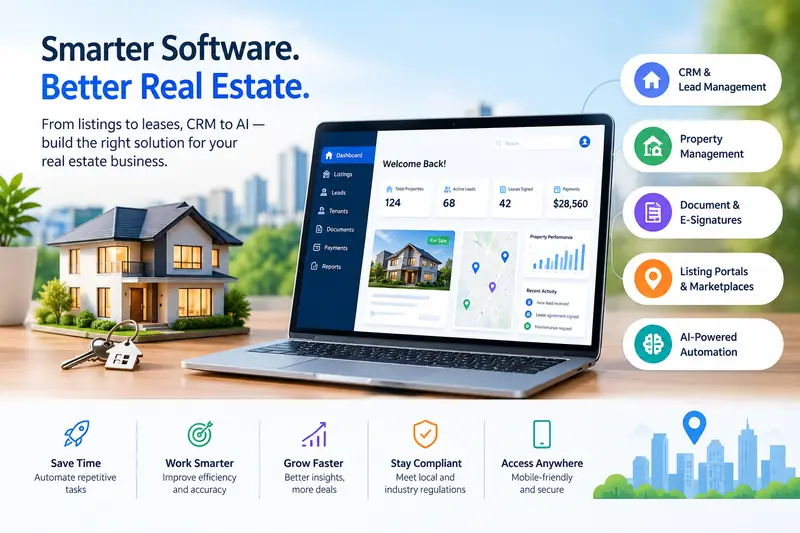
A few years ago, real estate software mostly meant a listing site and a contact form. Now a single brokerage might run a CRM, a tenant portal, a document workflow, and several integrations that all have to stay in sync. Buyers expect more, and so do the people using the tools every day.
If you’re researching real estate software development services, this guide covers what’s happening in the market, what to build first, what it costs, and how to pick a partner you can trust.
One industry overview puts the global PropTech market at $54.66 billion in 2026, with a projection above $185 billion by 2034. Forecasts vary by source, so take the exact numbers loosely. What matters is the direction. Software makes up roughly three quarters of the PropTech market, and most of it runs in the cloud.
Basic features no longer impress anyone. The same overview says 91% of real estate firms already use digital listings, and buyers now expect 3D tours, interactive floor plans, and smart search. A plain listing page is just the starting point.
For the last couple of years, AI in real estate mostly meant writing listing descriptions and social posts. That’s changing.
The National Association of Realtors’ 2026 technology report shows where agents stand today. About 23% use AI daily, 25% use it weekly, and another 31% are experimenting. Time savings was the top reason, cited by 81% of respondents. Coverage of the report describes a move away from content creation and toward cutting operational work.
Software vendors are heading the same direction. On September 29, AppFolio announced AI upgrades to its platform, including a new version of its Realm-X assistant. The company says AI actions completed on its platform grew sevenfold year over year, and that the assistant can handle multi-step tasks and remember the conversation instead of answering one prompt at a time.
In practical terms, “agentic” features do a job instead of just suggesting one. Examples already appearing in property software:
The first is hype. MRI Software’s 2026 outlook expects the industry to separate superficial “AI-washed” tools from products with AI genuinely built in. When you interview a development company, ask what their AI features achieved for a real client, not what they might do in theory.
The second is quality. One recent piece aimed at agents warns that AI-generated content can sound inauthentic and sometimes gets things wrong. For software builders, the lesson is simple: keep a human approval step on anything customer-facing, like contracts, pricing statements, and sensitive messaging.
It’s tempting to start with the flashy assistant. In practice, many AI projects stall because the data behind them is scattered across old systems. One PropTech guide lists legacy system integration as a core challenge, noting that many firms still run decade-old property management software.
A sensible order looks like this:
A good development partner will push you toward this sequence, even when a shinier option is on the table.
Real estate CRM. Lead capture, pipelines, follow-ups, and client portals. It’s the most common first project for brokerages and developers.
Property management software. Rent collection, leases, maintenance, tenant messaging, and reporting.
Listing portals and marketplaces. Search, maps, saved searches, agent profiles, and lead routing, often with MLS or IDX connections.
Investment and underwriting tools. Document parsing, comps, cash flow models, and portfolio dashboards.
Smart building platforms. Sensor data, predictive maintenance, and energy monitoring, mostly for commercial owners.
Whatever you choose, make sure the scope includes role-based access, document management with e-signatures, payments, readable dashboards, and messaging integrations (WhatsApp matters a lot in India). Mobile apps also need to feel as polished as banking or shopping apps. Security matters too. One guide notes that cybersecurity is increasingly a procurement criterion, so buyers will ask about it.
Rules differ by market, and your software has to reflect them. In India, one local guide says several state RERA authorities, including Maharashtra, Karnataka, Tamil Nadu, and Uttar Pradesh, now expect digital escrow integration with developer software, with a quoted integration cost of ₹1.5 lakh to ₹4 lakh. In the US, one guide says a configurable state-specific compliance engine for multi-state property managers adds $30,000 to $80,000. Other regions bring MLS rules, fair housing requirements, and privacy laws like GDPR or CCPA.
These rules change, so have a lawyer review yours, and pick a developer who has handled them before.
List the three slowest or most error-prone tasks your team handles each week. Pick the one with the clearest payoff, like lead follow-up, rent collection, or document handling. Ask two or three companies to scope a small MVP around it, pilot it for a month, and measure the time saved or revenue gained. Expand only when the numbers look good.
What are real estate software development services?
They cover designing, building, integrating, and maintaining software for property businesses, including CRMs, property management systems, portals, mobile apps, and AI tools.
How long does a build take?
Published guides suggest roughly 6 to 10 weeks for a basic CRM, 3 to 5 months for property management software, and 6 to 12 months for a full marketplace. Integrations and clear requirements affect the timeline most.
Is AI worth adding now?
Yes, if it’s tied to a measurable job, like faster lead response or sorting maintenance requests. It’s a poor investment if it’s only there to look modern.
Should I buy or build?
Buy if your workflow is standard. Build or go hybrid if you have specialized processes or fast-growing user counts.
The notable change in 2026 isn’t that real estate firms use more software. It’s that software is beginning to act on its own inside systems that hold a company’s leads, leases, and payments. That’s powerful, and it makes the foundation more important.
The right partner for real estate software development services will be honest about what AI can and can’t do, careful with your data, familiar with your local rules, and comfortable starting small.
Ready to scope your project? Share your business type, current tools, and the one process you most want to fix, and ask for a phased proposal with a timeline and budget.
Submit guest articles that reach decision-makers, influencers, and professionals. Yarabook offers a trusted platform for quality content, strong backlinks, and SEO-driven visibility. Pay. Publish. Promote.