

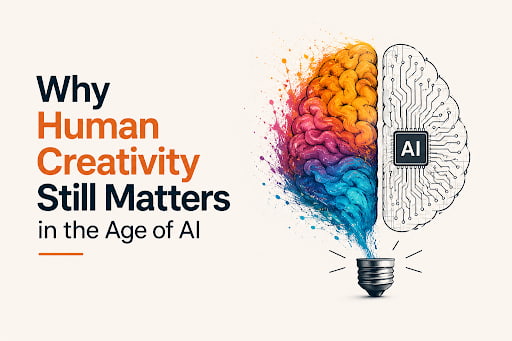
Recent studies have shown that the rate at which AI is being adopted has grown considerably in the creative process throughout different sectors. The McKinsey State of AI Report states that organizations are using AI more and more in their activities to make the design, marketing, and content development processes easier. With the help of ChatGPT, Midjourney, and Figma AI, it has become easier for organizations to generate ideas, develop UI designs, and improve the entire creative process.
However, as fast as the process of creativity has become, many digital solutions nowadays seem to be increasingly similar. If you look at the websites of modern startups, you would see that they all have similar layouts, similar text on their pages, and similar beautiful and polished designs. Everything is optimized, but little looks truly unique and original.
This makes human creativity enormously valuable in the present age of AI. Creativity has never been just about the process of writing content fast, but rather about understanding people, their emotions, behavior, and experiences thoroughly enough to be able to come up with something meaningful.
AI can generate content, but the creative work gives it emotions, originality, and a sense of purpose.
The use of AI in today’s modern creative practices is gaining ground quickly. Nowadays, teams rely on the use of Figma AI, ChatGPT, and Midjourney to generate ideas and visuals and hasten their work.
Thanks to AI, businesses can:
This opens new doors for startups and expanding companies. But the increasing use of AI produces a problem with the digital experience getting too similar.
One of the major drawbacks of AI-created designs is that many of them appear similar. Check any website pages of startups today, and you will begin to notice the same layout of website structure, recognizable user interface designs, engaging copywritten content, and very similar artistic styles used widely on the internet.
The explanation for this phenomenon is simple. AI collects information from a lot of different designs people have already created. It processes a huge database of different web designs that already exist, gets the idea of visual art, and generates new designs in accordance with existing patterns from previous products. Consequently, many designs created in this way look nice but lack the target value.
The creativity of the individual is completely different from that of the AI. The creativity of the human being comes from personal experience, emotions, curiosity towards life, and cultural knowledge. That is why unique designs usually cannot be the same: a real creator knows how people think and creates meaningful solutions using the proper approach.
AI has certainly sped up design processes. Using innovative AI systems, designers will be able to create models, UI concepts, and screens in a matter of minutes. So, while it is extremely useful for speeding up the development process, it is necessary to understand that just because something is produced faster, it doesn’t mean it is good.
Meanwhile, many AI designs appear very beautiful, but they might be boring in use when people use them. Although the design may be appealing at first, it will lose its potential if its users find it confusing and unnatural.
This is the place where humans come into play:
This is the reason why nothing can change the importance of human thinking.
The use of AI is growing in importance in the work of creative professionals since it makes teams more efficient and takes care of monotonous, repetitive activities. Processes that used to take hours now take minutes, and businesses have the means to try new things, tweak their processes, and act more quickly.
At present, companies operate AI to:
It helps immensely in dealing with start-up companies and fast-working teams. The concept of artificial intelligence helps in accomplishing tasks easily. It enables teams to spend their time improving their ideas rather than working manually. While artificial intelligence is really good at making things faster and more efficient, being creative is still something that people do best. People remember products not just because they look nice. They remember them because they are easy to use, make them feel something, and mean something to them. That kind of connection still comes from people thinking, caring about others, and understanding the real world.
Despite the rapid development of AI, it is hard to say that there are no areas of creativity where humans still have the advantage. The use of AI is fast, yet the process of creating requires emotional intelligence, strategy, and practical experience.
A good design and a good story are grounded in the understanding of how the human mind works. People have always been creative thanks to their own experiences, other people’s feelings, and their interpersonal connections, which is still something that AI struggles with.
Being creative does not mean just being able to create a nice piece. It means understanding the relevance of the idea and its impact on the users.
A lot of creative decisions are informed by the behavior of an audience, cultural currents, business needs, and perception of emotions. Humans inherently know context, whereas AI-generated technology fails to fully comprehend it.
While AI takes into account the patterns and produces output according to previous information, humans produce ideas that disrupt such patterns and give a new perspective on things.
Brand value is created via stories, emotions, and connections. While AI may help with implementation, the creativity that comes from people is what makes it relevant.
It is for this exact reason that companies that wish to build their brands and offer a distinct user experience will put so much effort into fostering human creativity and design thinking.
As AI-generated content becomes accessible, originality is becoming a defining factor for organizations. The same technologies, design platforms, and workflows are available to organizations. Different digital experiences look wonderful but lack emotional content.
As a result of this change, organizations have new priorities. Speed and efficiency, previously critical to organizations’ differentiation, are no longer essential.
At the same time, experiences characterized by clarity, memorability, and human touch are being appreciated more and more as these qualities have not yet been imitated correctly by artificial intelligence.
According to EncodeDots, companies building strong brands today are using technology to automate processes. They do not use automation to replace creativity but rather facilitate the process of creating ideas and experiences that people can relate to.
It is clear that AI is having a huge impact on the creative industry today, and this impact will grow even further into the future. Creative processes are becoming much quicker and more efficient, and companies now have access to technology that allows generating ideas, designs, and content in a matter of minutes.
However, as the use of AI-generated content becomes more common, human creativity and thought processes become easily recognizable.
Creatives that stick in people’s minds are usually not those who prioritize speed. The creations that people tend to remember most are those that seem intuitive, emotional, and thought through in order to fit real human needs. Human creativity is based on perspective, empathy, and good stories.
The influence of AI will keep improving the processes of creating content and design. However, the companies and creatives who will succeed in their business will be those who learn how to combine technology and creativity into something meaningful and human.
Submit guest articles that reach decision-makers, influencers, and professionals. Yarabook offers a trusted platform for quality content, strong backlinks, and SEO-driven visibility. Pay. Publish. Promote.