

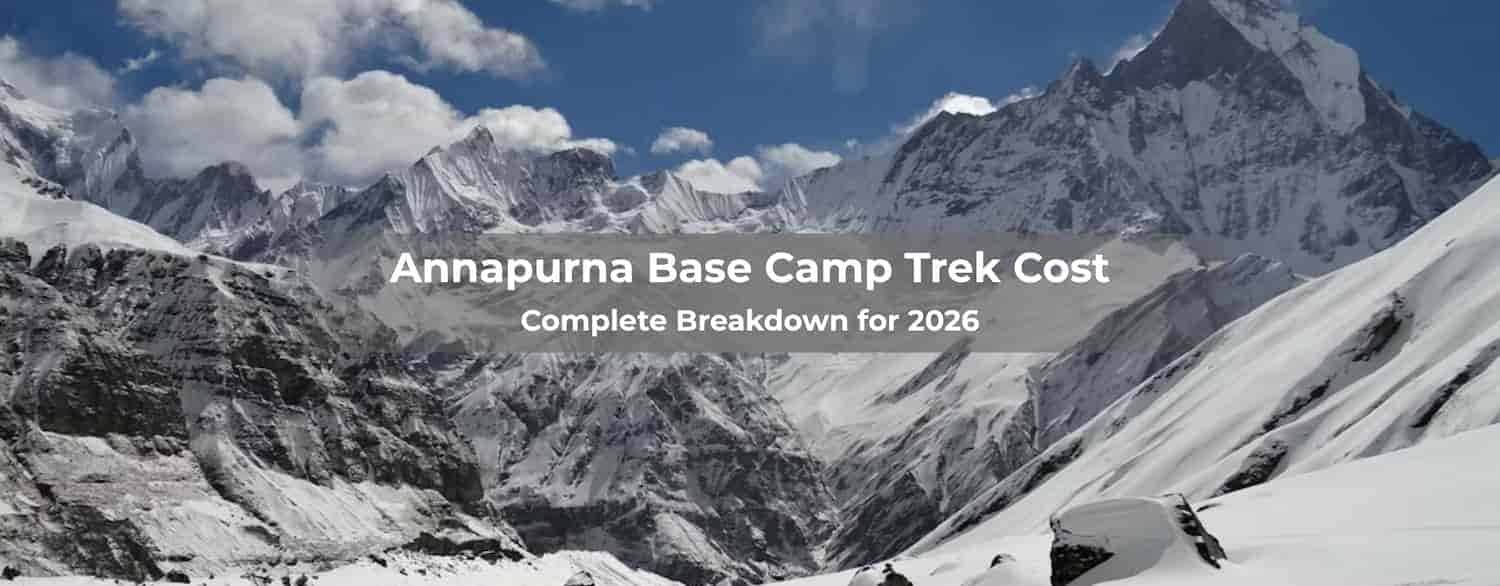
The Annapurna Base Camp (ABC) trek costs between $700 and $1,800 per person in 2026, based on a standard 14-day itinerary starting and ending in Pokhara. Where a trekker lands in that range depends on three practical choices: how much support they hire, when they travel, and what level of accommodation and transport they prefer. The article breaks this down into three tiers—Budget ($700–$1,050, roughly $35–$50/day), Standard ($1,050–$1,500, roughly $55–$80/day), and Comfort ($1,500–$1,800, roughly $90–$130/day)—and notes that international flights, Kathmandu accommodation, pre/post-trek meals in Pokhara, and souvenirs are not included, adding another $200–$400 depending on choices.
Cost categories
Six categories make up nearly all on-trail spending: permits, guide and porter fees, accommodation, food, transport, and insurance. Across a 14-day itinerary, permits stay fixed at $42–$45 regardless of trekking style, while guide and porter costs scale the most dramatically — from $280–$390 at the budget level up to $770–$980 for comfort-tier service. Food runs $196–$504 and accommodation $42–$280 depending on tier, with transport and insurance adding smaller but still meaningful amounts.
Permits
Two permits are mandatory: the ACAP (Annapurna Conservation Area Permit, NPR 3,000 / ~$25), which funds trail maintenance, wildlife conservation, and community development across the 7,629 sq km protected zone, and the TIMS card (Trekkers’ Information Management System, NPR 2,000 / ~$17), a safety registration document used by rescue teams to locate trekkers in an emergency. Both are available at the ACAP office in Pokhara or the Nepal Tourism Board office in Kathmandu, take 20–45 minutes to process (longer in peak season), and require a passport copy plus two passport photos. Permits are checked on trail at Birethanti and Chhomrong, and trekking without them results in fines or a forced return to Pokhara — no exceptions.
Guide and porter costs
This is the largest variable in the budget, accounting for 35–50% of total trail spending. Since 2023, Nepal’s government has made licensed guides legally mandatory for all ABC trekkers — solo independent trekking without one is prohibited, not just discouraged, and is enforced at checkpoints. A licensed guide costs $25–$40 per day (inclusive of their own accommodation, meals, and government insurance), monitors acclimatisation, watches for early signs of altitude sickness, and coordinates emergency evacuations. A porter costs $16–$25 per day and carries up to 20–25 kg of gear. For a 14-day trek, that’s $350–$560 for a guide and $224–$350 for a porter. Costs drop sharply when split across a group: guide fees are fixed per trek and divided among trekkers, so a solo trekker pays $574–$910 in combined guide/porter costs while a group of four pays closer to $200–$315 per person. The article also advises verifying any independently hired guide’s government-issued license card before agreeing to terms.
Food and accommodation
Tea house meals follow a predictable trail-wide menu — dal bhat, noodles, eggs, soups, and Western options — with dal bhat singled out as the best value due to unlimited refills. Prices rise steadily with elevation because everything sold above Chhomrong (where road access ends) is carried up by porter or flown in by helicopter: a plate of fried rice costing NPR 450 in Ghandruk can cost NPR 800–950 at Annapurna Base Camp itself. Basic tea house rooms run $3–$15 per night depending on elevation, with shared facilities becoming standard above 3,000m and no advance booking system at most stops. Beyond meals and rooms, hot showers, device charging, Wi-Fi, and boiled water are charged separately and can add $80–$150 over 14 days — the article recommends carrying a water purification method and a power bank to cut this down.
Transport
Getting to and from the trailhead at Nayapul (roughly 42 km from Pokhara) costs $2–5 by public bus or $50–80 by private jeep, shared among a group. Some itineraries push further by jeep to skip lower-trail walking, at a higher cost. A shared helicopter return from ABC or Jhinu Danda runs $250–400 per person, usually reimbursed by travel insurance but paid upfront. Between Kathmandu and Pokhara, options range from a $12–18 tourist bus (7–8 hours) to an $80–150 domestic flight (25 minutes), with most international trekkers opting to fly given time constraints and variable road conditions.
Insurance
Travel insurance is treated as non-negotiable rather than optional. A helicopter evacuation from ABC costs $1,000–$5,000 out of pocket without coverage, and policies must specifically cover helicopter evacuation (minimum $100,000, with some Nepal operators requiring $500,000), emergency medical treatment at altitude, trip cancellation, and gear loss. Crucially, standard travel insurance sold at airports or bundled with bank accounts commonly excludes trekking above 3,500–4,000m — and the ABC summit sits at 4,130m, so checking the altitude clause specifically matters more than the price of the policy. Adequate coverage for a 14–18 day trip typically costs $60–$150.
Agency package vs. independent trekking
The article directly challenges the common assumption that independent trekking is cheaper. A standard 14-day agency package costs $900–$1,400 and includes permits, guide, porter, meals, accommodation, and trailhead transport. Building the same trek independently as a solo trekker totals $1,224–$1,802 once guide, porter, accommodation, food, transport, and insurance are added up separately — meaning independent planning often costs more while adding logistics most first-time trekkers from abroad aren’t set up to handle. The article also notes that Western tour operators typically add a 30–50% markup over local Nepali agencies for the same on-the-ground service, since the trek is frequently subcontracted to the same local operators regardless of which brand books it. For trekkers comparing whether the ABC route is even the right fit, eBcTrails points readers toward its companion piece, Manaslu vs. Annapurna Circuit Trek: Which One Is Right for You?, as a parallel decision-making resource.
Hidden costs
A dedicated section covers costs absent from most planning guides: guide and porter tips, which are not contractual but strongly expected — $300–500 for a guide and $150–250 for a porter over 14 days, paid as a lump sum in cash at the end of the trek; Pokhara pre/post-trek stays, budgeted at $150–300 for three nights; gear rental in Pokhara (trekking poles, down jackets, sleeping bags, duffel bags), recommended over renting at trailhead villages where prices are higher; and an emergency cash buffer of 20% above the planned on-trail budget, since ATMs don’t exist along much of the route.
Bottom line and next steps
The article closes by reiterating the $700–$1,800 range and matching each tier to a trekker profile — budget for flexible, experienced trekkers, standard for first-timers, comfort for those prioritising ease. It recommends five concrete steps before booking: choosing a budget tier, securing travel insurance first and confirming its altitude limit covers 4,130m, booking permits early during peak months (October–November, March–May), requesting a written cost breakdown from a licensed local agency rather than a verbal quote, and starting physical preparation 6–8 weeks out. The guide ends by directing readers ready to commit toward the Wonderful Annapurna Base Camp Trek 14 Days package, eBcTrails’ own ABC itinerary, which bundles permits, a licensed guide, porter, meals, and trailhead transport into a single written quote with no hidden charges.
Submit guest articles that reach decision-makers, influencers, and professionals. Yarabook offers a trusted platform for quality content, strong backlinks, and SEO-driven visibility. Pay. Publish. Promote.