

If you’re running a small business and still tracking leads in spreadsheets or relying on memory to follow up with prospects, you already know the problem: there just aren’t enough hours in the day. AI-powered CRM automation solves this by handling the repetitive, time-consuming parts of customer relationship management — lead scoring, follow-ups, data entry, forecasting — so you can focus on the conversations that actually close deals.
AI-powered CRM automation refers to customer relationship management systems that use artificial intelligence and machine learning to automatically analyze customer data, predict behavior, and execute tasks without manual intervention. The key word is actively — where a traditional CRM is a filing cabinet that stores information, an AI CRM is more like a junior analyst that never sleeps: it watches your pipeline, flags what matters, and nudges you toward the next right action.
Strip away the marketing language, and modern AI CRMs come down to five capabilities that do the heavy lifting:
The problem: Small business owners waste hours chasing cold leads while hot prospects sit unnoticed further down the list.
The AI solution: Machine learning analyzes hundreds of data points — email opens, website visits, engagement history, demographic fit — to automatically score each lead from 0–100, surfacing your highest-probability prospects instead of whoever emailed most recently.
Real impact: Sales teams using AI lead scoring report 30% higher conversion rates because they’re spending energy on deals most likely to close.
Example: A Lahore-based manufacturing supplier implemented AI CRM and discovered leads who’d downloaded two specific whitepapers had a 73% close rate — a pattern invisible to manual review. Once the system auto-flagged those prospects for follow-up, the company saw a 28% revenue increase within three months.
The problem: Traditional forecasting runs on gut feelings and outdated spreadsheets, leading to missed targets and poor resource planning.
The AI solution: AI analyzes historical deal patterns, seasonal trends, and pipeline velocity to generate forecasts that update continuously as deals move or stall.
Real impact: Businesses using AI-powered forecasting hit around 83% accuracy compared to 45–60% with manual methods — the difference between confidently planning inventory and hiring versus getting blindsided by a shortfall.
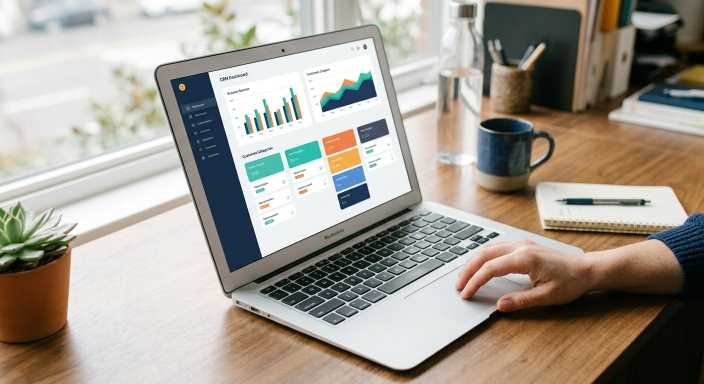
Your dashboard starts looking less like a static report and more like a live readout: “Deal #4521: 78% probability to close by Sept 30” or “Warning: Pipeline coverage 15% below target for October.” Catching a gap like that in September, instead of discovering it in November, is what actually saves money.
The problem: A large share of sales reps stop following up far too early, even though most sales need multiple touches before they close.
The AI solution: AI monitors customer behavior and triggers personalized follow-ups at the right moment. If a prospect opens your pricing email three times without responding, the system sends a case study instead of another generic nudge; if they revisit your demo page, it prompts your rep to call.
Real impact: Companies using AI follow-up automation see roughly a 35% increase in response rates and 25% shorter sales cycles.
Smart timing: AI doesn’t just automate the sending — it optimizes the when, learning each prospect’s typical email-opening patterns to schedule outreach for maximum engagement. That kind of personalization at scale isn’t something a manual process can replicate.
The problem: Sales reps lose 2–3 hours a day to manual data entry — logging calls, updating contacts, copying email threads by hand.
The AI solution: AI-powered CRMs automatically capture email exchanges, call recordings, meeting notes, and website activity, while enriching contact records with company size, funding rounds, and recent news — no manual research needed.
Real impact: Small businesses save an estimated 15 hours per employee per month on data entry alone. One three-person team calculated this added up to 540 hours a year — effectively a free extra rep, without the salary. And cleaner, auto-enriched data makes every other AI feature — scoring, forecasting, insights — more accurate; garbage data in still means garbage predictions out.
The problem: By the time you notice a customer is unhappy or ready to buy more, it’s often too late to act.
The AI solution: AI analyzes patterns across thousands of interactions to flag churn risk, surface upsell opportunities, and project lifetime value.
Real impact: Businesses using predictive insights report roughly a 70% improvement in customer engagement and a 40% reduction in churn — the shift from reacting to problems to preventing them.
Practical example: One implementation found customers inactive for 14 days had an 82% churn rate within 60 days. Once the system started sending automated re-engagement campaigns on day 10, churn dropped by 31% in a single quarter — the kind of early-warning signal a human team would rarely catch in time.
AI CRM adoption among small businesses has crossed the 50% threshold in 2026, and the numbers back up the hype:
The AI-in-CRM market is scaling accordingly — from roughly $11 billion in 2025 to a projected $48.4 billion by 2033. But only about 65% of businesses have actually activated the generative AI features already sitting inside their CRM. That gap is the opportunity: early adopters fully turning on lead scoring, automation, and predictive analytics now are the ones capturing the advantage while a third of the market leaves it on the table.
A structured four-week rollout works far better than flipping everything on at once.
Week 1 — Assessment & Selection: Audit your sales funnel and identify bottlenecks, define must-have AI features and integration needs, then test 3–5 platforms (Zoho CRM Plus, HubSpot, Salesforce Einstein, Capsule) using free trials. Don’t skip the audit — the businesses that struggle most are the ones that pick a platform before understanding which processes actually need fixing.
Week 2 — Data Migration & Setup: Clean existing data (remove duplicates, standardize formats), import it, and configure your AI features — lead scoring models, automation rules, dashboards. This unglamorous week determines whether your AI features are useful later, since importing a messy contact list just means your scores and forecasts start out wrong.
Week 3 — Integration & Automation: Connect email, calendar, phone, and accounting tools; build automated sequences for lead nurturing and follow-ups; and train your team hands-on. Skipping training turns a CRM full of AI recommendations into a dashboard nobody trusts.
Week 4 — Launch & Optimization: Go live with new leads while keeping parallel tracking for two weeks as a safety net, monitor adoption and forecast accuracy, then refine and expand automation gradually.
Common mistakes to avoid: over-automating every touchpoint instead of keeping high-value conversations human; ignoring data quality; skipping training; and expecting instant results — AI models typically need 30–60 days to learn your business patterns before recommendations sharpen up.
Best practices: start small by automating one process before scaling, treat AI suggestions as advice rather than autopilot, measure time saved and deals closed to prove ROI, and iterate on your automation rules monthly.
AI-powered CRM automation isn’t a future technology — it’s here, and it’s already reshaping how small businesses operate in 2026. The competitive advantage is clear: businesses using AI CRM save 30+ hours weekly, increase sales by roughly 30%, and deliver customer experiences that rival enterprise competitors.
Submit guest articles that reach decision-makers, influencers, and professionals. Yarabook offers a trusted platform for quality content, strong backlinks, and SEO-driven visibility. Pay. Publish. Promote.