
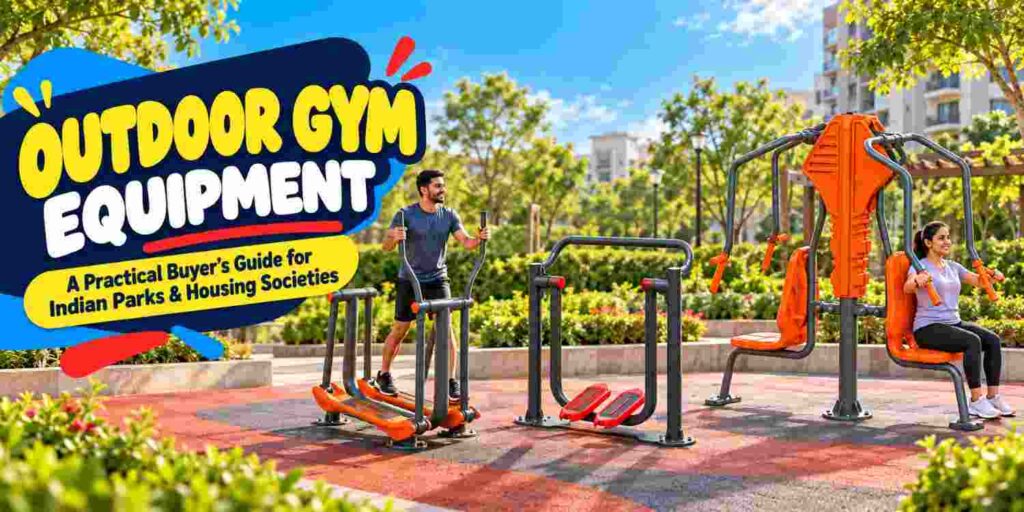
The Best Outdoor Gym Is One That People Will Keep Using
Early in a housing society or public park, one visitor wants light morning movement, another wants a stronger workout, and someone else is trying outdoor fitness equipment for the first time. A generic lineup rarely serves everyone well. Long-term value depends on matching equipment to real users, available space, Indian weather conditions, and ongoing maintenance capacity.
For developers, housing committees, schools, and municipal authorities planning fitness equipment in parks, Arihant Play offers an outdoor fitness range alongside playground equipment and surfacing solutions-helpful when coordinating shared recreational spaces for both children and adults.
Key Planning Considerations for Outdoor Gyms
1. Start With Users and Movement Variety
Identify who will use the space and at what peak hours so popular stations do not create bottlenecks. Build a circuit that supports cardiovascular exercise, upper-body pushing and pulling, lower-body strength, balance, and mobility-aligning with WHO guidance to do muscle-strengthening activities involving major muscle groups at least two days a week.
Before requesting quotes, prepare a project brief covering:
-
Expected age groups, peak user counts, and supervision arrangements
-
Fitness levels, accessibility needs, and intended exercises
-
Site conditions, space limits, and caretaker/maintenance capacity
2. Evaluate Resistance Mechanisms Practically
Compare bodyweight, fixed-resistance, and adjustable or plate-loaded machines based on your users and supervision model. Adjustable resistance helps vary intensity, but requires attention to starting load, plate security, pinch points, and access control—especially in unsupervised public parks. Fixed and bodyweight stations often suit public spaces well when movement paths are intuitive and effort can be scaled via posture, reps, or technique.
Always request a live demonstration at minimum and maximum loads, check ease of entry and exit, verify clear instructions, and review exact technical drawings for models from Arihant Play (such as leg presses, presses, pull stations, walkers, and rowers) before assuming adjustable or plate-loaded features.
3. Design a Connected Circuit and Layout
Plan an exercise circuit rather than dropping machines into open ground. Account for operating clearances, entry and exit room, unobstructed pathways, and space to read instructions without blocking traffic. Separate adult fitness zones from children’s playgrounds with clear layout and signage, and check sun exposure, drainage, and water pooling.
A site and procurement layout should show:
-
Machine positions, dimensions, and full movement clearances
-
Circulation pathways, finished levels, drainage direction, and anchor points
-
Supporting comfort features like shade, benches, and nearby walking paths
4. Verify Safety Standards and Model Documentation
Standards such as ASTM F3101 (permanently anchored unsupervised outdoor fitness equipment) and EN 16630 (permanently installed, freely accessible outdoor fitness equipment, distinct from playground gear) provide useful reference points, though project teams must independently verify applicable Indian rules and model-specific compliance.
Request model-specific age/height guidance, installation instructions, maintenance schedules, intended-use notes, and compliance documents, and inspect handholds, edges, joints, stops, fasteners, and readable graphics.
5. Build for Indian Weather and Long-Term Upkeep
Account for steel grade, corrosion protection, sealed/drained hollow sections, fasteners, replacement bearings/bushes, and local exposure to monsoon rain, heat, dust, coastal salt air, or sprinklers. Confirm proper foundation anchoring and drainage, spare-parts lead times, and whether servicing needs trained technicians or standard caretaking.
6. Compare Quotations on Total Lifecycle Value
Evaluate proposals on total cost per serviceable station over time rather than headline price alone. Require an itemised quote separating equipment models, materials/finishes, civil works, foundations, surfacing, transport, taxes, signage, warranties, spare parts, scheduled inspections, and defect lock-out procedures (plus tender rules for public projects).
7. Drive Adoption at Handover and After Launch
Include practical user demos, clear pictorial instructions, and a separate caretaker handover covering inspections, fault reporting, and taking unsafe machines out of service. After launch, observe peak-hour usage, queues, underused machines, and resident feedback to refine layout, shade, signage, or future additions.
Frequently Asked Questions
1. What equipment should a housing society outdoor gym include?
Balance cardiovascular stations (like walkers and rowers) with upper-body pushing/pulling, lower-body strength, and balance/mobility options tailored to residents’ ages, fitness levels, and space. A smaller, well-spaced circuit with clear instructions, seating, shade, and separation from children’s play areas often outperforms a crowded set of similar machines.
2. Is plate-loaded outdoor gym equipment better than fixed-resistance equipment?
Neither is universally better. Plate-loaded stations allow resistance changes for varied strength levels, but require careful checks on starting resistance, load security, moving parts, and unsupervised park suitability. Fixed-resistance and bodyweight machines are often simpler and lower-maintenance, though progression relies more on technique, reps, and positioning. Confirm exact specs model by model.
3. How much space is required for an outdoor gym?
There is no single standard area; it depends on machine count, movement clearances, user volume, pathways, drainage, trees, and nearby play zones. Use a scaled site plan with manufacturer clearance drawings, and reduce machine count if needed rather than crowding operating zones.
4. Can children use outdoor gym equipment in a public park?
Not automatically. Adult fitness machines and children’s play structures differ in design and intended users (ASTM F3101 references unsupervised outdoor fitness for users aged 13 and above, and EN 16630 separates fitness equipment from playground equipment). Keep zones distinct, follow manufacturer age/height limits, and verify local requirements.
5. What should an outdoor gym manufacturer provide before purchase?
Request model numbers, technical drawings, material and coating specs, age/height limits, usage graphics, foundation/anchoring details, maintenance schedules, safety standard documentation, spare-parts info, site layout clearances, warranty terms, and itemised costs for supply, civil work, installation, taxes, training, and servicing.
6. How can outdoor exercise machines be maintained during the monsoon?
Inspect foundations, anchors, coatings, fasteners, moving parts, and drainage before monsoon rains, clearing debris that traps water. After heavy rain, check for standing water, corrosion, loose parts, or damaged signs, follow manufacturer guidance before applying lubricants, and log inspections and repairs—isolating any unsafe machine immediately.
7. What is the difference between outdoor gym equipment and a playground?
Playgrounds support children’s open-ended play, imagination, and social activity, whereas outdoor gyms provide structured exercise stations typically for older youth and adults (as distinguished in EN 16630). Separate the zones with clear paths, seating, and appropriate documentation for each category.
8. Is an outdoor gym suitable for older adults and beginners?
Yes, when machines have accessible entry/exit, manageable starting resistance, comfortable grips/seating, clear instructions, and nearby shade, benches, and level pathways. Individual abilities vary, and anyone with medical conditions, injuries, or doubts about exercising should consult a healthcare professional first.
9. How can developers evaluate the value of an outdoor gym?
Look beyond machine count to peak-hour usability, exercise variety, integration with pathways and play zones, maintenance budget fit, and post-launch usage and repair logs. Avoid unsupported property-value claims; focus on practical, well-maintained access to physical activity.
10. How should we compare outdoor gym equipment quotations in India?
Send the same project brief and site drawing to every bidder so quotes are comparable. Check exact models, materials, corrosion protection, anchoring, spare parts, safety documentation, maintenance duties, and separated costs for civil works, installation, taxes, and warranties-and follow tender rules for public projects.

Leave a Reply
You must be logged in to post a comment.