
Keep It Running: A Maintenance Checklist for Distillation and Solvent Recovery Equipment
Here’s something most operators learn the hard way: distillation equipment almost never fails out of nowhere.
It complains first. A joint starts to smell of solvent. A batch takes twenty minutes longer than it used to. The condenser outlet feels warmer than normal. Nobody writes it down, because the batch still finished. Then one Monday, it doesn’t.
The fix isn’t complicated. It’s mostly a habit of looking at the right things at the right time. Below is a plain checklist, split into two parts: small glass setups in the lab, and the big systems out on the plant floor.
Part 1: Looking After a Glass Lab Setup
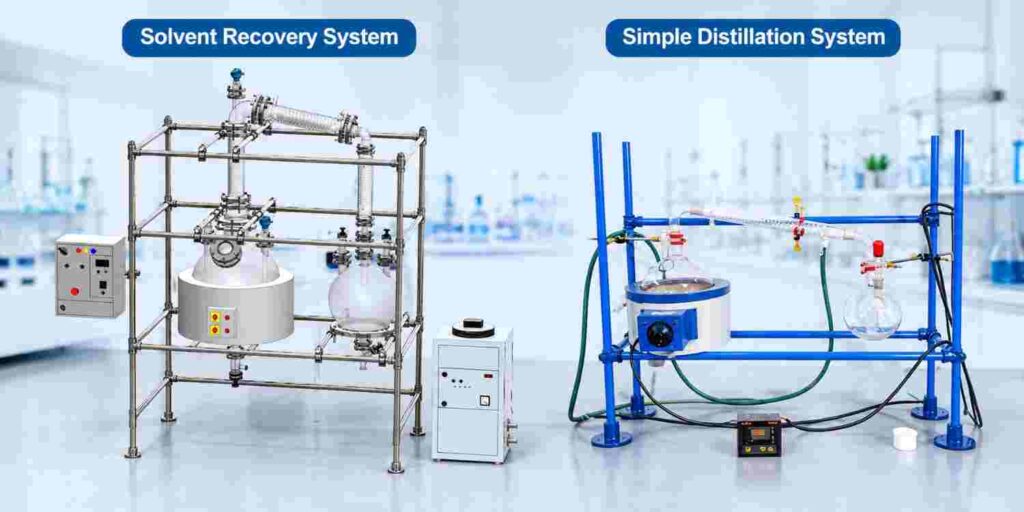
A simple distillation unit in the lab is usually borosilicate glass with PTFE seals, sitting on a heating mantle or oil bath. It’s tough kit. Borosilicate handles heat changes far better than ordinary glass. But it isn’t indestructible, and most breakages trace back to something that could have been spotted.
Before every run
Hold each piece of glass up to the light. You’re looking for chips on the rim and tiny star-shaped cracks, especially on the bottom of the flask. A star crack might survive one heating cycle. It might not. Either way, it isn’t worth finding out with hot solvent inside.
Check that every joint seats properly and the clamps actually hold the weight. The condenser should have its own clamp; it shouldn’t hang off the joint. And glance at the water hoses. Rubber tubing goes hard and cracks with age, usually right where it bends over the hose barb.
After every run
Let it cool completely before you touch it. Rinse with a suitable solvent, wash with warm water and lab detergent, then a final rinse with distilled water. Leave it to air dry.
Don’t let residue sit in the flask overnight. It’s far easier to clean while it’s still soft.
Once a month or so
- Look over the PTFE seals and sleeves for wear or deformation, and replace any that don’t seal snugly anymore
- Check the heating mantle’s cable and plug for damage
- Make sure the thermometer or temperature probe still reads correctly against a known reference
- Store spare glassware where pieces can’t knock into each other
That last point sounds trivial. It isn’t. A lot of “mystery” cracks start as a knock in a crowded drawer.
Part 2: Looking After a Big Recovery System
An industrial solvent recovery unit is a different animal. Feed tanks, a pre-filter, a jacketed or electrically heated vessel, a condenser, product tanks, plus automated temperature and pressure controls. The vessels are usually stainless steel or glass-lined steel. More parts means more things to keep an eye on, but the logic is the same: catch small problems while they’re still small.
Always start with the maker’s manual. What follows is a general checklist, not a replacement for it.
Every day
- Walk around the system and look for drips, stains or puddles under joints and valves
- Notice the smell. A stronger solvent smell than usual often means a leaking seal or vapor getting past the condenser
- Check feed and product tank levels, and confirm the right solvent is going into the right tank
- Look at operating temperature and pressure. Are they where they normally sit for this solvent?
- Check that cooling water is flowing to the condenser
Every week
- Clean or change the pre-filter. A clogged filter slows the feed and lets solids through to the hot vessel
- Look at how much residue is building up in the vessel and remove it on schedule
- Compare this week’s recovered volume with last week’s. A quiet drop is often the first sign of a problem
Every month
- Inspect gaskets and seals, and replace worn ones before they leak
- Check insulation on the vessel and hot lines. Damaged insulation wastes energy and can create hot spots people might touch
- Confirm that alarms and safety interlocks still trigger the way they should
Every year (or as the maker recommends)
- Get the temperature and pressure sensors calibrated
- Inspect the inside of the vessel. On stainless steel, look for pitting or early corrosion. On glass-lined steel, look closely for chips in the lining
- Inspect the condenser for fouling or scale that reduces cooling
- Review the control system and data logs for any slow drift over the year
One small warning about glass-lined vessels: never use metal tools inside them, and avoid shocking them with sudden hot-to-cold changes. Most lining damage comes from one of those two things.
Warning Signs Worth Acting On
If you only remember one part of this article, make it this table.
|
What You Notice |
What It Often Points To |
|---|---|
|
Batches taking longer than usual |
Crust on the vessel walls or a heating problem |
|
Less solvent recovered |
Weak condenser cooling, or a leak somewhere |
|
Strong solvent smell near joints |
Worn seal or loose connection |
|
Cloudy or off-color recovered solvent |
Filter not working, or temperature running too high |
|
Condenser outlet water warmer than normal |
Low water flow or fouling inside the condenser |
|
Temperature readings that don’t make sense |
Sensor needs checking or calibration |
None of these is an emergency on day one. All of them become expensive if they’re ignored for a month.
Keep a Simple Logbook
This is the habit that ties everything together. It doesn’t need to be fancy. A notebook or a shared spreadsheet works.
Write down the date, the solvent, how much went in, how much came back, how long it took and anything odd you noticed. After a few weeks, you’ll know what “normal” looks like for your equipment, and anything unusual will jump out. Systems with PLC control and data logging make this easier, but someone still has to actually look at the numbers.
A Few Common Questions
How often should a lab distillation setup be checked? Before and after every run, with a closer look at seals, cables and sensors about once a month.
What’s the most common cause of trouble in a large recovery system? Often it’s the simple stuff: a clogged pre-filter, worn seals or weak cooling at the condenser. Daily and weekly checks catch most of it.
Can we do all the maintenance in-house? Much of the routine work, yes. Sensor calibration and internal vessel inspections are usually best done with the equipment maker or a qualified technician.
The Short Version
Look at your equipment every day, clean it every week, inspect it properly once a year, and write things down. That’s really it. Glass on the bench or steel on the plant floor, equipment that gets a little attention often will keep turning used solvent into clean solvent for a very long time.

Leave a Reply
You must be logged in to post a comment.