

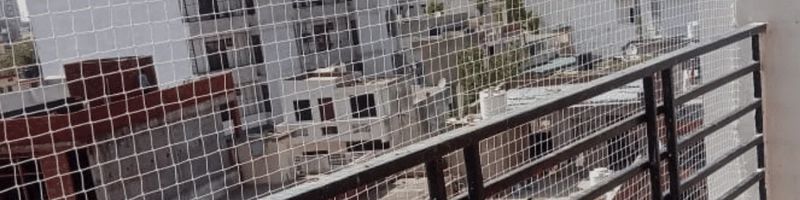
Most people who put up a bird net want one simple thing: to keep birds out of a balcony, terrace or storage area. But a net that is chosen or fitted badly can do the opposite of what you want. Birds can get tangled, injured or trapped, and then the problem becomes both a safety issue and a cleanliness issue. The good news is that a bird net, done right, is one of the most humane and long-lasting ways to deal with unwanted birds. Here is how to get it right.
Birds are persistent. If they have been nesting in a spot for months, they will test every edge of a new net. When there is a gap, they push in, and if they cannot find the way out, they panic. This is where most problems start.
If the openings are bigger than the bird’s body or head, smaller birds can push through and get stuck halfway. A mesh that suits pigeons may not suit sparrows or mynas, so the target bird should decide the mesh size.
A slack net forms pockets and folds. Birds can get their feet, wings or heads tangled in them. A firm, evenly stretched net gives no such room.
Even a tight net fails if the corners are open. Gaps near pipes, window frames and the wall line are where birds enter and then get trapped between the net and the wall.
Good planning prevents most of these problems.
For small birds such as sparrows, a fine mesh around 25 mm is safer. For larger birds such as pigeons, a larger mesh such as 40 mm or 50 mm is commonly used. HDPE bird nets are made in several sizes, so there is usually an option that fits.
A net sits in the sun for years. Material that is not UV stabilized turns brittle, loses strength and can break, leaving loose threads that can harm birds. A UV stabilized net keeps its strength and shape much longer.
White, black, green and natural white options are available, so the net can match your building and stay almost invisible from a distance.
The way a net is installed matters as much as the net itself.
Never leave a half-finished net up, even for a day, because it can trap birds that come back to their old nesting spot.
If birds are nesting in the area, check first whether there are eggs or chicks. In many places, nests with young birds should be left alone until the young have left. Once the nest is empty, clean the area, remove old nesting material and then install the net. Cleaning also removes the smell that attracts birds back.
A net is not something you fit and forget. Look at it every few months for tears, loose fixings and sagging, and especially after strong wind or heavy rain. If you ever find a bird caught in the net, stay calm, free it gently and fix the gap that let it in. Repair any small damage right away, before it grows into a hole.
The same net does not suit every place. On a small balcony, the priority is a tight, neat fit around railings and pots. On a terrace or rooftop, the net may need extra support poles so it does not sag over a wide span. In warehouses, offices and hotels, the net often covers large openings, so strong fixing points and regular checks matter even more. Wherever it goes, measure the space first and plan the fixing points before you buy, because a net cut to the wrong size is hard to fix later.
A bird net should keep birds out without hurting them. That comes down to the right mesh size, strong UV-stabilized material, a tight fitting and regular checks. With those in place, your balcony, terrace or storage area stays clean, and the birds simply move on to a safer spot. If you want to see what typical mesh sizes and colours look like, you can check HDPE bird net options while you compare.
Tags:
bird net, pigeon net, bird netting, bird net installation, bird safety
Submit guest articles that reach decision-makers, influencers, and professionals. Yarabook offers a trusted platform for quality content, strong backlinks, and SEO-driven visibility. Pay. Publish. Promote.