

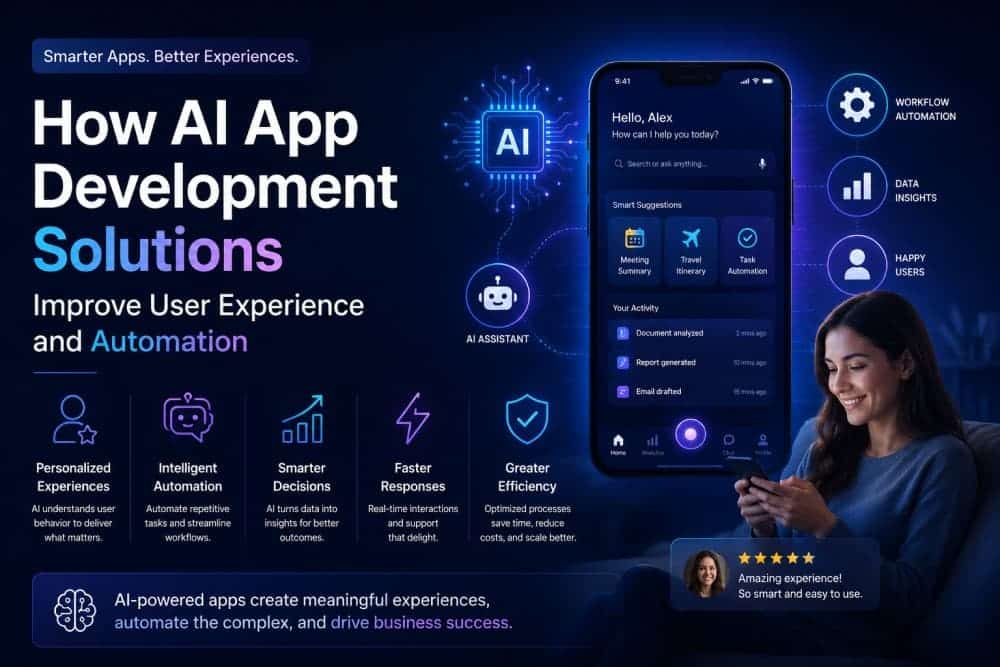
A few years ago, most business apps followed the same pattern: open the app, tap through menus, fill out forms, and wait for a response. It worked, but only up to a point.
Users have changed faster than software teams expected. Today, people expect apps to respond in entirely new ways.
And if an app forces them to repeat the same task, frustration builds quickly. That shift is pushing companies to rethink how digital products are built.
The conversation is no longer just about features. It is about experience, speed, convenience, and eliminating friction before users even notice it.
This is one reason businesses are investing heavily in AI app development solutions. Not because AI feels futuristic, but because customers are beginning to expect it.
Global adoption of generative AI tools continues to rise sharply across both consumer and enterprise markets. At the same time, mobile engagement around AI-powered apps is growing fast. Expectations are shifting quietly, and they are shifting everywhere.
There is a reason people keep returning to platforms that seem to “understand” them.
Streaming apps remember preferences. Shopping apps surface products people were already considering. Banking apps flag unusual activity almost instantly.
Those experiences feel easier because AI reduces unnecessary effort.
Traditional apps usually operate on fixed rules. Everyone gets the same flow, the same screens, and often the same recommendations. AI changes that completely.
With AI-based app development, applications can respond differently depending on user behavior, history, location, preferences, and intent. Over time, the app becomes more adaptive instead of remaining static. That matters more than many businesses realize.
Most users will never say, “This app has excellent machine learning capabilities.” Instead, they will say, “This app is easy to use,” or “This app saves me time.”
That is the real value: technology that disappears into the background while delivering simplicity, speed, and convenience.
Many organizations originally approached AI carefully. Some treated it like a side experiment. Others waited to see whether the technology would mature.
Now the conversation inside boardrooms looks very different.
Executives are asking practical questions:
In many cases, the answer is yes.
That is why demand for AI app development solutions continues to grow across industries.
AI-powered applications can automate tasks that previously consumed hours of manual effort. They can process large amounts of data quickly. Also, they can personalize user journeys at scale without requiring large operational teams. Importantly, users notice the difference almost immediately.
Gartner predicts that agentic AI systems will autonomously resolve 80% of customer service requests within the next few years. That kind of shift could dramatically change how businesses approach customer experience.
There is no universal AI model that works perfectly for every business.
A logistics company has different challenges than a retail brand. A healthcare provider serves users differently from a fintech startup.
That is where custom AI app development services become valuable. Instead of forcing businesses into generic templates, custom solutions are built around specific workflows, customer expectations, and operational goals.
Recommendation engines have become far more sophisticated over the last few years. Users now expect apps to understand context.
A retail customer browsing winter jackets probably does not want random summer products suggested immediately afterward. A fitness app should adjust recommendations based on activity patterns. A finance platform should surface insights relevant to spending behavior.
AI makes that possible. When recommendations feel relevant, users stay engaged longer.
Search is still one of the most frustrating parts of many apps. Traditional keyword-based search systems often struggle when users phrase things differently.
AI-powered search improves this dramatically. Instead of relying only on exact keywords, modern AI models interpret meaning and intent.
Users can type conversational queries and still receive useful results. That reduces friction in a way people immediately appreciate.
Nobody likes waiting for support tickets, and this is one area where AI is already making a visible difference.
Businesses using custom AI app development services are deploying AI assistants that handle routine questions instantly. More advanced systems can analyze urgency, identify customer sentiment, and route issues to the correct team automatically.
The goal is not always to replace human agents. Often, it is about reducing delays and improving efficiency for everyone involved.
Gartner has also noted growing enterprise investment in self-service and live support technologies. That reflects changing customer behavior more than anything else.
People increasingly expect immediate responses, and companies that meet those expectations are setting new standards for customer experience.
Some of the best AI-driven experiences are barely noticeable. That is usually a good sign. When automation works properly, users spend less time dealing with repetitive tasks.
Consider the small conveniences people now take for granted:
These features may seem minor individually. Together, they create smoother digital experiences. And smoother experiences usually lead to stronger customer retention.
Businesses leveraging AI app development are increasingly focused on eliminating small operational bottlenecks because those frustrations compound over time.
Even reducing a process from five steps to two can improve engagement significantly.
AI adoption is no longer limited to Silicon Valley startups or tech-first companies. It is spreading across nearly every major industry.
Healthcare
Healthcare providers are using AI-powered applications to assist with diagnostics, patient engagement, appointment scheduling, and remote monitoring.
Administrative automation is becoming especially valuable because healthcare teams already face heavy operational pressure.
Retail and Ecommerce
Retail companies are using AI to personalize shopping experiences, improve inventory forecasting, and optimize customer communication. Consumers now expect recommendations to feel tailored instead of random. That expectation keeps growing.
Finance
Banks and fintech companies are using AI for fraud detection, risk analysis, automated support, and personalized financial insights.
Speed matters heavily in financial services. AI helps reduce delays while improving accuracy.
Logistics
Logistics firms are applying AI to route optimization, delivery tracking, predictive maintenance, and warehouse operations. The operational savings can be substantial.
Manufacturing
Manufacturers are increasingly using AI-powered systems to monitor production quality and predict equipment failures before downtime becomes expensive.
In many cases, automation helps teams solve problems before customers are affected.
AI projects are rarely successful when businesses approach them without clear goals. That is why choosing the right artificial intelligence app development company matters greatly.
A reliable development partner does more than add AI features to an existing app.
They help businesses identify where AI can genuinely improve operations or customer experience.
That process often includes:
The strongest AI projects usually begin with practical business problems rather than flashy technology demos. That distinction matters because users care far more about convenience than complexity.
The next generation of apps will likely become far more proactive than reactive.
Instead of waiting for commands, applications will increasingly anticipate needs and automate actions in the background.
We are already seeing early versions of this with AI agents capable of handling scheduling, workflow management, customer interactions, and operational tasks with minimal supervision.
At the same time, personalization will become deeper and more contextual. Users will expect apps to remember behavior patterns, preferences, and communication styles naturally.
Eventually, intelligent experiences may stop feeling innovative altogether. They will simply become normal expectations.
Businesses investing in AI app development solutions now are preparing for that shift early rather than reacting later.
The role of business applications is changing quickly. Users no longer want software that simply functions. They want software that feels intuitive, responsive, and efficient.
That is where AI is creating measurable value.
Businesses adopting AI app development solutions are improving customer experiences while also streamlining internal operations through automation and predictive intelligence.
At the same time, companies using custom AI app development services are building more personalized and scalable digital experiences tailored to how real users behave.
The greatest advantage isn’t always the technology itself. Often, it’s the elimination of friction that people have endured for years. And in the end, that seamlessness is what customers remember most.
Submit guest articles that reach decision-makers, influencers, and professionals. Yarabook offers a trusted platform for quality content, strong backlinks, and SEO-driven visibility. Pay. Publish. Promote.